NASA wants to establish sustained human presence on the lunar surface, but Houston has a problem — keeping the lights on when night falls on the Moon.
The lunar South Pole, where NASA announced plans in March to build humanity’s first long-term Moon base, sees two weeks of total darkness at a time, making surface solar power untenable. An outage could be catastrophic for life support systems, down to the habitat's oxygen supply.
So, an NJIT-led undergraduate team brought a new idea to NASA — move the power source off the Moon entirely and instead power it with a swarm of solar-harvesting robots from space.
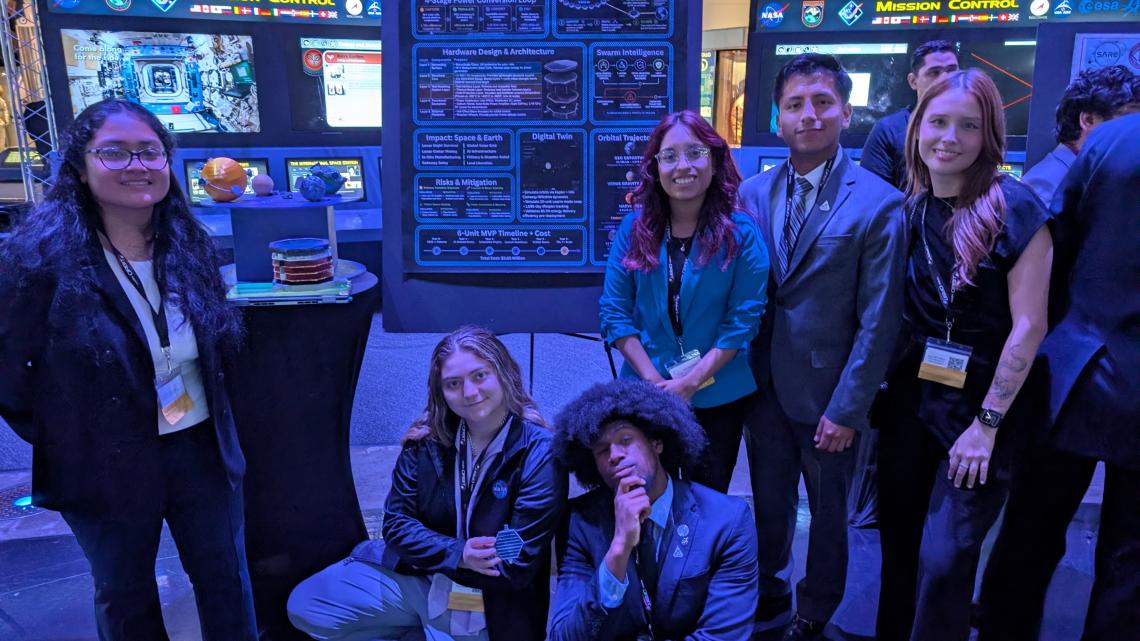
The six-member team, known as Star Maker, pitched its bold concept at NASA’s first-ever ORBIT Challenge in Houston in July, a student competition seeking new ideas to advance NASA’s exploration goals. Star Maker was one of 10 finalists in the competition’s “Space Track,” with 20 teams overall selected from hundreds of university entries nationwide.
Star Maker landed a $15,000 prize for their Orbital Solar Energy Harvesting Swarm (OSEHS) solution — autonomous satellites that collect energy near the Sun and relay it to receivers on the lunar surface via microwave beams.
Tatiana Mejia ’27, an NJIT mechanical engineering student who conceived the project, says the concept may not be as far off as it sounds.
“It is a concept that sounds like science fiction, but when you really break it down into components, you see that we kind of already have the technology,” Mejia said. “We just need to push it forward more.”
“Swarm robotics is just such good and ingenious technology,” added Mejia, whose previous swarm robotics concept recently earned a $10,000 NASA grant. “A swarm can carry out its mission even if individual units fail. Especially in space, this is important — one little mistake and everyone’s dead.”
Mejia had spent three years working with swarm robotics in NJIT’s Swissler Innovative Robotics Lab when the idea began taking shape in fall 2025 with NJIT mechanical engineering student Natalie Kiwanian ’27 and Jennifer Salto, a mechanical engineering student at Stevens Institute of Technology.
They initially considered another competition until Salto came across NASA’s new ORBIT Challenge, and a team soon assembled.
They recruited Kevin Gutama ’26, an NJIT electrical engineering alumnus now at GE Aerospace, to tackle power distribution; NJIT physics student KesUranNu Baylor, who had orbital-mechanics experience from a NASA Goddard internship; and NJIT student Andrea Yanez Soto, who modeled swarm communication.
The team envisioned an agile network of roughly 1,100 six-foot-wide autonomous satellites — some harvesting sunlight closer to the Sun, others relaying that energy to continuously power the Moon’s surface.
Above: Artistic blender representation of OSEHS system (not to scale). Credit: Star Maker
“Just harnessing 0.01% of the Sun’s raw power would exceed our current global energy demands by a factor of roughly 2 billion,” Mejia said.
They simulated 12 units orbiting the Sun in a “pearl necklace” formation, showing how the swarm could recover from individual failures without intervention from Earth.
“The simulation, prototypes, the presentation display we built — most of this was not required by NASA,” Gutama said. “We wanted to show our vision and that we could compete.”
“The day before our flight, we were at NJIT until after midnight putting final touches together,” Kiwanian recalled. “I didn’t sleep for almost two days … it was a lot.”
At Johnson Space Center, they spent the week sightseeing and meeting space scientists, engineers and entrepreneurs before presentation day.
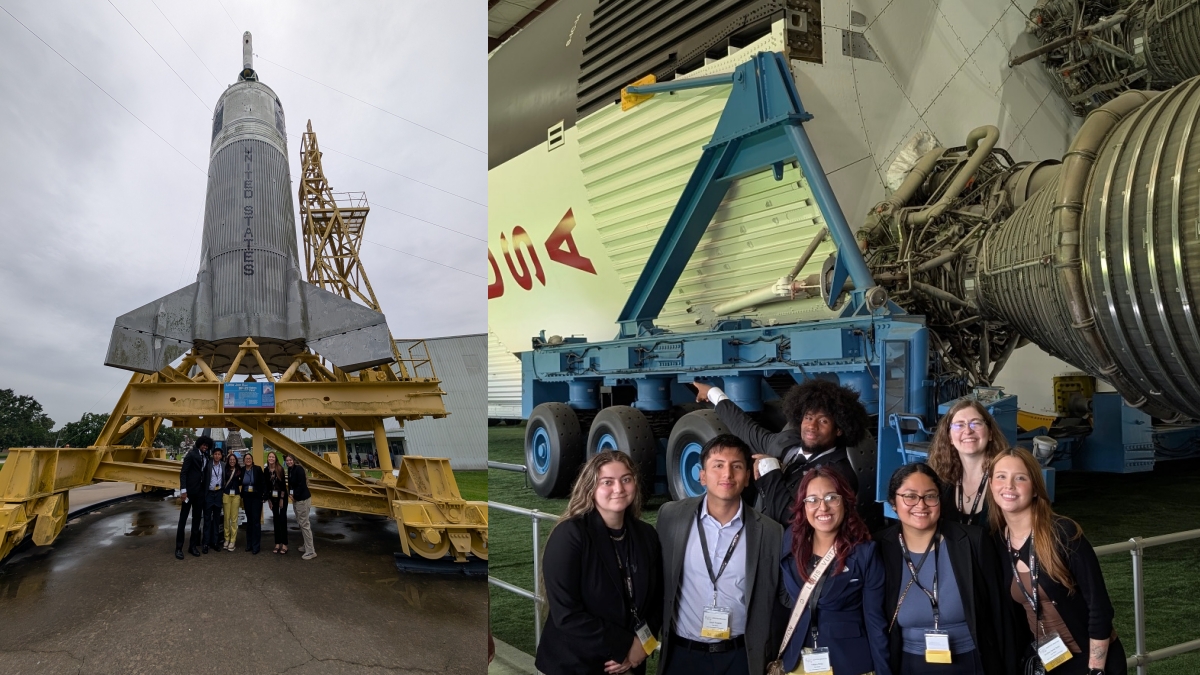
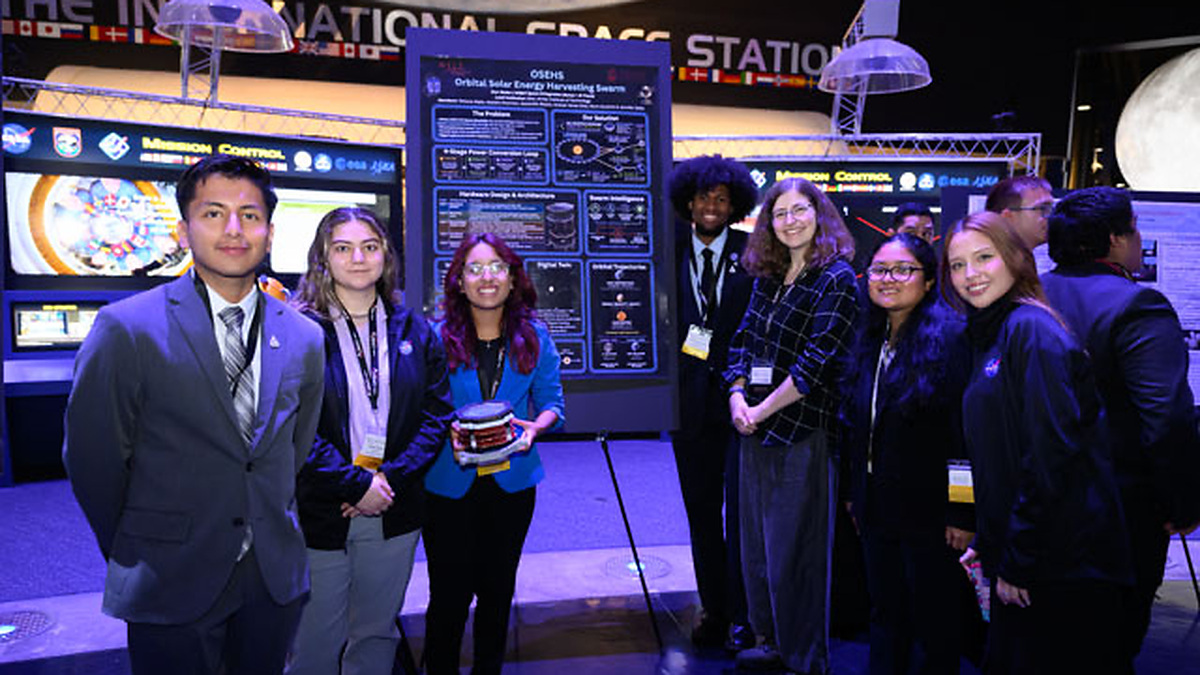
“At the Pitch Showcase our final day, we had 15 minutes to present everything we’d done since February,” Kiwanian said. “I remember KesUranNu explaining how we could use Venus’ gravity to bring our swarm closer to the Sun. We noticed the chief scientist of the International Space Station Program nodding along with him. Seeing that was a really good sign.”
“My applied understanding of everything I’ve learned at NJIT, like how physical bodies move in space, really accelerated through this experience,” Baylor said. “Being able to bring this work to NASA and talk with people there … I feel I’ve really grown as a physicist.”
One Small Step in Houston, One Giant Leap for Star Maker
“What was most encouraging was the judges — from JPMorgan representatives to NASA engineers — didn’t want us to think of this as just a concept for NASA,” Mejia said. “They believed we should actually make it happen after the competition.”
Back from Houston, the six split the prize — $2,500 apiece — but neither the project nor the team is finished.
Star Maker plans to turn their OSEHS idea into a startup venture that may not need to shoot for the Moon.
“We all came together to make these ideas happen,” Gutama said. “There was this ambition and want to really see it through.”
“We think we can help data center developers power new sites by reducing their burden on the grid,” Kiwanian said. “There’s a lot of discourse about [generative AI] and the immense burden that it has on our resources. We think we have a solution.”
The team is applying to the NSF I-Corps program for customer discovery and set sights on a new challenge — NASA TechLeap — a prize program that could provide up to $500,000 to build and test hardware.
“The NASA Orbit Challenge made this real for us, and now we’re applying to programs to be able to raise money to create a prototype and launch our startup,” Mejia said.
“Space exploration has always been about looking at the big picture — not continents, not skin color, but bringing humanity together,” Mejia added. “If we want to avoid exhausting Earth’s resources, we must collaborate as one. That’s what has been inspiring our work together.”
