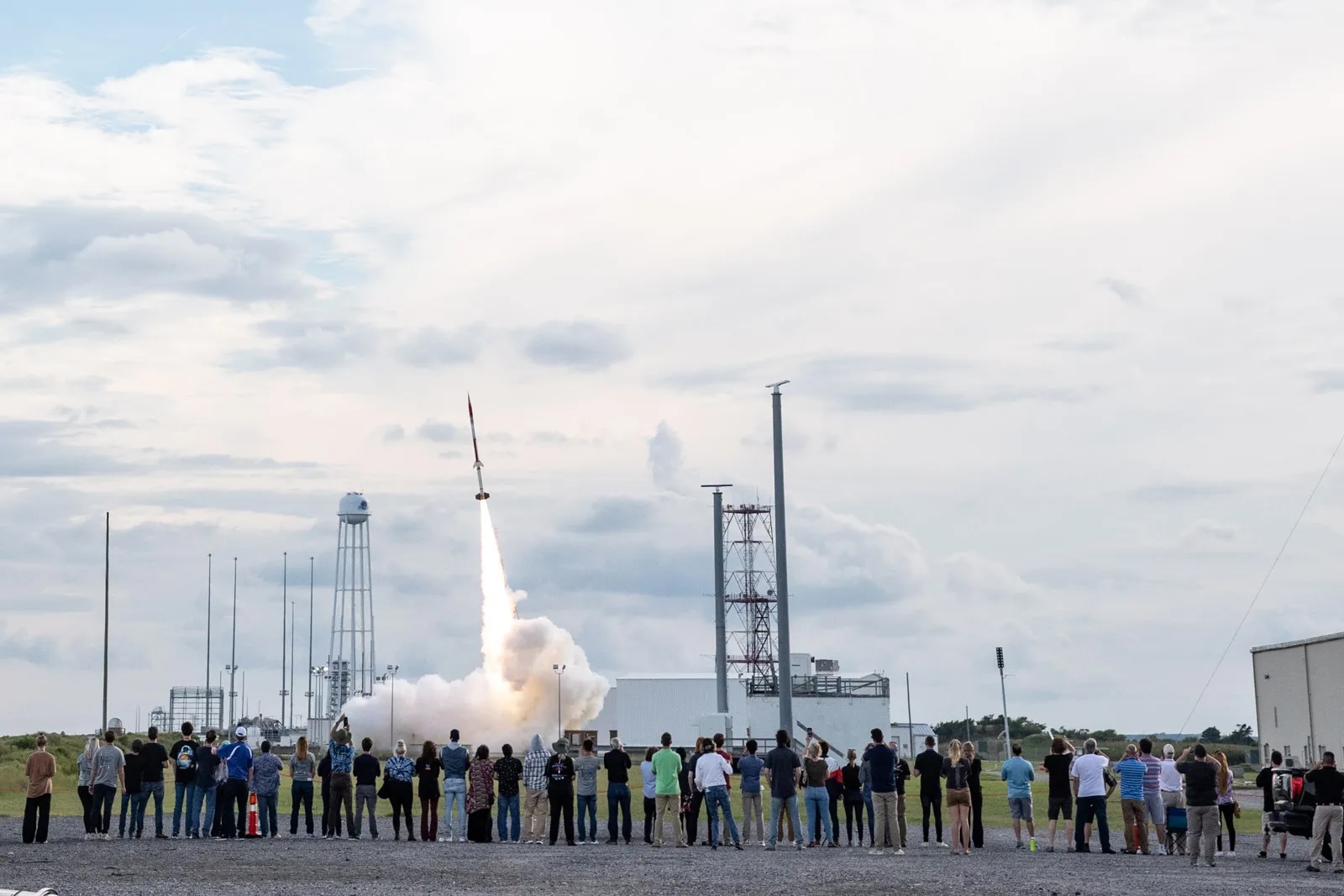
A multidisciplinary team of NJIT students from the Ying Wu College of Computing (YWCC) and Newark College of Engineering (NCE) Rocketry Club made history as participants in NJIT’s first team to launch in NASA’s RockSat Program. With their A.R.R.O.W. Mission (Aerospace Retrieval and Re-Entry Observation Workstation) NJIT’s team successfully qualified, integrated, launched, and captured data at the NASA Wallops Flight Facility. This milestone marks the first time a student-designed payload from NJIT reached outer space, putting NJIT on the map as a rookie club achieving instant success.
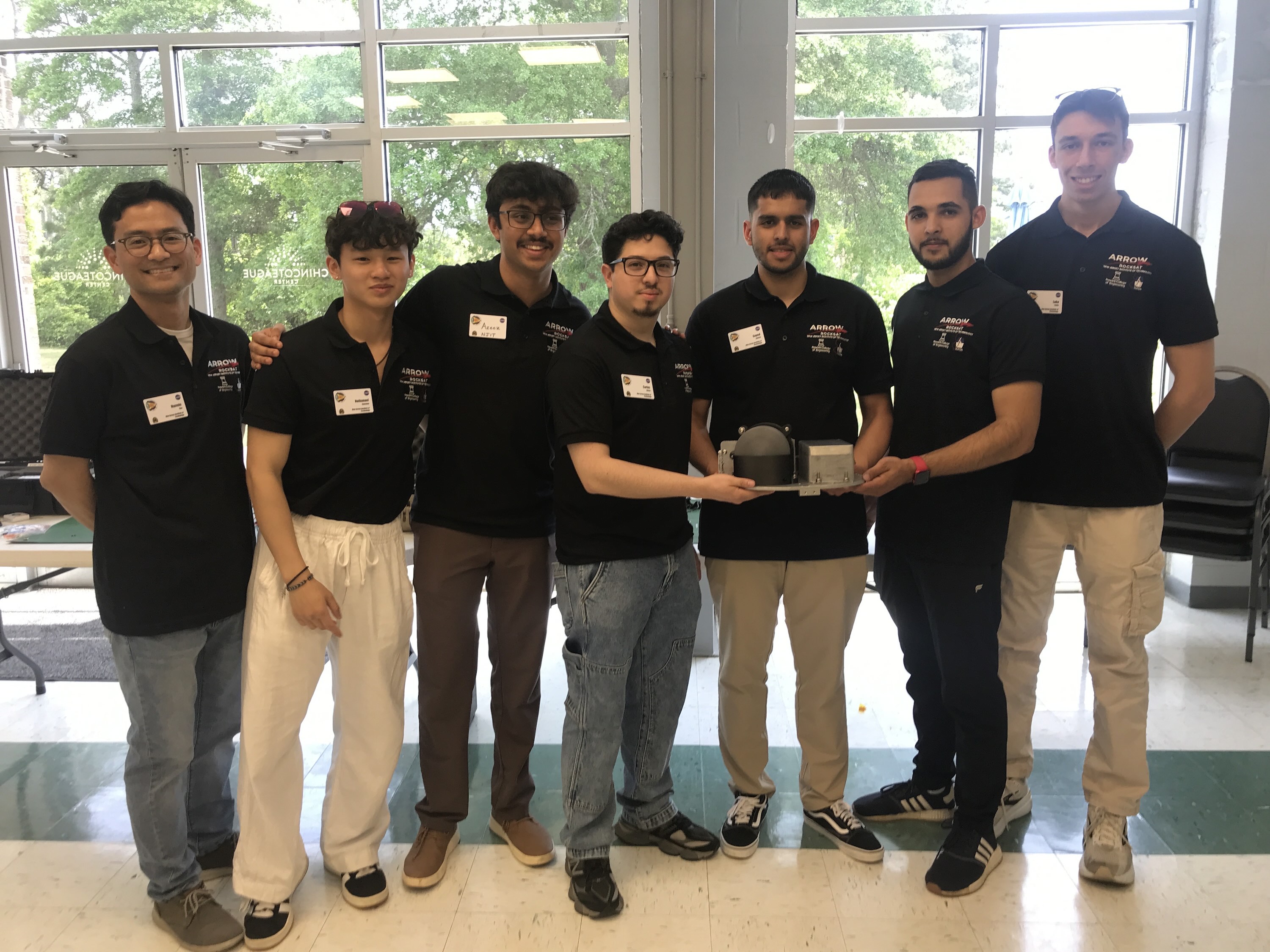
Under the advice of Dr. Hyomin Kim (Associate Professor, Department of Physics), YWCC junior Abdul Azeez Shaik (Computer Science Lead), along with NCE mechanical engineering majors Luka Stulic (Mechanical/Instrumentation Lead), Dariel Torres (Project Manager), Carlos J. Munoz (Project Manager) and Sayed Rahimi ( Mechanical/Design Lead), and electrical engineering major Nathanael Gunawan (Electrical Lead) had the distinctive opportunity to have their A.R.R.O.W. project accepted and fully launched through the highly competitive RockSat program, which is not only a first for NJIT but uncommon among universities who either are down-selected or do not meet NASA’s flight requirements pending a series of strenuous review periods during their initial attempt to earn a place on the sounding rocket.
“To reach launch at all is itself a real outcome, not a formality,” said Shaik.
The RockSat program is a competitive collegiate sounding rocket initiative managed by the Colorado Space Grant Consortium in partnership with the NASA Sounding Rocket Program Office (SRPO) at NASA’s Wallops Flight Facility in Virginia. Students progress from RockOn, an entry-level introduction to building flight hardware up to RockSat, where teams design, build, test, integrate, and fly an original scientific or technology payload on a real NASA sounding rocket under the same review standards used for professional missions.
RockSat payloads fly on a two-stage Terrier-Improved Malemute Rocket to roughly 114 miles in altitude, giving just a few minutes of flight time and a genuine microgravity window before the payload descends by parachute and is recovered from the Atlantic Ocean.
The NJIT A.R.R.O.W. mission featured sub-orbital dual stage payload that consists of Overwatch (Central Hub) and SCOUT, a free-flying probe equipped with a custom-built, dual Langmuir probe designed to measure ionospheric electron density during re-entry, which can directly affect GPS accuracy, space weather, and radio communications.
Previous missions mounted the probe on a fixed boom as an extension of the rocket.
A.R.R.O.W. instead ejects the entire probe as its own free-flying vehicle, avoiding plasma disturbance a mounted boom caused by the rocket body. The project demonstrates that a low-cost, custom-built Langmuir probe is viable for characterizing the ionosphere during re-entry . The experiment is “one small step” to studying that layer of the Earth’s atmosphere from the inside.
Shaik noted that GPS accuracy has national economic and security significance, from commercial aviation and shipping to military navigation, the accuracy of which is degraded by ionospheric electron density in ways that are difficult to model, especially during dynamic space weather events and geomagnetic storms.
“A mission that improves the data available on that problem, even modestly, has value to NASA beyond training the students who built it,” he said.
To qualify for one of 15 spaces, or canister real estate, on the rocket, student teams must submit an Intent to Fly proposal, then pass through a sequence of NASA-graded design and test reviews: Conceptual Design Review, Preliminary Design Review, Critical Design Review, Subsystem Test Review, Integrated Subsystem Test Review, Full Mission Simulation Review and a final Visual Verification Check-In. Teams that clear every review travel to Wallops twice, once for integration and testing and once for launch. A final technical report must be submitted to NASA following the flight.
RockSat payloads had an option to share their canister real estate with another school, which means the two payloads must integrate and fly together on the same deck plate. During check-in, the University of Nebraska–Lincoln (BigRed) and NJIT collaborated on final inspection and flight readiness.
Such constraints are what separate a real flight program from a classroom project, Shaik contends, and is the reason why the program exemplifies a primary tenet of the NJIT strategic plan: experiential learning.
“RockSat exists because flying real hardware is a fundamentally different skill from designing it on paper, and the U.S. has a direct interest in producing engineers who have done both before they graduate. NASA and the Space Grant Consortium treat [it] as workforce development,” he said.
The project also taught Shaik to move outside his comfort zone and area of expertise. Beyond his task of leading the full software and data side of the mission (flight software architecture, deployment control code, RF communication and data handling code, and mission-critical safety logic), he had to understand the mechanical deployment hardware, electrical constraints, and the science payload well enough to build software that served all of them. These are direct software applications common in high-end R&D that traditional computer science curricula do not teach.
Despite the many successes associated with the project, the mission’s one shortfall was was structural/electrical rather than scientific: SCOUT’s probe used two tungsten electrodes, one carrying the applied sweep voltage and one capturing the resulting current response, and a physical failure of the second electrode prevented a complete electron density measurement. However, that failure was identified “with confidence” from the flight data itself and visual confirmation from a university camera, and every other system, deployment, structural, RF communication, and data logging performed as designed.
“[This experience] is a concrete demonstration of what a computing education at NJIT can produce outside the classroom, and it did so while contributing directly to a partner university’s recovery from its own testing failure, on a mission that secured its own funding and flew successfully on the first try,” Shaik said. “That is the kind of ownership NJIT students rarely get to claim before graduation.”
