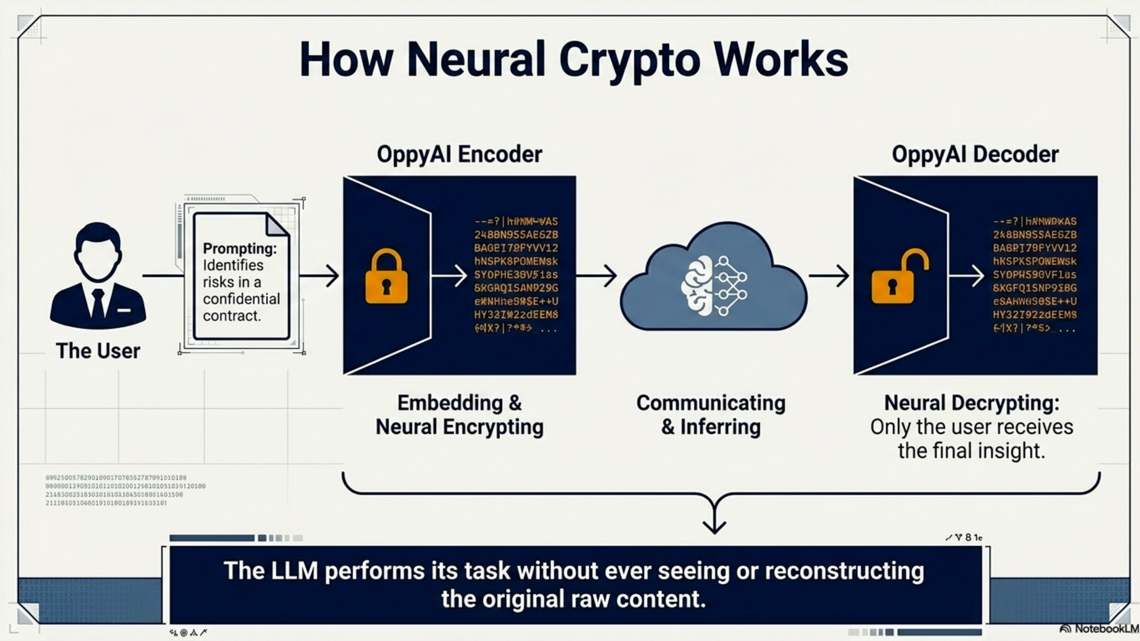
What if organizations could use powerful cloud AI without handing over readable prompts, confidential context, or generated responses? OppyAI, an NJIT spinout led by Associate Professor Hai Phan in the Department of Data Science, is tackling that challenge with Neural Crypto, a technology designed to combine cloud-scale intelligence with customer-controlled privacy.
Phan, an associate professor of data science in NJIT’s Ying Wu College of Computing, and his research team have spent four years developing the technology. Now, industry collaboration, research recognition, and new investment are helping move it from the university lab toward broader commercial use.
OppyAI’s founding team also includes Professor Ruoming Jin, chief operating officer, and Professor My T. Thai, chief scientific officer. Jin, a computer science professor at Kent State University, co-founded GraphSQL, now TigerGraph, and served as its founding chief technology officer. Thai, a professor at the University of Florida and an IEEE Fellow, brings expertise in AI safety, resilience, and explainability. Together, the founders combine domain expertise and academic innovation with startup experience.
Bringing private hybrid AI to Qualcomm’s ecosystem
Neural Crypto was recently demonstrated in collaboration with Qualcomm at its Snapdragon Summit 2026 in Maui, Hawaii, bringing the NJIT-born technology into an international showcase of next-generation AI. Coverage by South Korea’s Digital Daily highlighted OppyAI and its approach to protecting sensitive information in hybrid device-and-cloud workflows.
The collaboration brings a practical value proposition to Qualcomm’s ecosystem: keep readable information under customer control on Snapdragon-powered devices while using larger cloud models for the heavy computation. For device manufacturers and developers, the opportunity is to build more capable AI assistants without making full on-device execution the only path to privacy.
Share the task, not the raw context
Neural Crypto divides AI processing between a trusted device or enterprise environment and the cloud. Prompts are encoded locally, and only protected representations cross the cloud boundary. The cloud performs the main model computation and returns inference representations that are decoded into readable responses within the trusted environment.
Rather than relying only on protection for stored data or network traffic, the approach builds privacy into the inference architecture itself. Its software-based design enables access to larger AI models while keeping the local workload focused on encoding and decoding, rather than hosting the entire model.
“We help enterprises, developers, and device manufacturers build privacy-preserving AI assistants and agents without running entire large models locally,” said Phan.
Research recognized at USENIX Security
The technology builds on NOIR, a privacy-preserving code-generation framework co-developed by Phan, fellow NJIT professor Cristian Borcea, OppyAI co-founders Jin and Thai, and a multi-institutional research team. NOIR received the Distinguished Paper Award – Runner Up recognition at USENIX Security ’26 in August, adding a significant research milestone to OppyAI’s commercialization story.
NOIR combines split inference, randomized tokenization, and token-level local differential privacy. The work pairs formal privacy analysis under defined assumptions with evaluations against attacks that attempt to reconstruct sensitive information, providing a peer-reviewed foundation for Neural Crypto’s approach.
Accelerating through New Jersey’s AI ecosystem
OppyAI has also been selected as one of 17 companies in the fall 2026 cohort of the NJ AI Hub Accelerator, powered by Plug and Play. The selection places the company within a statewide effort to connect AI innovation with commercial opportunities.
The NJ AI Hub was founded by Princeton University, the New Jersey Economic Development Authority, Microsoft, and CoreWeave. Its startup accelerator offers mentorship, enterprise connections, and pilot opportunities. For OppyAI, the program offers a path to build new relationships and bring privacy-preserving AI to additional customers.
New investment to turn research into enterprise impact
OppyAI raised $3.5 million in equity financing in August 2026. According to the company, Sumach Enterprises, LLC led the seed round, joined by prominent Silicon Valley investors, at an $18.5 million post-money valuation. This is the largest seed round in NJIT history. The company plans to use the funding to support commercialization and customer engagements, including work with Qualcomm and one of the top 10 largest retail banks in the world.
The investment builds on $75,000 awarded through NJIT’s Technology Innovation Translation Acceleration program to help launch Neural Crypto. That progression, from university-backed research to private investment and industry collaboration, illustrates how NJIT innovation can develop into a commercial platform. OppyAI has entered into an exclusive worldwide license agreement to commercialize this technology.
“Congratulations to the OppyAI team, particularly its members who are part of the NJIT community," said NJIT Interim President John A. Pelesko. "Our university has been a leader in both AI research and application across teaching, learning, operations, and economic development, and successes like this fuel our university community to continue innovating in high-impact ways. For those wanting to pursue creative and innovative uses and business concepts for AI, NJIT is where you want to be. We have the infrastructure through our Grace Hopper AI Research Institute, the deep faculty expertise and student talent necessary to build strong project teams, and we have the mechanisms through our Center for Translational Research and our New Jersey Innovation Institute to scale start-ups and bring new products to market.”
With research recognition, a Qualcomm-validated technology demonstration, accelerator support, and new capital, OppyAI is advancing a clear proposition for enterprises, developers, and device manufacturers: expand what AI can do while keeping sensitive information readable and under customer control. Cloud-scale intelligence. Customer-controlled privacy.
