Associate Prof. Cong Wang and doctoral student Neel Adwani designed and built a new kind of robotic hand that’s less expensive and more reliable than high-end commercial options without sacrificing function.
Wang and Adwani’s research paper for the IEEE Humanoids conference in December 2026 highlights degrees of automation, kinematic analysis and AI-aided control. The real story began in 2024, as Wang was confined to a hospital bed and barred from using any device with a camera. Without a phone, tablet, or laptop, his only tools were a notebook and pen.
He’d been working on a chopsticks robot and thinking generally about electronic hands. In the hospital, “The experience also reminded me how labor-intensive medical service is and how far robots are from serving it. Since I've been studying robot hand functions, I couldn't help to think about how would a robot hand do it, every time when a nurse or a doctor did something on me. Every small task can be a huge challenge for the robot hands today.”
“I felt that the dexterous humanoid robot hands on the market are all too complicated, expensive, fragile and maintenance demanding. I figured there must be a way to come up with a Ford Model T of robot hands, and staying in the hospital really provided me the chance to focus and think about it carefully. I kept scratching the journal and playing with some models made of paper until finally coming up with the design.”
When he was back on campus, Wang shared his design with Adwani, who led the building team that included research assistant Muhaiminul Akash, undergraduate Saffia Ouali and Union County Magnet High School student Ethan Liu.
Current industrial hands are tendon-driven, but also expensive and high-maintenance, while current linkage-driven hands have limited degrees of actuation. The goal for the PHD Hand — short for printable humanoid dexterous — was to accomplish an accessible design that didn’t have sacrifices and can be built using ordinary tools.
“Unlike other linkage-driven designs of similar dexterity, our design does not require many miniature moving parts,” the paper states. “As a result, the hand can be fabricated easily with a budget 3D printer. This not only significantly lowers the barrier to entry for using and developing dexterous humanoid robot hand functions, but also allows the hands to be sized much closer to regular human hands.”
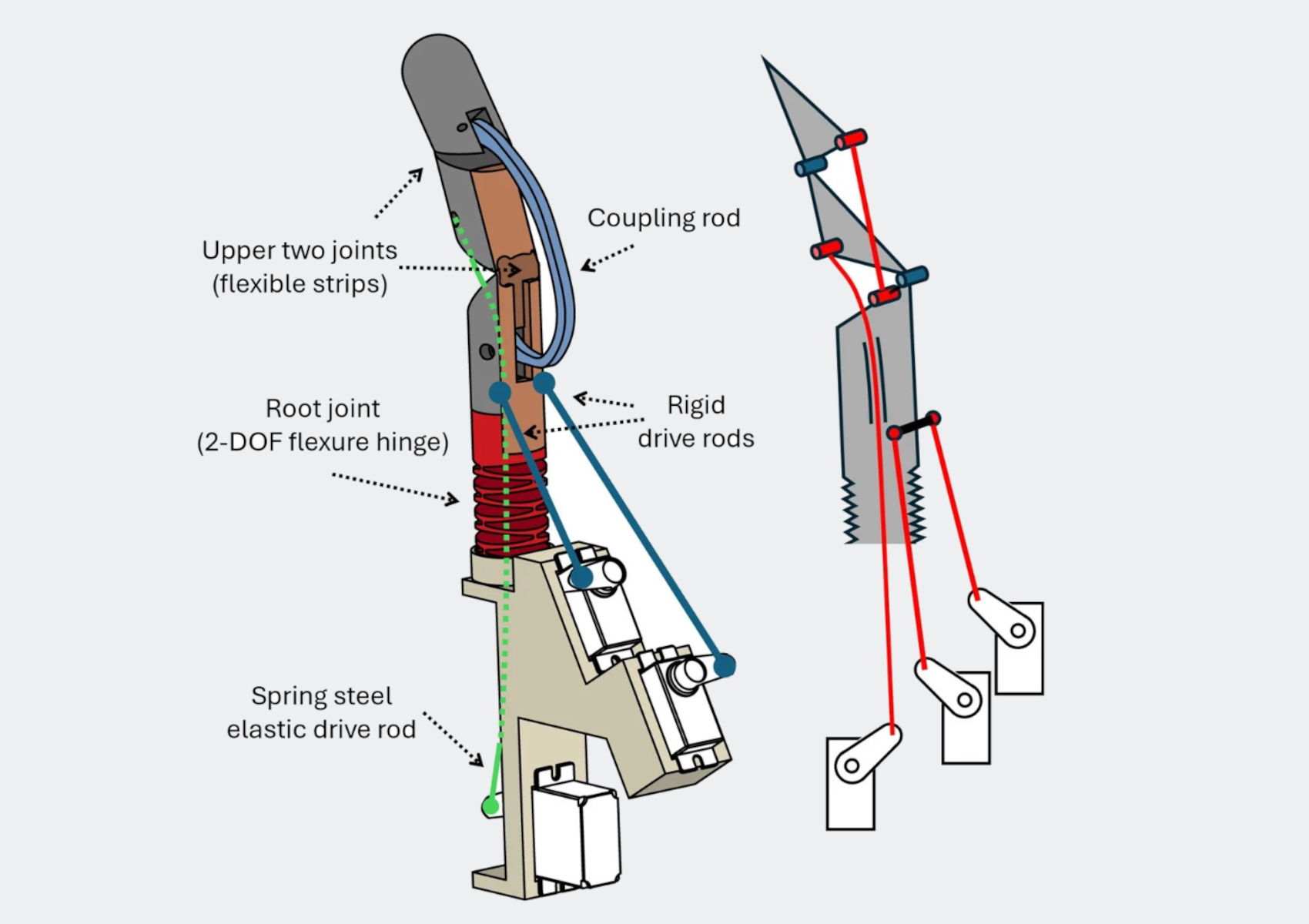
Adwani explained that the hand contains 3D-printed joints and knuckles, with tiny holes inside to accommodate metal rods. There are springs inside the finger tips and off-the-shelf servos meant for hobby projects. The hand and its fingers can return to a preset neutral position if power is lost, something that’s uncommon in current commercial hands. All functions are controlled by browser-based software that lets users drag desired movements with a mouse. The system is also prepared to work with typed or spoken commands interpreted by a large language model.
Files, videos and complete instructions to build the hand are being released on the project website.
 Looking forward, “One of my targets for my Ph.D. and also with this hand is to manipulate real-world objects,” Adwani said. For example, a human can easily grab a spatula backward and reorient it without a second thought, but for a robot and human programmers that is a difficult task. Tactile sending is on their agenda as well.
Along with opening an eyeglasses case or putting a cap on a jar, “We will be setting up some cameras. We will be trying to get AI to help us with that, and then we will actually run into some challenges. We just cannot predict what those challenges are right now.”
Wang, thinking back to his hospital stay, is grateful for how it turned out. “Putting aside robotics and research, it's the first time that I realized I need to take care of myself at least for the sake of my family,” he said. Yet engineers will engineer — “I was frustrated at the beginning but soon realized that staying away from emails and the Internet is actually great for creativity.”
