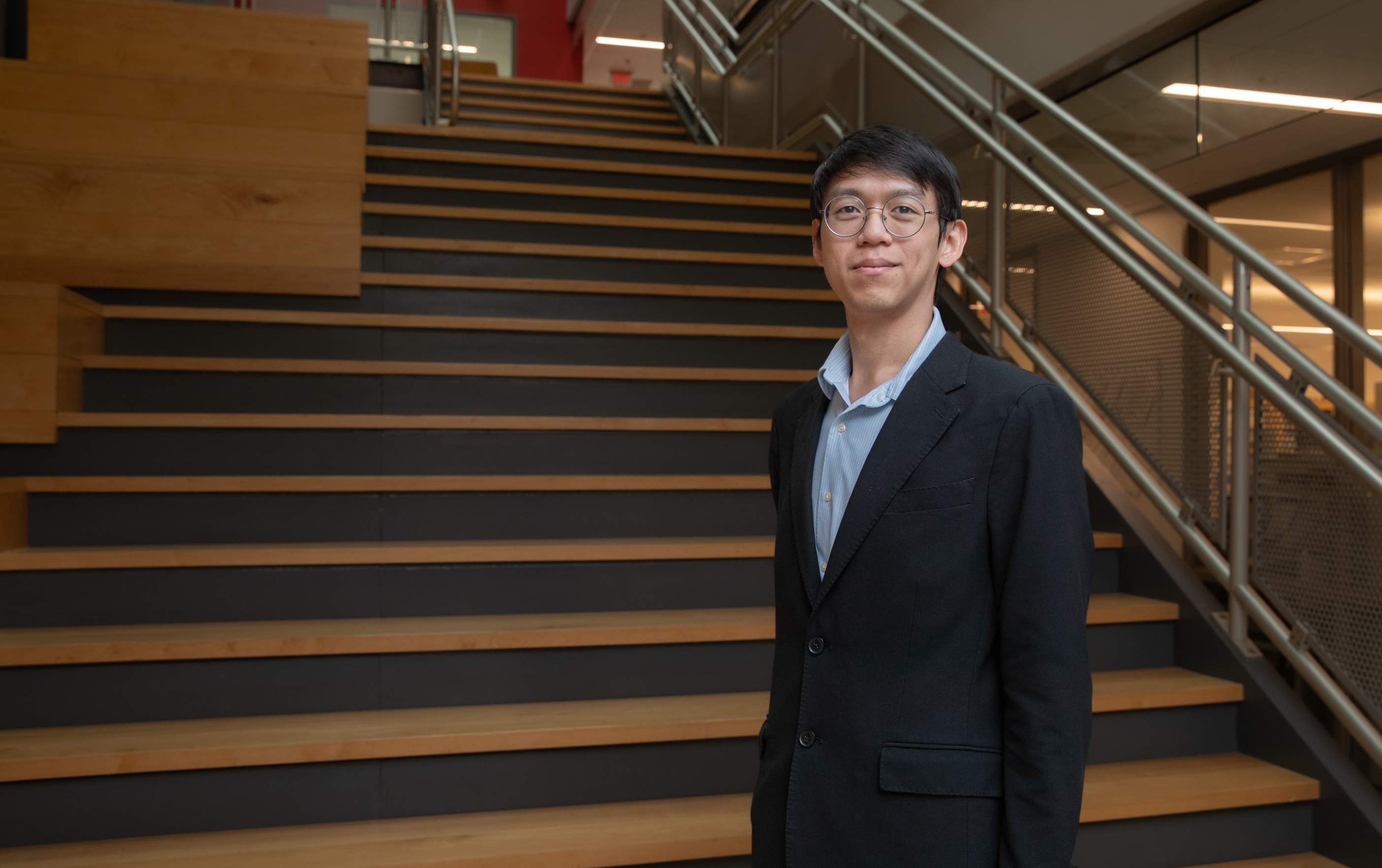
Nutth Tuchinda, an assistant professor of chemical and materials engineering at New Jersey Institute of Technology (NJIT), has been selected for the U.S. Department of Energy's (DOE) 2026 Early Career Research Program, a competitive national initiative supporting promising scientists in the early stages of their research careers.
Tuchinda is among 67 scientists selected nationwide for the program, which provides five years of research support. His project, "The Role of Entropy in the Interfacial Cohesion of Metals and Alloys," aims to improve scientists' ability to predict how and why metals fail, potentially contributing to the development of stronger, more reliable materials for demanding energy applications.
Metals and alloys contain microscopic crystals separated by internal boundaries that can become vulnerable points where fractures begin. Chemical elements that accumulate along these boundaries can strengthen or weaken the connections between crystals, influencing whether a material withstands stress or becomes susceptible to brittle failure.
“Understanding this type of mechanism will help materials scientists and engineers design both new processing routes and alloys that are resistant to fracture such as steels and refractory alloys in nuclear applications,” said Tuchinda.
Tuchinda's research examines a factor often overlooked in conventional models of material failure: entropy, a thermodynamic property related to the possible arrangements and motions of atoms within a material at finite temperatures which are the environment materials face in practical processing routes and applications.
Although scientists have long studied how chemical elements influence the strength of crystal boundaries, the effects of entropy are frequently excluded from predictive calculations because they are difficult and computationally expensive to account for. Through advanced computer simulations, thermodynamic modeling and machine-learning-assisted techniques, Tuchinda aims to develop a more complete understanding of the interplays between atomic arrangements, chemical composition and temperature influence the strength of these interfaces.
Building on a Foundation of Materials Research
The DOE selection builds on Tuchinda's research into the atomic scale defects and atomic interactions that influence the properties of metals.
At NJIT, he leads the Imperfection Engineering Group, which studies grain boundaries, triple junctions — locations where three crystals meet — and other structural imperfections within crystalline materials. His work combines computational materials science, thermodynamics and data-driven modeling to better understand how these features affect material behavior.
In a 2026 review published in Acta Materialia, Tuchinda and collaborators examined advances in computational models that predict how chemical elements accumulate along grain boundaries. Their review highlights how accounting for differences in atomic environments and thermodynamic properties, including entropy, can improve predictions of material behavior and inform the design of more stable alloys.
The publication builds on Tuchinda's earlier research at MIT, where he investigated how alloy composition and atomic-scale interactions influence material strength and stability. His studies examined grain-boundary embrittlement in aluminum alloys, developed large computational databases to predict how chemical elements affect interfacial cohesion, and advanced machine-learning-assisted methods for understanding atomic interactions across different alloy systems.
Building on these investigations, Tuchinda's DOE project will expand his research beyond grain boundaries to other interfaces commonly found in engineering alloys, including boundaries between different material phases, intermetallic compounds and reinforcing particles within a metal matrix. The research will examine how atomic arrangements and their stability at different temperatures influence the accumulation of chemical elements at these interfaces and the strength of the connections between them — processes that scientists still lack comprehensive models to explain and predict.
“This DOE project will help establish my lab and support graduate students who will further develop the future STEM workforce, and help mentor undergraduate students at NJIT,” said Tuchinda.
Supporting Early-Career Scientific Discovery
The DOE Early Career Research Program supports scientists at U.S. universities, national laboratories and Office of Science user facilities who are pursuing fundamental research in areas central to the department's scientific mission.
The 2026 cohort includes 67 scientists from 39 universities and 11 DOE national laboratories and user facilities. Tuchinda's project was selected through the DOE Office of Basic Energy Sciences, which supports research into the fundamental properties and behavior of matter.
Tuchinda earned his Ph.D. in materials science and engineering from the Massachusetts Institute of Technology in 2023 and his bachelor's degree in metallurgical and materials engineering from Chulalongkorn University in Thailand in 2018.
