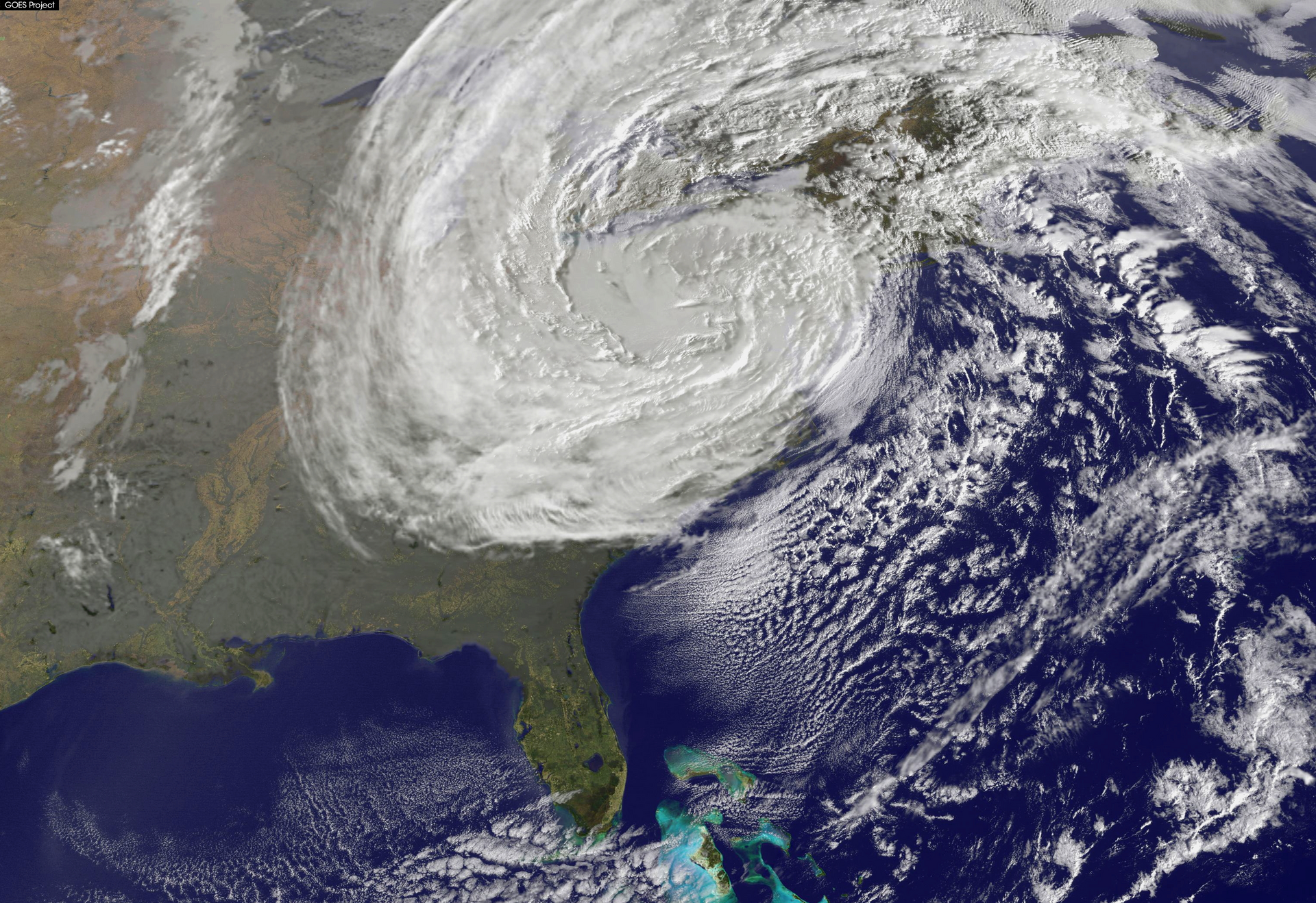
Meteorologists could predict hurricanes and analyze tsunamis more accurately and faster than ever, if a New Jersey Institute of Technology engineering professor’s creative software works out as planned.
The new technique would run artificial intelligence on a simulation of what’s called a quantum reservoir computer — that’s a network based on measurements of how atoms interact with each other — to manipulate weather data for pattern discovery. By gaining new pattern insights, better forecasts can be made, potentially saving lives and protecting property.
“Before AI, you could still try to simulate extreme events, and it wasn't the problem. The problem was not data. The problem was how much computer power you have to solve the partial differential equations,” explained NJIT Associate Prof. Simone Marras, who has joint appointment in the departments of mathematical sciences and mechanical/industrial engineering.
Marras said he was inspired to develop his software called Jexpresso based on lessons learned from 20 years of experience spanning three major programs that solve the atmospheric equations.
Marras co-developed commercial software for multi-physics called Alya, while working for the Barcelona Supercomputing Center as a graduate student. He also worked on NUMA (Nonhydrostatic Unified Model of the Atmosphere) which became the basis for the U.S. Navy’s current meteorological model, known as NEPTUNE. Next, he worked on the turbulence component of ClimateMachine.jl for Caltech's CLIMA association.
“Developing all these ad-hoc packages designed for one very specific goal had me learn what a package [needs] to allow new users and developers to add their own physical problem without having to know the details of the underlying software,” he said. “So in the summer of 2022 I started developing Jexpresso from scratch by making sure that I designed it with both the users and developers in mind.”
Another inspiration stems from the computing hardware side. The emerging technology of quantum computing works by tracking the movements of atoms, which can be in one of two positions or even in both simultaneously, unlike classical computing where a transistor is firmly on or off. Running conventional software on quantum computers would be a waste of the machine’s power, so new software is needed that can exploit the cutting-edge processors. Jexpresso does so by positioning the quantum system as the input for its neural network.
Marras programmed Jexpresso in a language called Julia, which he learned from the Caltech project. Most weather software is written in C++ or the powerful Fortran scientific language, which gives them speed, while Python is used for the interface, which is far more user-friendly. Julia is not yet as mainstream as the classical languages but it offers the best of both worlds, he noted.
Now, Marras will test and improve his software during the next three years, funded by a $266,000 National Science Foundation grant, Quantum Computing Approach for Predicting Extreme Atmospheric Events.
Jexpresso software tools will be open-sourced. They can run on a standard or high-performance computer, or on a real quantum computer if available to the user. He said his priority is to pick the perfect graduate student as a trusted assistant.
Then, upon the project’s completion, “Scientists will not need to know anything about either machine learning or quantum computers, other than the bare minimum,” Marras said. “It'll be as black of a box as they'd need it to be, or as open to their scrutiny and modifications as they need it to be.”
