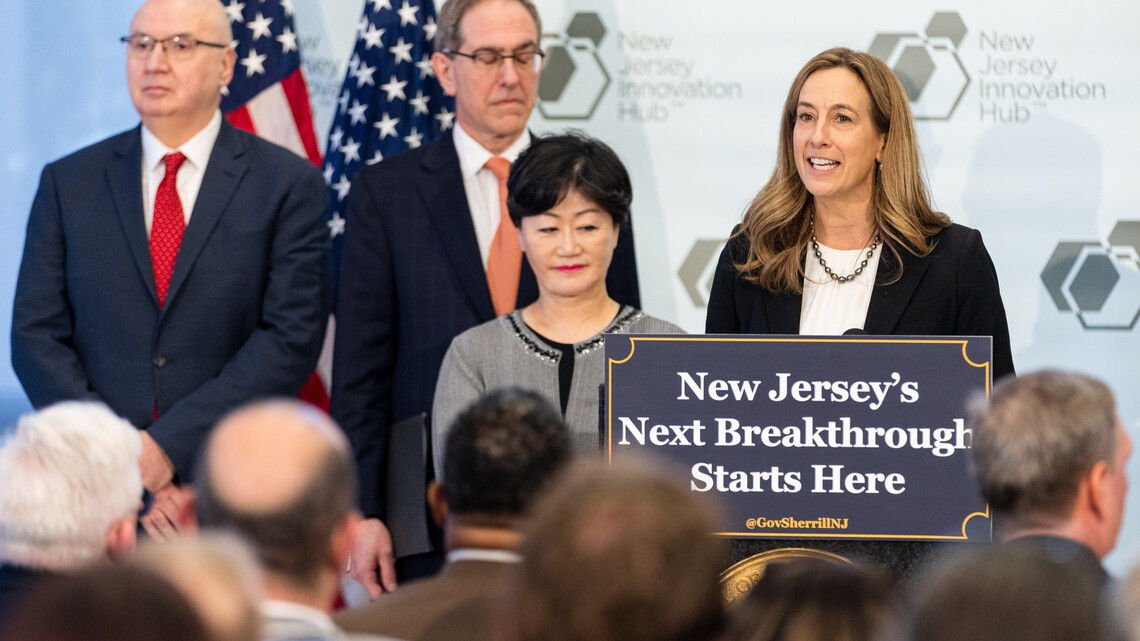
New Jersey Governor Mikie Sherrill was joined today by a contingent of representatives from New Jersey Institute of Technology (NJIT) for the launch of the New Jersey Supercomputer Initiative (NJSCI), a groundbreaking, public-private partnership that will drive the next generation of research, innovation, education, and workforce development across New Jersey. NJIT will play a central role in the NJSCI, in collaboration with other universities and state agencies.
NJIT Interim President John A. Pelesko, Dean of NJIT’s Ying Wu College of Computing Jamie Payton, and David Bader, Distinguished Professor of Data Science, Associate Dean for Research in the Ying Wu College of Computing, and Director of the Institute for Data Science at NJIT gathered with leaders from other higher education institutions, state agencies, and the NJ AI Hub for Governor Sherrill’s announcement today in New Brunswick.
The NJSCI will establish a supercomputer that serves as a shared resource to meet the advanced computing needs of researchers, students, entrepreneurs, businesses, and other organizations across the state. The supercomputer will allow faculty and students to conduct advanced research on key challenges, like cancer research and flood risk mapping, in a cost-effective, timely manner that would be impossible with conventional computers. The NJSCI is expected to double the current supercomputing capacity available across all of New Jersey’s research universities while expanding world-class education and training, unlocking economic opportunity, and creating quality jobs for New Jersey residents. The initiative is supported by more than $125 million in public and private investment that includes a $75 million personal gift from NVIDIA Co-Founder Chris Malachowsky and his wife, Melody, as well as a $25 million investment from SHI International. Through the New Jersey Economic Development Authority, the State is also investing $25 million.
“Large-scale computing has become one of the real limits on what we can discover. Many good ideas, whether in a lab or a classroom, wait because the machine needed to test them is out of reach,” said Pelesko. “The New Jersey Supercomputer Initiative lowers that barrier for researchers and students across the state, and we are grateful to Governor Sherrill, to Chris and Melody Malachowsky for their generosity, and to SHI and our fellow universities for building it together. As New Jersey’s public polytechnic university, NJIT will work to make sure that access turns into new discoveries, and into graduates ready for an economy that AI is rapidly reshaping.”
Payton, who serves on the serving on the NJSCI Governance, Allocation and Access Working Group and the NJSCI Education and Workforce Collaborative that is advancing curriculum, faculty professional development, and workforce development efforts, said, “This initiative advances the promise of AI+X: bringing AI together with expertise across disciplines to address complex challenges. By democratizing access to AI research and education, we can prepare students and working professionals to contribute to that work and connect talent across New Jersey’s universities to tackle large-scale problems together.”
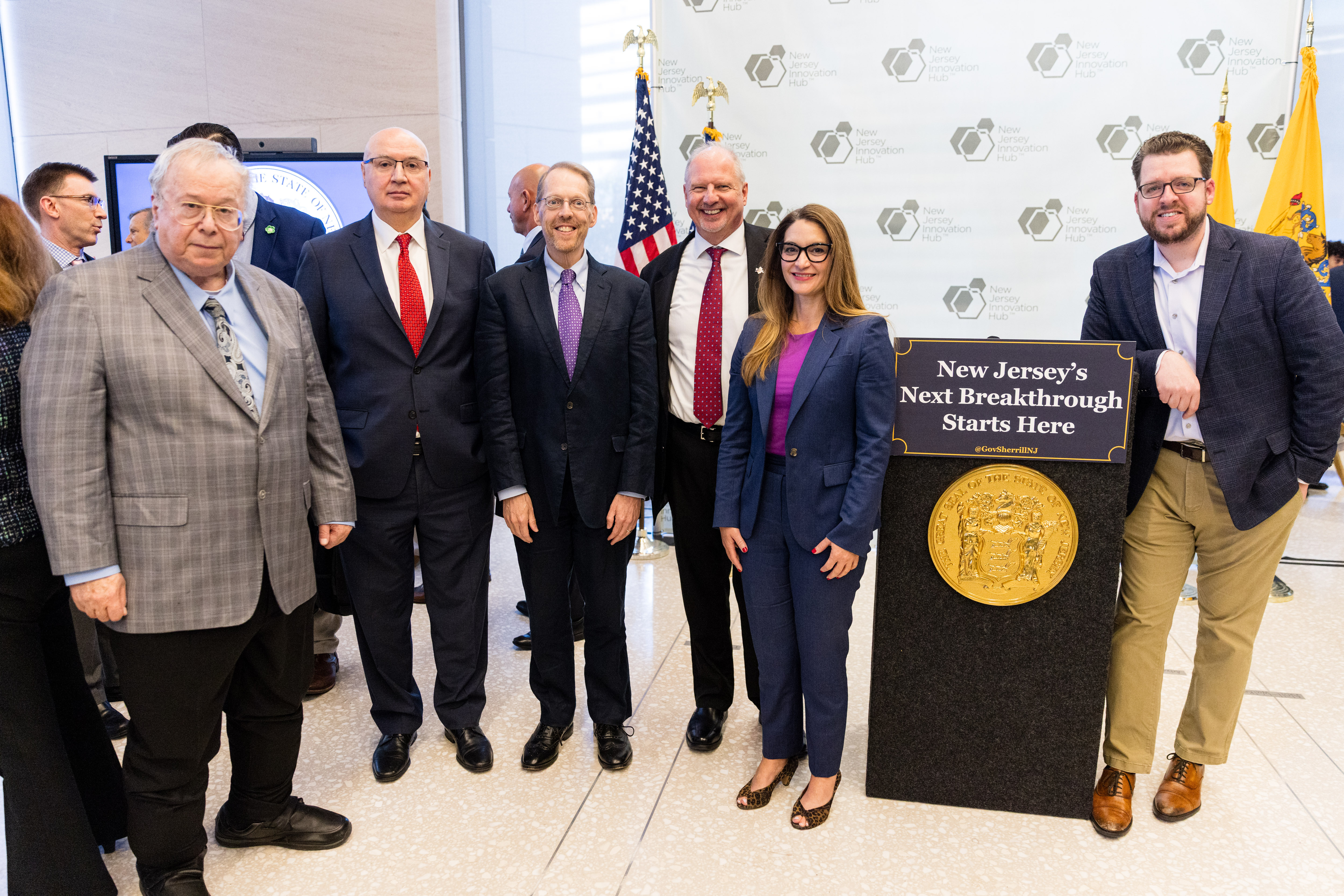
According to Bader, who has been part of the AI Supercomputer working sessions with the Governor’s Office, NVIDIA, SHI, and partner universities since the outset of this effort, “Right now, the best ideas in AI are held back less by talent than by access to computing. New Jersey has the talent. This initiative gives it access, and NJIT’s faculty and students will be among the first in line to put it to work.”
Bader also explained that NJIT built a Department of Data Science and an Institute for Data Science to train people for an economy that runs on data and AI. Most students still learn AI on laptops and free cloud tiers. Employers want people who have actually trained and run models at scale. The NJSCI lets NJIT put serious hardware in front of students in their courses. He added that getting the state, NVIDIA, SHI, and many colleges and universities across the state to share one resource is rare and gives us a structure we can keep building on.
“From Thomas Edison to Bell Labs and beyond, New Jersey has earned its reputation as the Innovation State through groundbreaking research and discoveries that transform lives. Today, we are building on that proud legacy by launching the New Jersey Supercomputer Initiative,” said Governor Sherrill. “This major initiative will ensure that New Jersey strengthens its longstanding leadership in using new technologies to uncover scientific breakthroughs, to help our students build the skills and experience they need to compete for jobs in high-demand fields, to expand opportunities for our workforce, and to improve quality of life throughout our communities. We look forward to seeing how this game-changing investment in New Jersey’s future will accelerate cures for diseases, strengthen environmental resilience, and solve many other challenges facing our state.”
Malachowsky said of his support, “New Jersey is where my story began, and it means a great deal to give back to the community that raised me. I am grateful to Governor Sherrill and our partners across the state for making this a reality. Through the New Jersey Supercomputer Initiative, we can unlock the talent that exists all around us, transform schools, businesses, and the workforce, and together, tackle our most pressing challenges.”
