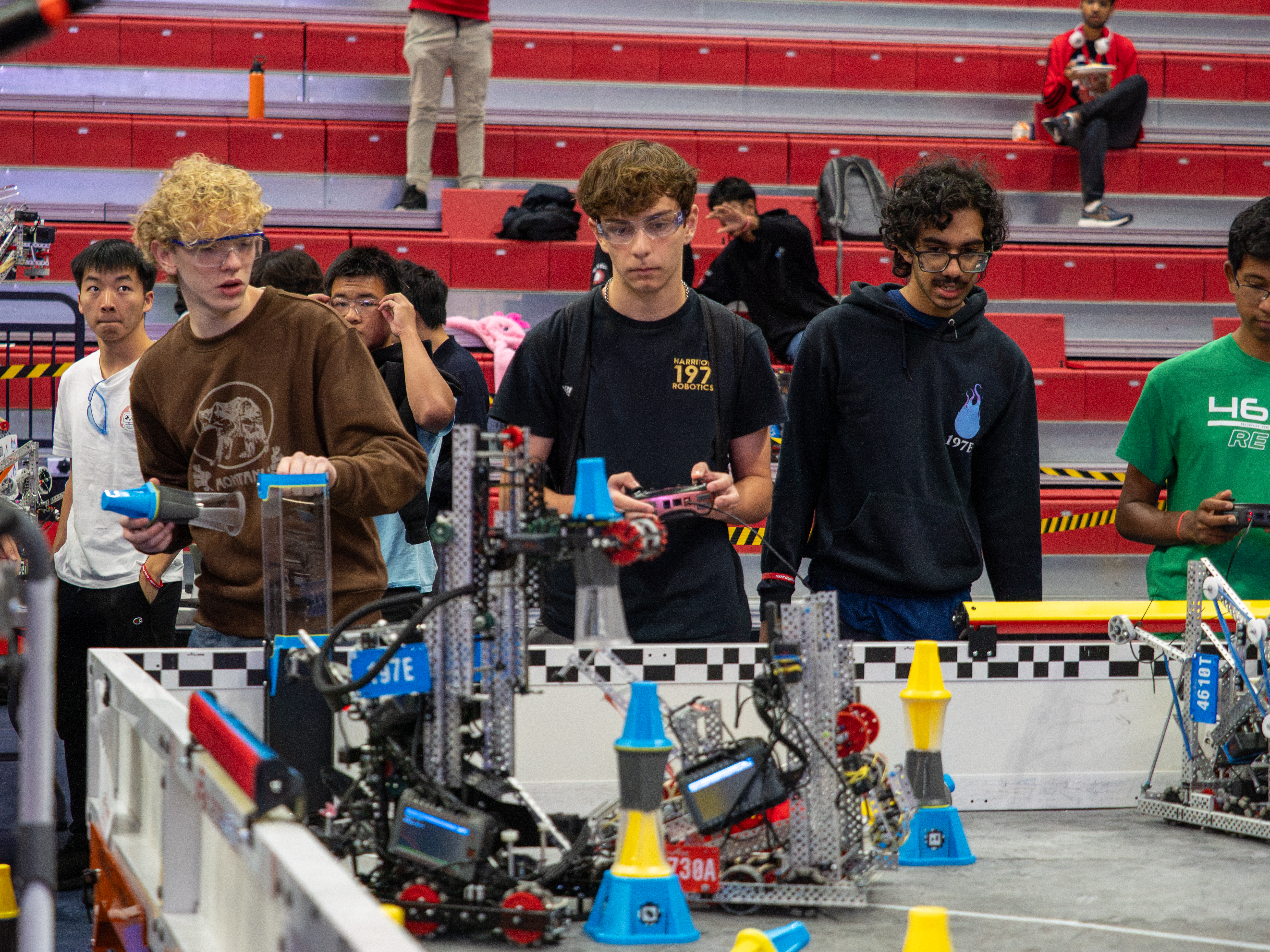
High school robotics teams from Vancouver, B.C., Irvine, Calif. and Flushing, N.Y. won the 2026 Highlander Summit at New Jersey Institute of Technology’s Wellness and Events Center this fall.
The summit is a major competition on the Vex Robotics circuit, with the winners besting 94 others to advance to the World Championships scheduled for April 2027 in Las Vegas.
In each round, robots gripped, lifted and stacked plastic cones and defended their sides of the ring to earn points. Blocking opponents is allowed, but points are deducted for intentionally toppling an opponent’s stacks. Robots operate autonomously for part of the round and then human drivers take over by radio control.
“We wanted to go to a competition that was fun and winnable,” said Nathan Park, captain of the Irvine team that allied with peers from Vancouver to win the four-team final round. Park said they’ll keep tweaking their robot design, as well as practice driving in scrimmages, to prepare for the Las Vegas event. Park, a junior, added that he plays lacrosse and would consider NJIT for the next stage of his education.
A team from New York’s Jericho High School, on Long Island, won the Innovate Award. Most teams program their autonomous modes based on the positions of where the cones would be placed, which are shared in advance, but Jericho roboticist Milo Lin said his team installed a color sensor so their robot could grab cones with extra precision.
Patrick Thornton, director of robotics for NJIT’s Newark College of Engineering, said this year was the first that a team entered from beyond North America with a team simply named “One” traveling from Taiwan. Thornton also said that 90% of volunteer work at the event was performed by current NJIT undergraduates, and that graduate students often serve as judges.
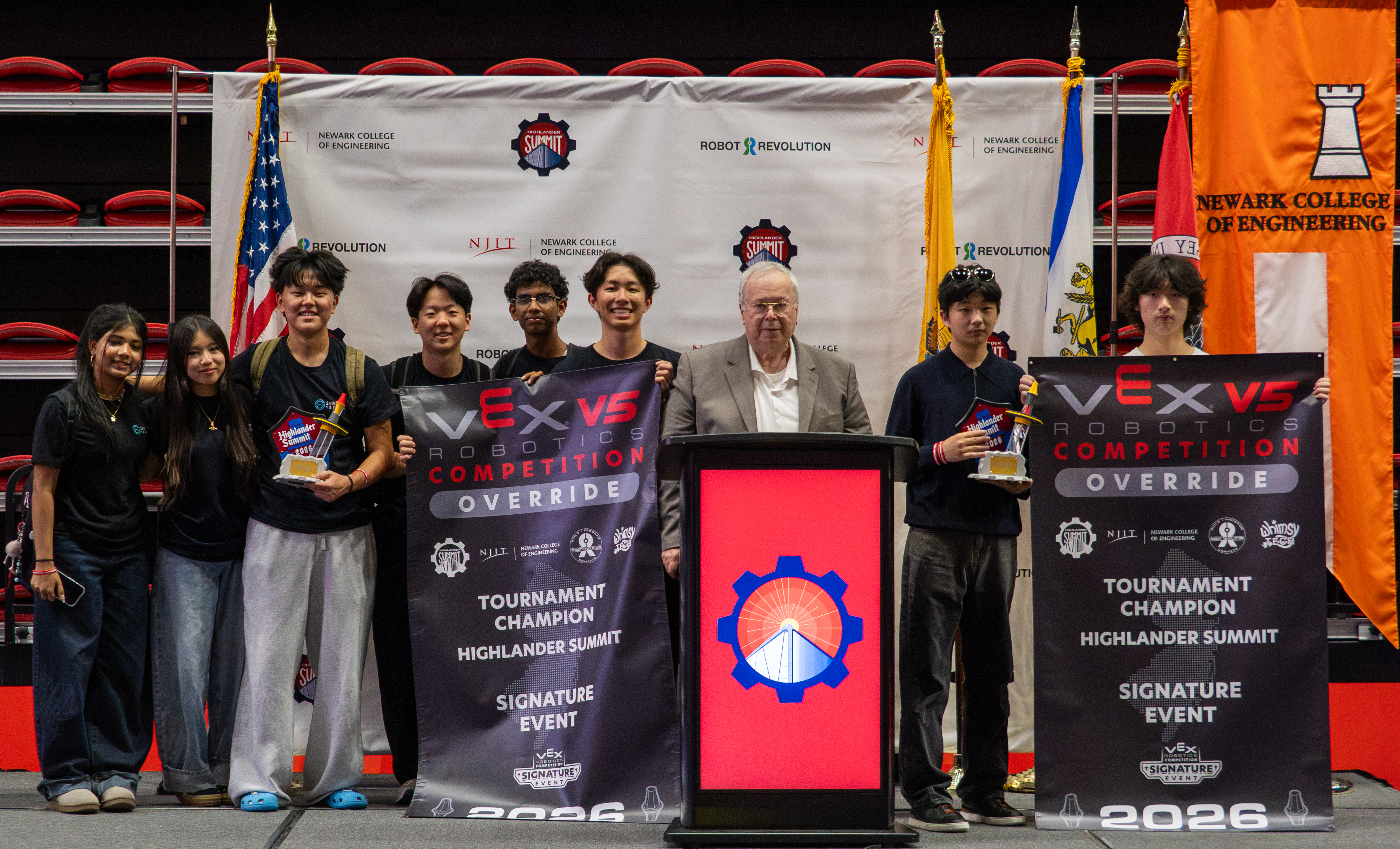
Winning teams with NJIT Interim Provost, Moshe Kam
An NJIT alumnus, Dale Nacianceno '23, '25, served as head judge. He’s gone full-circle — he competed in Vex Robotics for South Brunswick high school, and then earned B.S. and M.S. degrees in computer science while also serving as an officer of the NJIT robotics club — but he later walked away from the high salaries of corporate software development jobs to follow his passion and become a technology teacher, now working for the Perth Amboy school district.
Nacianceno commented on what makes a robot successful in the tournament. “There is a lot of design convergence where teams very early figure out what the best robot is or best couple of robots, and build a variation of that. But it's very easy to build a robot that has that structure — it is very hard to fine tune that robot to actually make it work really, really well,” he explained. “So it comes down to their ability to execute. These robots are very complicated.”
He cited the example of object lifting mechanisms. There are common scissor lifts, which are simple but shaky; cascade lifts, which work in stages but require some tuning; and something called a double reverse four-bar, which is ultimately simpler but takes more space.
Nacianceno added that in addition to color sensors like those used by Jericho’s team, high schoolers in general are beginning to use artificial intelligence for extra or speedier object interpretation. In addition, he spoke of a robot that could spin an object 180 degrees vertically after gripping and lifting, which avoids the issue of selecting objects that are already upright.
