
The old saying, “Waste not, want not,” rings especially true in America's Battery Belt.
Today, roughly 10% of the material used to make an electric-vehicle battery ends up as manufacturing scrap. But a proposed $110 million project aims to turn that scrap back into material for producing new batteries right here in the U.S. — and do so in as little as seven days.
Behind the effort are two NJIT alumni at Princeton NuEnergy (PNE): co-founder and CEO Chao Yan (M.S. '13, Ph.D. '17) and founding partner and chief operating officer Peng Zhao (M.S. '13).
Since its startup beginnings in 2019, PNE has grown into a pioneer in direct battery recycling — reusing valuable cathode material from scrap instead of breaking it down to recover its metals — just as U.S. battery manufacturing has taken off.
The company has now been selected to negotiate for $50 million in U.S. Department of Energy grant support for a planned facility capable of rejuvenating 3,000 metric tons of cathode material annually.
“No one has moved direct recycling to this scale yet,” Zhao said. “We're bringing this technology to the commercial world with this first-of-its-kind facility. The goal is to build a true domestic closed loop — keeping these critical battery materials in the U.S. and bringing down their cost.”
Cathode material in manufacturing scrap can be essentially brand new, Zhao says, but conventional recycling shreds it into “black mass” to recover metals such as lithium, nickel and cobalt.
Zhao estimates U.S. manufacturing scrap and end-of-life batteries generate roughly 100,000 metric tons of battery waste annually, much of it requiring further processing overseas.
PNE's patented Cathode-to-Cathode® process instead uses low-temperature plasma to clean and restore cathode material for reuse.
“Think about it like you have a dirty spoon,” Zhao explained. “The traditional recycling process is like taking that spoon, melting it down and extracting the metals one by one, then sending them overseas to make a new spoon and importing it back so you can use it. What we do is more like simply putting the spoon in a dishwasher. The cathode material is still good — it just has impurities. We use plasma to clean the surface, remove those impurities, polish it and use it again right away.”
Building the Closed Loop
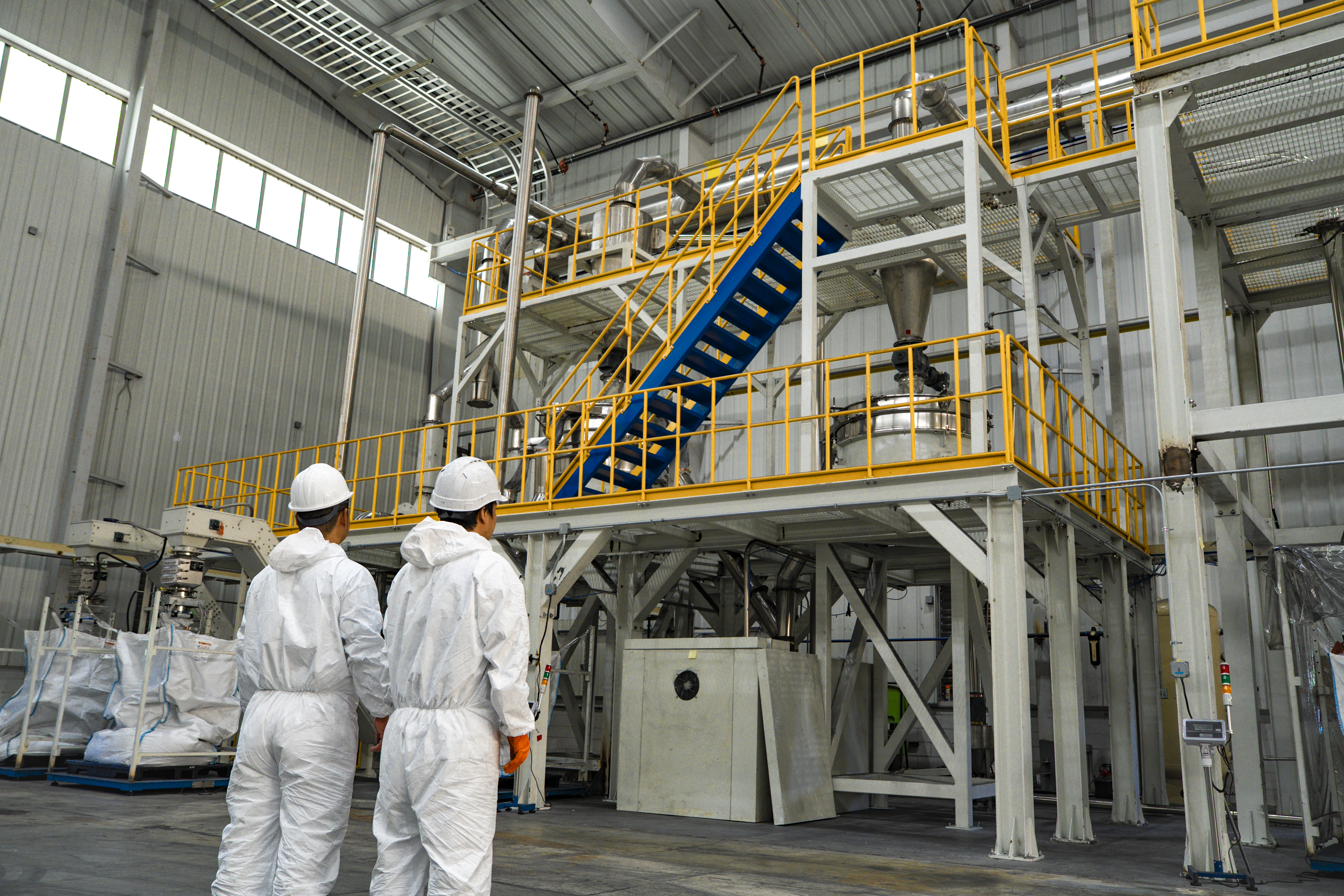
Above: Engineers oversee battery recycling operations at Princeton NuEnergy's facility in Chester, South Carolina. Credit: Princeton NuEnergy.
PNE plans to save U.S. battery scrap from that globe-spanning journey. Construction of the proposed facility is targeted for early 2027, with the roughly 30-month project expected to begin operating in 2029.
“Battery factories produce manufacturing scrap every day,” Zhao said. “We take that scrap, rejuvenate the cathode material and give it back to our customer to make a new battery. This closed loop is within the United States.”
A DOE-backed study with Argonne National Laboratory found PNE's rejuvenated cathode material could cost about 45% less than comparable virgin material.
“It’s also a national security issue,” Zhao said. “If you fully rely on foreign countries for critical battery materials and something happens geopolitically, how can you build your EV? How can you build your data center? How can you build your defense applications?”
“A lot of direct recycling is still at the lab scale,” Zhao said. “Some approaches use organic solvents that become difficult to handle safely at this scale; others are very expensive. We use low-temperature plasma to remove impurities from cathode active materials, reducing costs and minimizing waste.”
Yan said scaling the technology comes down in part to how PNE builds its facilities. More than 90% of the equipment is commercially available, while the company's proprietary components are designed in modules that can be replicated as production needs grow.
“Depending on the capacity required, we replicate these modules and deploy them in parallel to meet each facility’s production needs,” Yan said. “This modular design allows us to deploy the technology quickly at different scales to meet customers’ varying capacity needs.”
PNE's next Cathode-to-Cathode® facility would also allow other battery manufacturers to validate the company's process before potentially bringing it to their own sites.
For Yan, reaching 3,000 metric tons annually would mark a significant step toward bringing direct recycling into widespread industrial use.
“This facility has the potential to redefine how critical battery materials are recovered and reintroduced into the U.S. supply chain,” Yan said. “More importantly, it establishes a commercially viable model we can replicate across the country.”
PNE plans as many as 10 production lines around the country over the next decade, totaling 30,000 metric tons of annual capacity.
“This is a seed,” Zhao said. “We need to let the seed grow, then go to 10 branches.”
It's a scale far beyond what Zhao envisioned when Yan, whom he knew from their days sharing a dorm at NJIT, began working on his plasma-based purification technology under chemistry professor Lev Krasnoperov nearly a decade ago.
Zhao had taken a different path. An NJIT career fair internship with Panasonic North America became a 10-year career, eventually taking him to a senior manager role in technology commercialization at the Panasonic Innovation Center in Harrison, New Jersey.
When Yan approached him around 2018 about using plasma to recycle batteries, Zhao saw its potential but wasn't convinced the market was ready.
By 2020, the market was catching up. Major automakers were accelerating their electric-vehicle plans and U.S. battery manufacturing was expanding. Zhao left Panasonic the following year to join PNE full time.
Since then, PNE has built toward commercial scale — from early pilot work to its direct recycling line in Texas and a commercial-scale black mass production facility in South Carolina. Zhao said the company has also raised $38 million in equity financing and received or been selected for more than $73 million in federal grant support, including the $50 million DOE funding still under negotiation.
The $110 million facility would be its biggest step yet.
“I always believe we want to do the right thing at the right time with the right people,” Zhao said. “Right now, I feel we have all three.”
