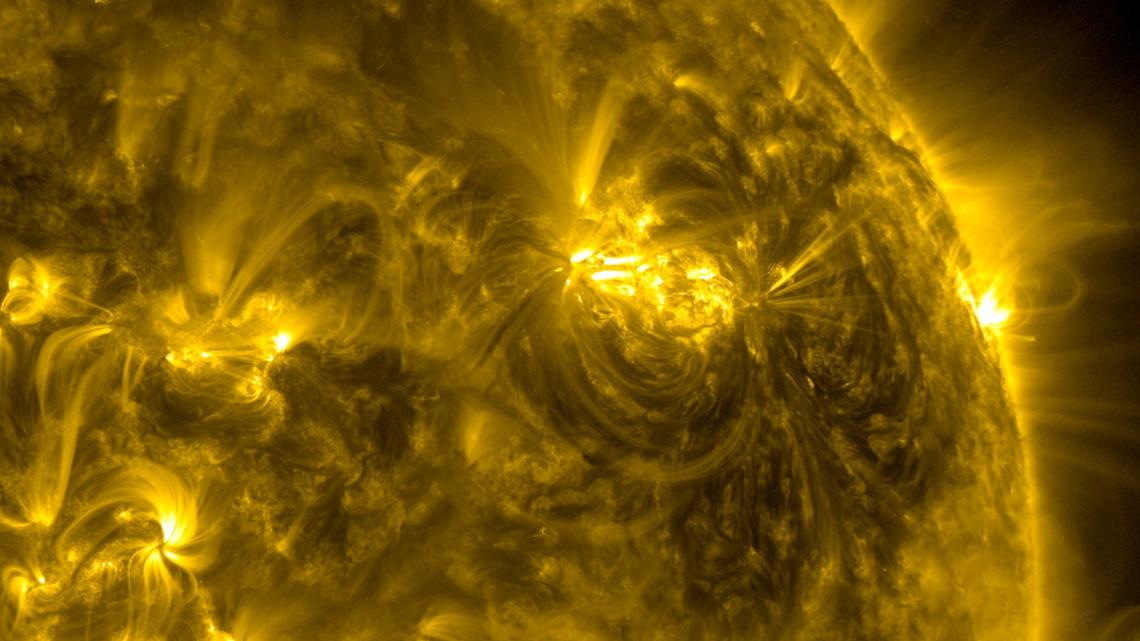
Long before dark sunspots appear on the Sun's surface, a new active region — where powerful solar eruptions can originate — begins showing subtle signs of its formation.
Now, researchers say a new artificial intelligence model can detect those early signals and forecast the emergence of solar active regions nearly nine hours in advance on average.
In a study published Aug. 14 in the Journal of Geophysical Research: Machine Learning and Computation, a research team led by New Jersey Institute of Technology (NJIT) reports an artificial intelligence model, called EarlyDetect, that can identify precursor signals of active region emergence in the Sun's acoustic activity and magnetic field.
Scientists have struggled to capture such signals until now.
NJIT undergraduate researcher Jonas Tirona, the study's corresponding author, developed the approach with NJIT computer scientists and solar physicists, along with collaborators at Princeton University and NASA's Ames Research Center, using observations from NASA's Solar Dynamics Observatory (SDO).
"The most valuable thing this work shows is that we can use machine learning to predict when solar active regions will emerge in advance," said Tirona, an incoming senior computer science major and Albert Dorman Honors College scholar. "That early warning could allow satellite communications companies or power grid companies to prepare and potentially mitigate damage from solar storms."
Active regions — magnetically intense areas where sunspots form — begin emerging over several hours, while their full development can take one to several days.
As magnetic fields rise toward the Sun's surface, they leave faint signatures in acoustic waves that scientists can detect through helioseismology, the study of solar vibrations.

Above: At the beginning of Feb., 2026, an extremely dynamic active region on the Sun rotated into view of Earth. For nearly two weeks, this active region, designated AR4366, produced intense solar flares. These eruptions were observed by multiple spacecraft, including NASA’s Solar Dynamics Observatory (SDO). This video condenses nine days of solar activity into just four minutes, playing 3,240 times faster than real time. Credit: NASA's Goddard Space Flight Center/SDO.
To identify those signatures, the team’s EarlyDetect model analyzes hourly acoustic power maps and magnetic field measurements from NASA's Solar Dynamics Observatory.
The acoustic maps are derived from sound-wave observations recorded every 45 seconds by the Helioseismic and Magnetic Imager (HMI) aboard NASA's SDO.
"The main difficulty is that an active region begins developing beneath the Sun's visible surface, where we cannot directly observe the magnetic structure," said Alexander Kosovichev, distinguished professor of physics at NJIT and co-principal investigator of the project. "Instead, we’re looking for very small changes in the magnetic field and in the pattern of acoustic waves continually traveling through the Sun. It's more like detecting a slight change in rhythm within a very noisy orchestra."
The team's model uses a Transformer architecture — the same type of AI technology behind large language models such as ChatGPT. While those systems learn patterns in text, EarlyDetect learns patterns in solar observations to predict future changes in the Sun's activity.
After joining the project last year, Tirona and the team discovered that a filtering technique they had applied to help the AI model identify important patterns in solar data was actually making its forecasts worse.
"That surprised us most," Kosovichev said. "We initially expected it to help isolate useful short-timescale patterns. Instead, it averaged away the very faint fluctuations that provided the earliest warning."
"It's kind of like noise canceling … it normally removes the loud noises so you can see the overall trend better," Tirona said. "But we found it was detrimental in almost every case. The signals that the filter removed turned out to be really important in helping the model predict when an active region would emerge."
Animation: This visualization shows the emergence of solar active region AR11158 using observations of the Sun's magnetic field, continuum intensity and acoustic power derived from Doppler-velocity measurements. Warm and cool colors represent opposite magnetic polarities. The tracked region is divided into smaller patches to monitor changes over time. A drop in acoustic power appears first, providing an early signature of active-region emergence, followed by changes in continuum intensity and magnetic field as the active region becomes visible. The visualization illustrates the data analysis pipeline used by EarlyDetect, the machine learning model developed to forecast active-region emergence. The model is not yet operational. Credit: Irina N. Kitiashvili (NASA Ames Research Center) and Spiridon Kasapis (Princeton University).
After training on observations from NASA's SDO/HMI, the researchers tested EarlyDetect on active regions the model had never seen before.
The best-performing version identified precursor signals an average of 9.24 hours before active regions became visible, outperforming both a standard Transformer model and a previous benchmark approach.
"Machine learning hasn't been widely applied to solar activity forecasting yet," said Mengjia Xu, assistant professor of data science at NJIT and principal investigator of the project. "Our work shows that advanced machine learning models can open new possibilities for future space weather prediction."
The project was among the first supported by NJIT's Grace Hopper AI Research Institute, which launched in 2025 to advance interdisciplinary AI research. Additional support came from NASA heliophysics and space weather research grants, including the NASA Science DRIVE Center, Consequences Of Fields and Flows in the Interior and Exterior of the Sun (COFFIES).
To help other researchers build on the work, the team has also released the Solar Active Region Emergence Dataset (SolARED), a publicly available collection of solar active region observations compiled from SDO, along with the Solar Active Region (SAR) Portal — an interactive web platform for exploring the data.
"This is the first public dataset for solar active region emergence," Xu said. "It provides a shared resource for both the machine learning and heliophysics communities to develop and test new prediction approaches."
While promising, Tirona said EarlyDetect is not yet ready for real-time forecasting. The model was trained on known emergence events and still produces occasional false alarms or late predictions.
An emergence warning is also not a prediction that a flare or coronal mass ejection will occur — many active regions never produce major eruptions. The team says it still needs to validate the approach across many more solar events.
"I hope this project brings more awareness to how machine learning can contribute to heliophysics," Tirona said. "It would be really cool if a model like this could someday help predict solar weather events. We're not there yet — but this is an exciting step."
