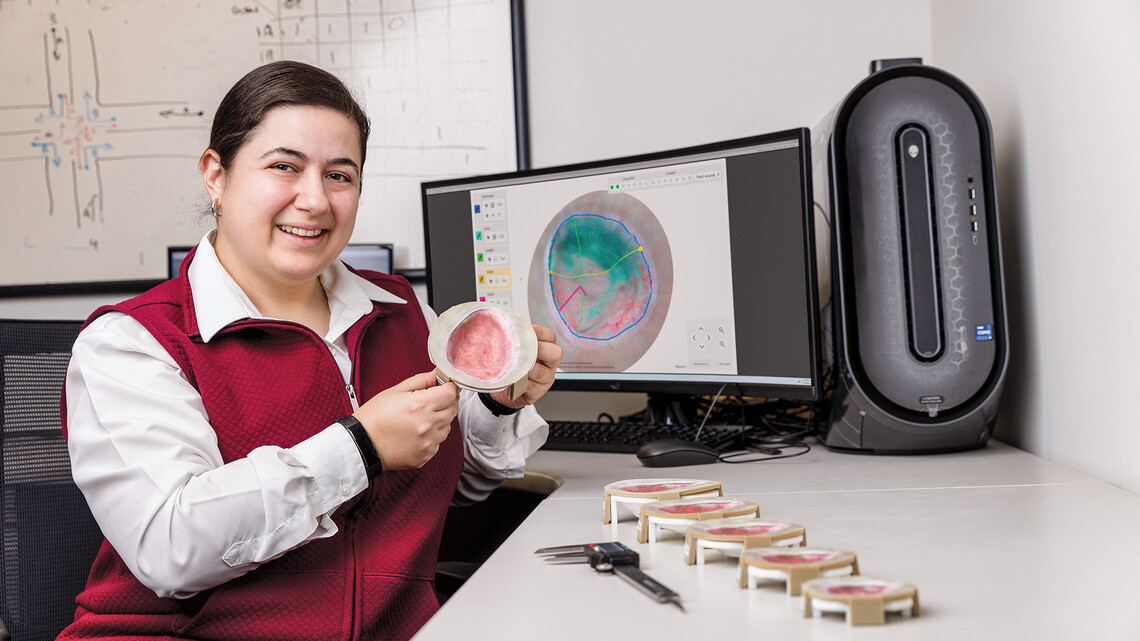
There's a saying that time heals all wounds, but there's less certainty about how wounds heal. The process can be difficult for medical experts to track. Though changes in surface contours and wound boundaries offer clues about the pace of healing, measurements at the surface can overlook changes in the wound's deeper layers. Variations between different healthcare providers' measurements of a wound's width and length can present conflicting data about healing progress.
To address this, Salam Daher, an associate professor of informatics at New Jersey Institute of Technology, turned to scans and digital models of skin abnormalities. Together with medical researchers from the University of Central Florida (UCF), Daher developed a method for analyzing and monitoring damaged skin regions with greater precision than in existing techniques.
"It's a challenge to measure wounds," Daher says. "First, it's hard to measure the thickness of a wound. Second, there are multiple standards for measuring wounds, so different people would measure the same wound differently."
She realized that scanning wounds in 3D and using an algorithm to calculate digital measurements would increase precision and uniformity when tracking how wounds heal. The system received a U.S. patent on Sept. 29, after previously winning Best Innovation Award in 2025 at the International Meeting for Simulation in Healthcare.
Tracking a Wound's 'Ups and Downs'
Using Daher's method, a skin anomaly is first digitally scanned and then reconstructed as a virtual 3D model. The system measures a wound's length, width and depth — a common practice in other types of wound analysis. But the process goes a step further. It also evaluates a wound's perimeter, surface area and volume, enabling medical professionals to observe how those variables change over time as wounds heal or get worse. The technique presents a more complete view of changes across the entire wound.
"Right now, most healthcare providers use a ruler and a Q-tip to measure your wound," which can be less precise than digital measurements, Daher says. Some medical professionals take photographs to monitor healing, but this, too, can be misleading, as images may be warped or otherwise distorted by the lens or the position and angle of the camera.
Accurate wound analysis can be further derailed by variations in the measuring techniques of different healthcare providers, Daher adds. Often, individuals select different points on a wound for determining its linear surface dimensions, creating inconsistencies between measurements.
"Now you have a false sense of whether the wound is increasing or decreasing in size," Daher explains.
In addition to capturing more consistent measurements, the new system maps a wound's overall shape — including all of the contours, peaks and valleys of healing tissue at all depths — which prior methods did not do.
"What's special about this is we're using all of the 'ups and downs' of that wound," Daher explains. "You see more changes in the middle than you see at the edges. So, it could give us a faster indication of how the wound is healing or not." In June, she presented a paper about the system at the Institute of Electrical and Electronics Engineers (IEEE) International Conference on Healthcare Informatics, held in Minneapolis.
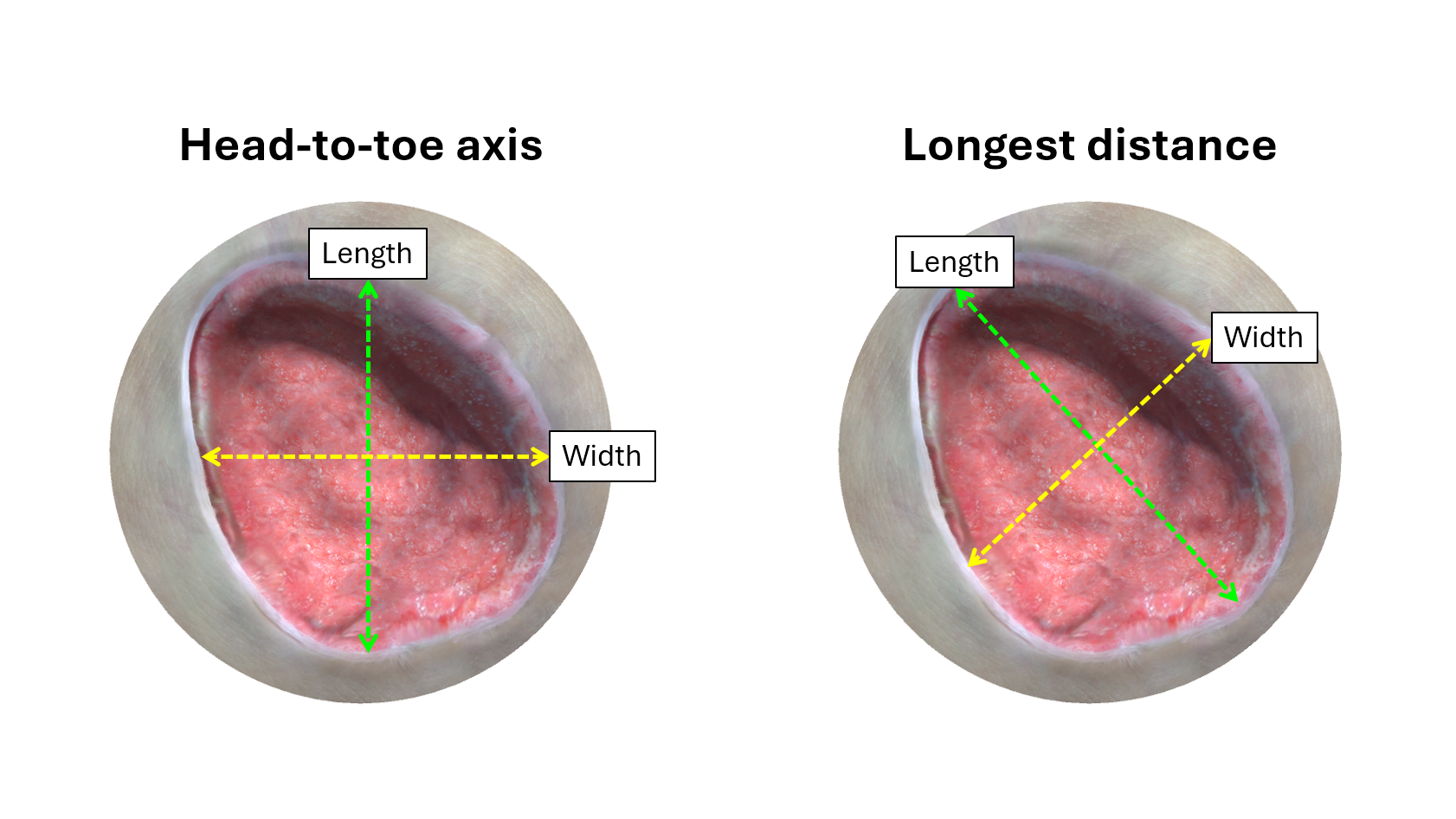
The researchers tested the method by scanning soft models representing skin anomalies at different stages of healing. But those models were fabricated by hand and did not originate as digital files; to ensure the accuracy of the system's measurements across all wound stages, Daher went back to the drawing board, creating digital files and 3D-printing six models showing pressure ulcers as they progressively healed. The final part of the system was software, which used an algorithm to measure and compare the wounds.
Daher's collaborators at UCF then brought in healthcare providers to test the system, measuring wound progression first by hand, and then using the software. Their results, published in the IEEE Open Journal of Instrumentation and Measurement in 2025, confirmed the scientists' prediction — that the software provided more accurate measurements.
"We also found that the healthcare providers trusted the system, so the system can measure things manually or semi-automatically," Daher says. For manual measurements, the user can trace the wound contours and select measuring points, while the system does the computation. In the automatic mode, users simply define which part of the contours are wound and which are not, and the algorithm selects the measuring points.
Daher and collaborators from the Catholic University of America published a paper on the automation process in the journal Proceedings of the 2025 IEEE International Conference on Data Mining Workshops; the system also won the conference's Outstanding Demo Award.
A Rigorous Defense
While this isn't Daher's first patent, it was her first patent submission as a lead inventor. And inventiveness is just one part of earning a patent. Time management and detailed record-keeping from start to finish are also essential to the process' success, especially after a patent has been filed and the inventor must then explain to lawyers and a patent examiner how a new device or system differs from other patented technologies or methods.
"You're trying to defend something that doesn't exist," she explains. "The patent writing and part of its defense happens during a time when the work may not yet be published in a peer-reviewed journal or conference proceedings. In early stages, inventors typically hold off from publishing so it doesn’t invalidate the patent."
Defending the patent was rigorous and time-consuming, but rewarding — and acceptance of Daher's defense progressed more quickly than expected. "I responded to the examiner and he retracted all of his rejections after my first response," Daher says. When she told a colleague that she wasn't sure what would happen next, he told her the next thing she had to do was celebrate.
"I didn't know that usually it takes more back-and-forth, with some claims not surviving the process," she added. "I'm happy that the hard work paid off."
