
When Kristen Hagen ’13 is working through a design, she still returns to a question she first heard from the late Barbara Littman ’94, an interior designer and NJIT benefactor who taught her in studio: “Do you like it?”
The question has stayed with her through hotel renovations, a return to the classroom as an instructor and her current work as a senior associate and interior design director at Mancini Duffy. Today, Hagen helps develop the firm’s design processes and standards while working with architects and designers to create workplaces that support their clients’ employees.
Her career has developed around an interest that first brought her to NJIT: exploring how technology can expand what a designer is able to imagine and build.
A creative education at a polytechnic university
Hagen wanted an education that combined artistic exploration with the technical skills she expected to need professionally. NJIT’s interior design program offered that combination, along with the opportunity to live on campus near family and friends and within reach of New York City.
“I chose NJIT because I wanted to find a design program that focused on technology and forward thinking design,” she said.

Outside the studio, Hagen became involved in the Residence Hall Association, the fencing team and Alpha Sigma Tau sorority. She also worked at the campus pub and spent two summers as a Miniversity coordinator. Those experiences introduced her to people she might never have met within her major.
While still a student, she interned at Wyndham Worldwide, gaining an introduction to hospitality design from the hotel company’s perspective.
She earned her bachelor’s degree in interior design in 2013. Exposure to modeling software helped her compete for early jobs, but she credits the experience of learning and experimenting with those tools with shaping her approach to solving design problems.
Her first professional designer role followed at Kraig Kalashian Architecture and Design, known as KKAD, where she worked on hotel and restaurant projects. She also earned NCIDQ certification early in her career, a credential recognizing professional competency in interior design, to deepen her industry knowledge and strengthen her qualifications as a young designer.
Taking ownership of a design
Among her projects at KKAD, the Washington Hilton’s lobby renovation remains a particular source of pride. Hagen took a lead role in the interior design of the project, which the firm dates to 2018, designing custom lighting, millwork and furniture while incorporating the hotel’s history into its interiors.
“I was given a lot of trust and freedom to shape the experience, and I learned so much during the process,” Hagen said.
A custom light fixture she designed sweeps around the lobby lounge, using traditional beaded crystals in a modern interpretation of a chandelier. The choice was a nod to the hotel’s history and glamor.
As the fixture was being built overseas, Hagen reviewed production photographs showing people standing beside its frame for scale.
“I was so nervous about how large it was going to be and how the pieces were going to come together on site,” she said.
Once installed, the fixture balanced the rest of the space and became a feature guests see when they first walk in.
Returning to NJIT opened another direction
As her career developed, Hagen began teaching. NJIT Senior University Lecturer David Brothers introduced her to her first teaching position at Raritan Valley Community College, experience that helped her return to NJIT to teach a design studio.
Back in the classroom, she was struck by how much the technology had changed in the few years since her graduation. Teaching renewed her interest in the software tools used in interior design and helped draw her to Mancini Duffy, whose approach to using these tools appealed to her.
One experience that changed her approach came when she first used the firm’s in-house Mancini:Toolbelt software with a client. The system links to a project’s Revit model, allowing clients to explore a design through virtual reality.
For a food service project, a chef could experience the proposed workflow in VR and request changes based on how it felt to use the space.
“This changed the way I thought about our design tools,” Hagen said.
The experience convinced her that modeling and exploring designs in three dimensions should happen as early as possible.
“We are able to catch mistakes before they happen because we are getting to experience every nook and cranny of a project in VR,” she said.
Her responsibilities now span client presentations, construction site visits and mentoring junior staff. She helps teams translate ideas into functional spaces while developing the processes they use to deliver their work.

At Omnicom’s New York City office at 220 E. 42nd St., Hagen was part of the Mancini Duffy team that adapted the space for hybrid work. The redesign converted offices into meeting rooms and created areas for collaboration.
The advice she brings back to students
Hagen remains connected to NJIT’s interior design program through student reviews. Drawing on her past service on NEWH’s New York board as scholarship chair she also encourages students to explore professional organizations and scholarship opportunities where available.
Her immediate advice is practical: “Find a mentor or alum to review your portfolio and practice presenting it.” Start early, she recommends, and keep updating the work so an internship interview does not become a last-minute scramble.
As a mentor, she also draws on her own experience learning to set boundaries around work. She knows that a conversation about a project can reveal pressures extending well beyond the assignment.
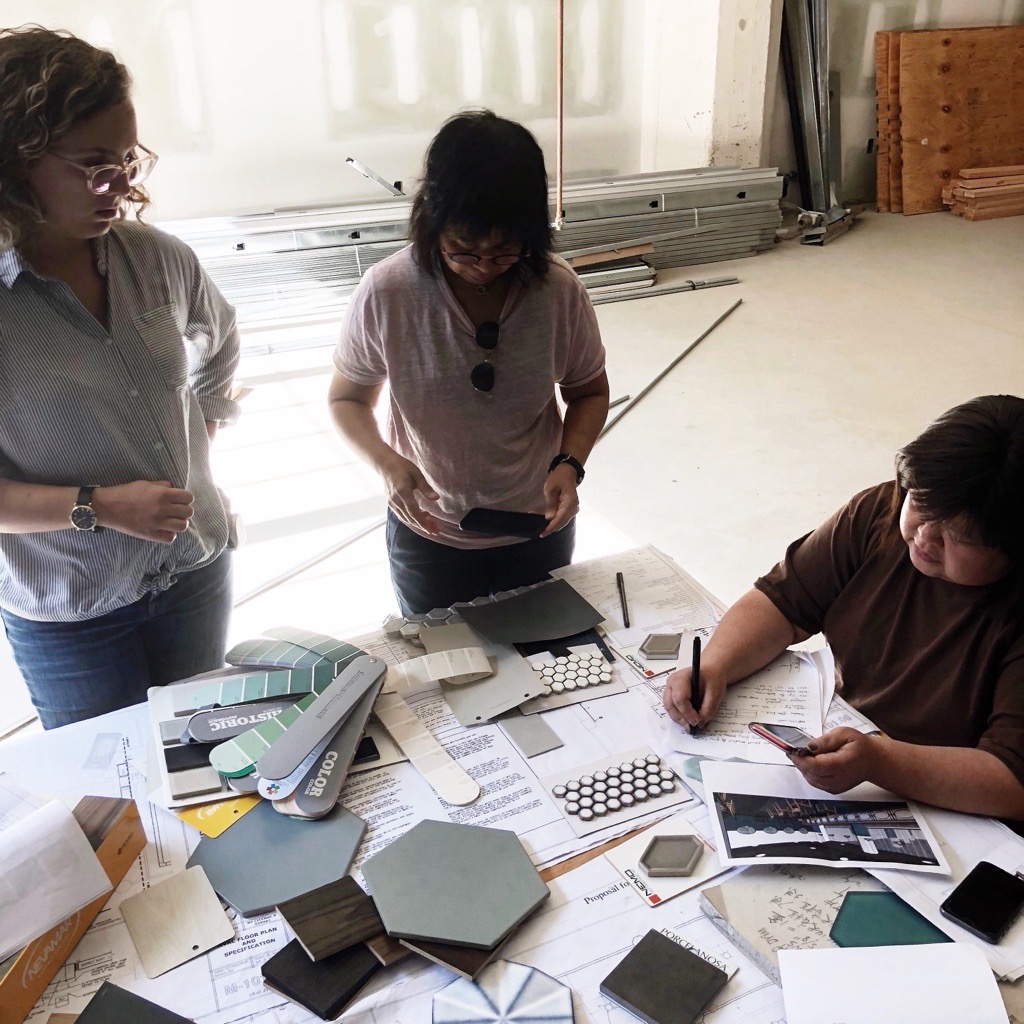
“Just like being asked in studio ‘Do you like it?’ simply asking a mentee ‘How do you feel?’ opens up the door to more conversations about what is going on in the full picture of their lives,” she said.
Those conversations have helped her recognize when someone preparing for professional exams needed a lighter workload to prevent burnout, or when a designer needed opportunities outside work to express their creativity.
She wants younger designers to have room to explore interests that make them feel fulfilled.
“I realized that goals don’t always have to be big or specific to your current job, they just need to be a target to get somewhere that makes you happier or more fulfilled,” she said.
