Lead is a neurotoxin, particularly dangerous to infants and children. In 2017, when tests revealed hazardous levels of the heavy metal in Newark’s water, the city raced to replace more than 18,000 lead service lines in record time.
While federal, state and city officials responded to the infrastructure crisis, grassroots activists created the Newark Water Coalition (NWC) to advocate for the community and offer resources.
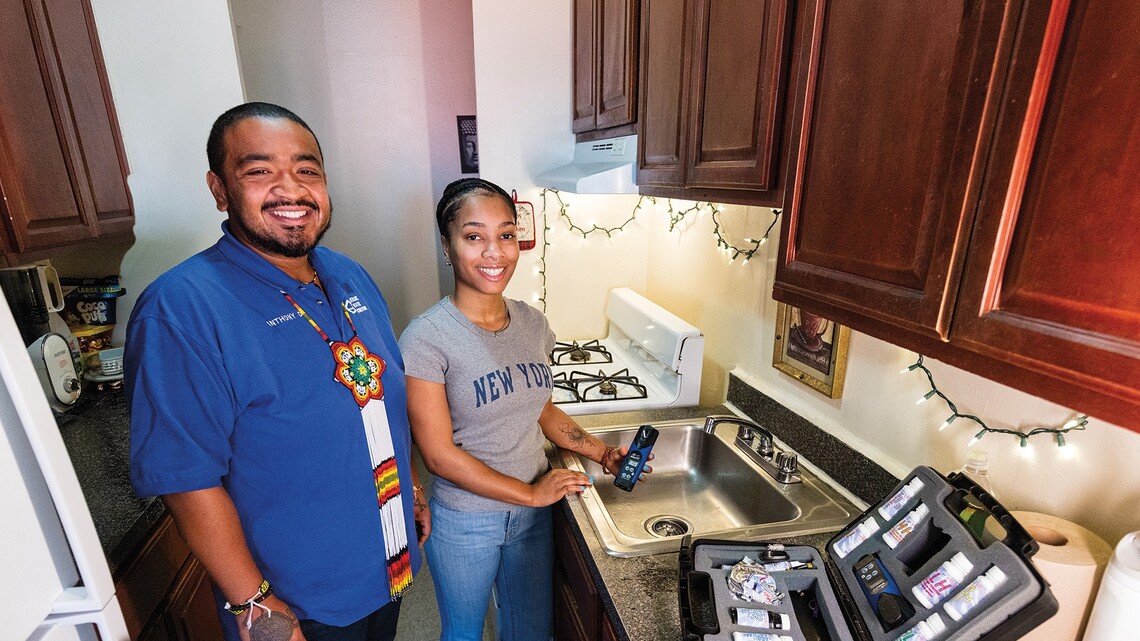
NWC has since distributed over 300,000 gallons of water and 500 filters, but co-founder and Executive Director Anthony Diaz, a lifelong Newark resident, also built a program that tests water in city homes. Working alongside a lead risk assessor, the coalition trains Newark high school students to test the water using a spectrophotometer. Residents “get peace of mind,” says Diaz. “They might have thought, ‘Hey, my water always tasted funny.’ But now they know.”
“We used to test only for lead,” explains Diaz. “Now we are testing for fluoride, chloride, chlorine and lead. Eventually we’ll test for PFAS as well. We have our own XRF [handheld X-ray fluorescence device] which also allows us to test for lead and paint in soil and consumer products.” Diaz says NWC is training other groups to do this work, as well as publishing scientific papers.
NJIT, through its Community-Data Equity AI Lab (Community-DEAL) is working with NWC to make its testing results readily available. The lab is part of NCE’s Clean and Safe Water Lab, forming a two-lab structure under a proposed Center for Clean Water at NJIT. Together, the Community-DEAL and water lab received about $1.5 million from NJIT.
NJIT Professor Neil Maher, an environmental historian working on the project, says that public agencies keep data on water quality, but it can be difficult to access. Alongside Maher, data scientist professor Aritra Dasgupta is developing an app that will take the NWC water data, geolocate it and make it more accessible for “people who are not familiar with often opaque scientific language.” Maher says the app will allow community members to use their phones to check the quality of water in their own neighborhood. The team plans on replicating this for future projects and is currently working with NJIT’s biology department to determine if a similar community data app could be developed to inventory tree planting by the city of Newark.
Through the Community-DEAL initiative, NJIT students are collaborating with the Newark high school students who work with NWC. In addition to helping distribute water, NJIT students are creating a traveling exhibit that can be brought to water NWC distribution sites, such as St. Stephen’s Church in Newark’s Ironbound neighborhood. The exhibit will explain the water problem in the city and how community residents are responding.
Jaila Adams ’27 was a high school student in Newark when a friend told her about the water coalition and she started going after school, helping to distribute water and food. By her junior year she was helping with in-home water testing.
“This one story — it hit home. We tested this one house and all of the people had lead poisoning and there were three or four kids. It was a lot. It rerouted how I want to go about my life,” she says, explaining that she enrolled at NJIT and decided to study civil engineering.
