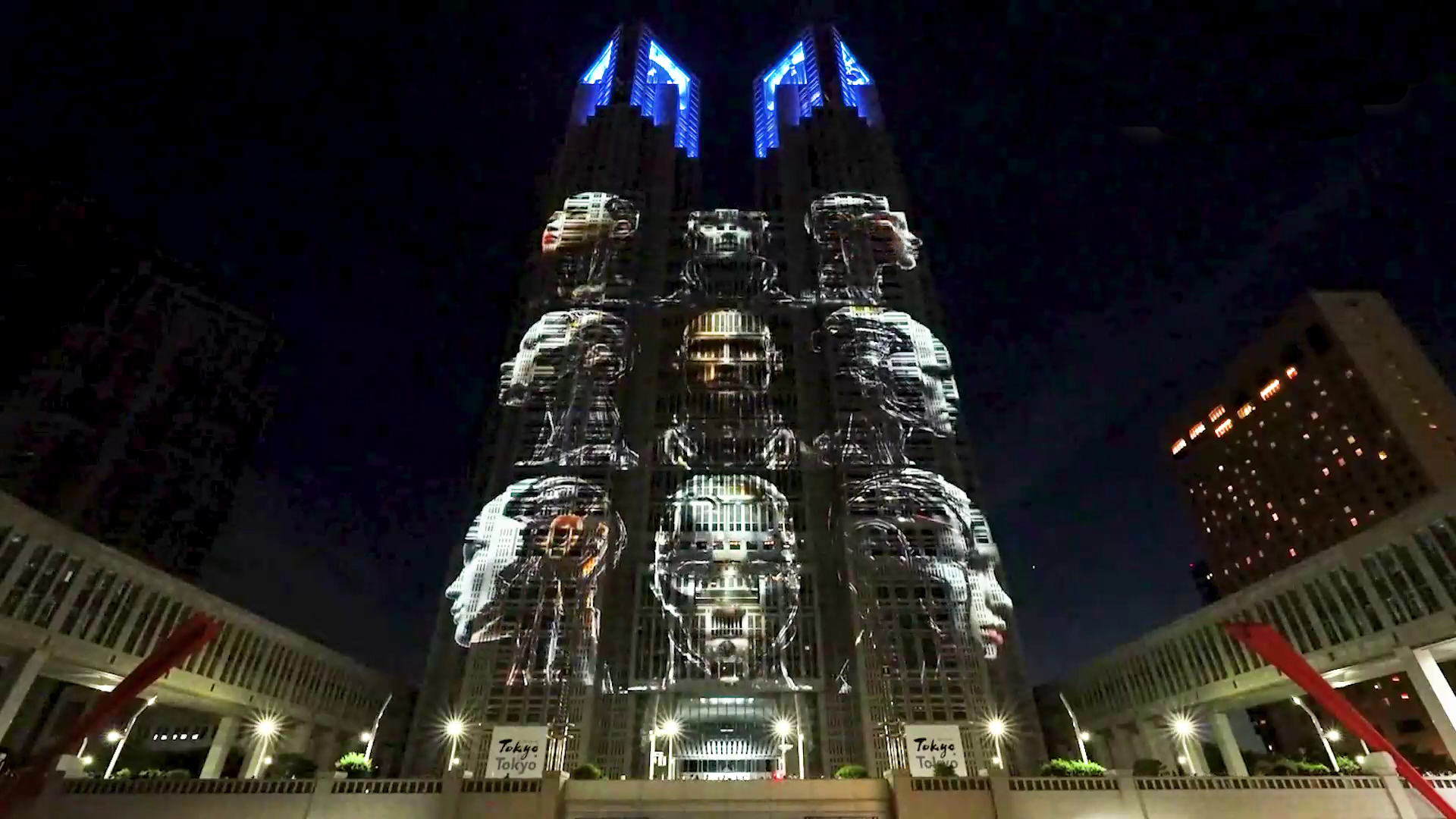
Taro Narahara’s work turned one of Tokyo’s most recognizable buildings into a public conversation between architecture, computation and light — and earned the NJIT associate professor international recognition.
Narahara, associate professor at the Hillier College of Architecture and Design, received the Audience Prize at the 13th 1minute Projection Mapping Competition in TOKYO LIGHTS 2026 for his work, Infinite Dialogue. The piece was projected onto the Tokyo Metropolitan Government Building No. 1 as one of 18 finalist works selected from 412 submissions from 65 countries and regions.
The 1minute Projection Mapping Competition, launched in 2012, is one of the world’s leading international platforms for projection mapping. The event brings together top creators, media production teams, and emerging artists exploring how moving images can transform buildings into public experiences. Narahara entered the competition as an individual artist and researcher rather than as part of a production company.
Image
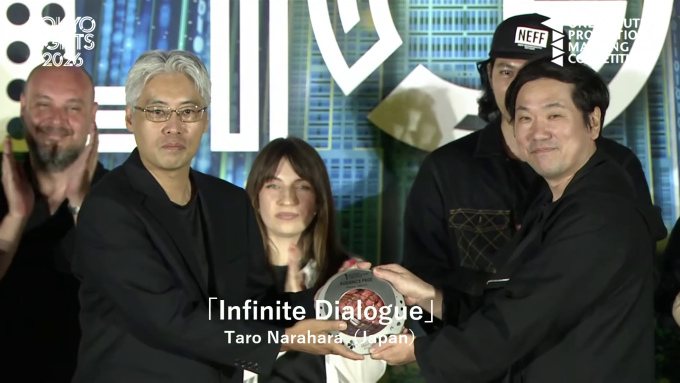
The Audience Prize was given to the finalist work that received the most votes from the public audience. Under the 2026 award process, the Audience Prize-winning work was treated as a separate public-vote category and was not part of the jury-selected ranking.
“Receiving the Audience Prize was especially meaningful to me because it came directly from the people who experienced the work on site in Tokyo,” said Narahara. “For me, this recognition represents a direct response from the public audience and from the city itself, where the work was temporarily projected onto one of Tokyo’s most visible civic landmarks.”
Watch the original video version of Infinite Dialogue.
For Narahara, whose work connects computational design, media art and architecture, the recognition places his research-driven practice in conversation with an international field of creators. Projection mapping uses light, animation, and digital design to transform buildings into moving visual experiences, allowing architecture to become part of the artwork rather than simply serving as a surface.
This year’s competition theme was “Dialogue,” a concept shaped by questions about communication, technology and distance in a world transformed by the pandemic and rapid technological change. Narahara’s Infinite Dialogue responded directly to that theme by imagining dialogue beyond human exchange.
“Infinite Dialogue explores how the idea of dialogue is changing in our time,” said Narahara. “Dialogue is no longer only between people across gender, race, or generations; it is increasingly expanding toward conversations with machines, AI, nonliving systems, and other forms of intelligence that are similar to us but fundamentally different. In the work, architecture becomes both a screen and a participant in this dialogue. Computation, image, sound, and light come together to transform the Tokyo Metropolitan Government Building into a temporary public interface between the physical and virtual worlds. The piece ultimately returns to nature, suggesting that even as our dialogues expand through technology, our relationship with the natural world remains fundamental.”
Narahara is an architect and media artist whose work explores the relationship between human intention, computation, architecture, and light. His recent creative work has also been presented and recognized internationally, including at the Bi-City Biennale of Urbanism/Architecture (UABB) in Shenzhen, the Architizer Vision Awards, and the ASAI AIP Competition. At NJIT, he teaches computational design and has led research in human-centered computational design, data-driven architectural design, and digital design education.
His previous work has also focused on artificial intelligence and machine learning as tools for architectural research, including floor plan analysis and flexible design tools for residential housing. His AI-based floor plan analysis and housing evaluation research has been published in IEEE Transactions on Multimedia and received the 2021 IDR User Forum Excellence Award from the National Institute of Informatics (NII) in Japan and the 2020 Human Communication Award from the Institute of Electronics, Information and Communication Engineers (IEICE). In 2022, Narahara served as principal investigator on an award from the NSF I-Corps National Teams program for the development of design tools for multifamily residential housing.
The Audience Prize adds another layer to that body of work, highlighting Narahara’s ability to bring architectural research into a public setting. Projection mapping requires creators to think about image, space and audience at the same time — concerns that increasingly shape how architects imagine the built environment.
By receiving public recognition in Tokyo, Narahara’s Infinite Dialogue showed how a building can become more than a landmark. For one minute, it became a medium for exchange.
