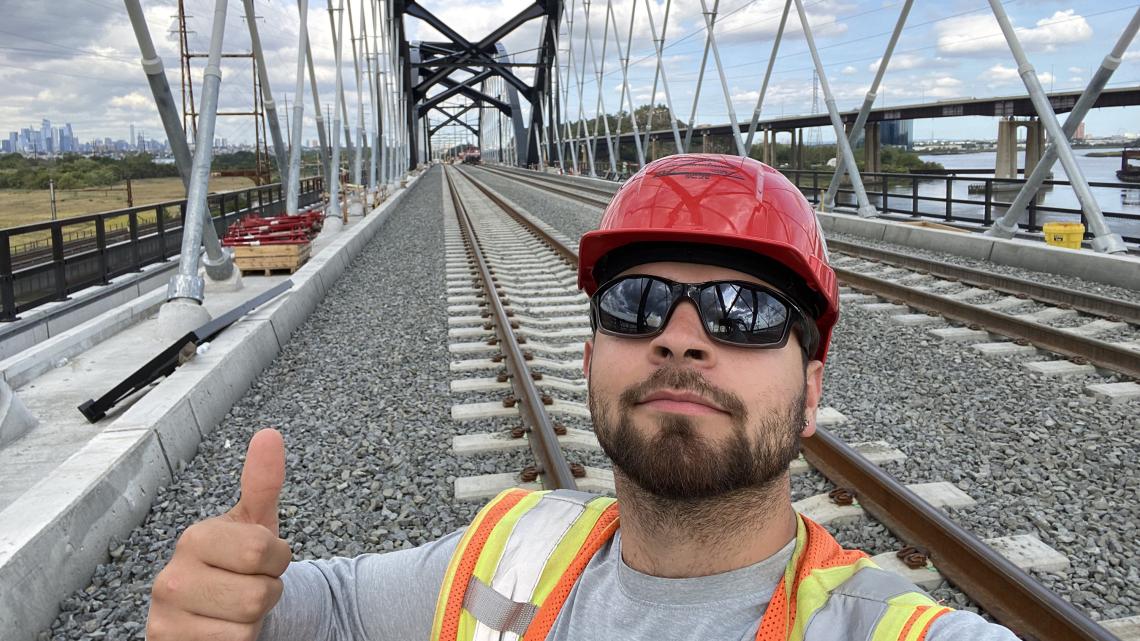
Attending New Jersey Institute of Technology set Enzo Suarez '25 on the right track: toward a career in railroads. Suarez graduated magna cum laude — a semester early — with a B.S. in Civil Engineering and multiple departmental honors, including the Freshman and Senior Excellence Awards from the John A. Reif, Jr. Department of Civil and Environmental Engineering. After graduation, he joined Railroad Construction Company (RCC) as a full-time field engineer.
"I work on the railroad — we install everything from the ballast to ties, and then finally the rail on top," Suarez says. "We take track out of service, improve its condition for riders, and then we put it back into service without anyone noticing."
At RCC, Suarez has contributed to critical infrastructure projects on the East Coast of the United States, such as the Portal North Bridge, a roughly $1 billion undertaking for Amtrak and New Jersey Transit, that replaced an existing bridge over the Hackensack River. He is now working on several station projects for the New York City Transit Authority, performing track maintenance and replacement.
"When I was in high school, I knew I wanted to have some kind of engineering focus," he recalls. Choosing civil engineering as his major at NJIT narrowed that focus, but still offered many possible career paths.
"There are so many different fields civil engineers can go into," Suarez says. "There are people who work in construction, transportation, structural, geotechnical and in water." Transportation engineering, with its ability to connect people and cities, appealed to Suarez, as did the sense of civic responsibility that accompanied that type of work.
"As a civil engineer, we're servants of the public," he says. "Once the project's done, commuters will have an easier time getting where they need to go — and should be happier."
Building versus designing
Suarez further sharpened his career focus with internships, realizing that he preferred working on sites to being behind a computer or drafting table in an office. A summer with design and construction firm Gannett Fleming (now GFT) in their rail and transit department pointed him toward railroad engineering and led to his current production role at RCC.
"I'm still doing railroad engineering," he says, "but now I'm the one building the work instead of designing it."
While at NJIT, being around other hardworking students — many of whom were juggling internships and part-time jobs along with their courses — inspired Suarez, and he found support among the advisors and faculty in the civil engineering department.
"There are so many great professors in the civil engineering department, and all of them contributed to helping me out," he says.
His efforts earned him an Educational Foundation Scholarship from the American Railway Engineering and Maintenance-of-Way Association (AREMA), and the Newark College of Engineering Outstanding Senior Award for the John A. Reif, Jr. Department of Civil and Environmental Engineering.
Suarez founded NJIT's AREMA student chapter and was its first president, building a valuable resource for students specializing in railway and transportation engineering. Prior to this, he also served as vice president of the American Society of Civil Engineers and was co-captain of the Student Steel Bridge Competition Team.
"Everybody at NJIT is very driven and motivated," he says. "You surround yourself with those types of people and you pick up those qualities."
In June 2025, Suarez passed the Fundamentals of Engineering Exam; he plans to take the next exam — Principals and Practices of Engineering — in 2026, and then intends to pursue a professional engineer license. Suarez expects to continue working on railroads as a contractor, with a goal of eventually working on accelerated railway lines such as those in California, Florida and the Northeast Corridor, and helping to bring true high-speed rail systems to the U.S.
Another long-term dream is to teach engineering at the university level after earning his professional licensure, a master's degree, and accumulating a portfolio of work experience. In that way, Suarez adds, he can give back to the academic community that helped him find early career satisfaction and success.
"I would love to be in a position to contribute to the next generation's education and learning," he says.
