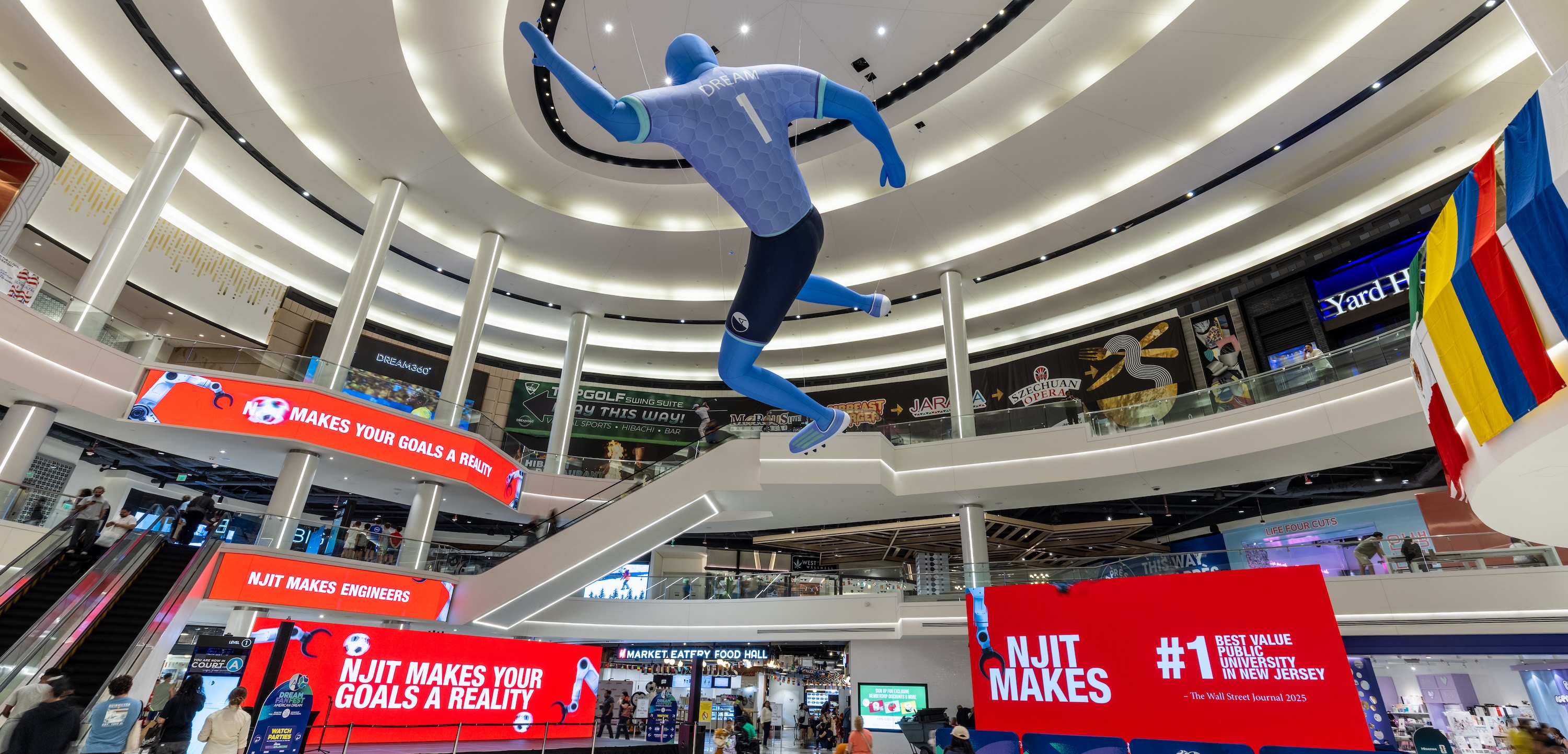
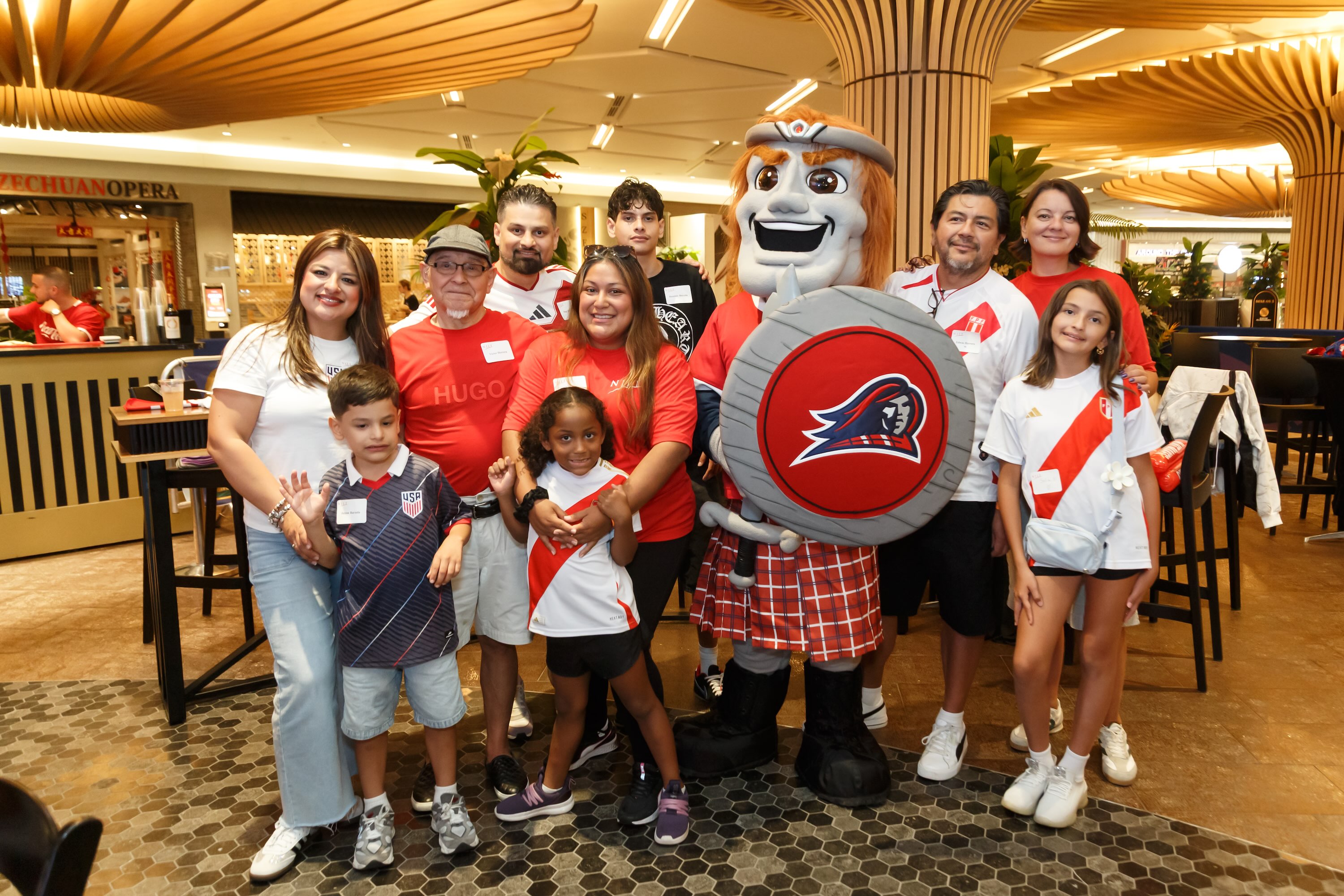
As Norway and England met in a World Cup quarterfinal Saturday, NJIT alumni, families and friends gathered in a reserved VIP space at La Plaza de Fútbol inside American Dream, experiencing the energy of a tournament that turned New Jersey into a global destination.
The gathering brought together 150+ alumni and friends across generations, many accompanied by family members, as they watched the match from a space surrounded by the sights and sounds of the tournament.
“I’m meeting so many alumni and hearing their stories and journeys,” said Elisa Charters ’92, ’93, co-vice chair of the Board of Trustees. “They’re excited to be here, and they feel very much a part of the NJIT family — la familia. They’re enjoying this watch party together.”
For Charters, the gathering also reflected how effectively NJIT had positioned itself within the region’s World Cup experience.
“It’s a 39-day extravaganza of soccer, with people from around the world here at American Dream,” she said. “And NJIT is front and center.”
The gathering was one component of a broader NJIT response to the World Cup’s arrival in the region. Across the university, students and faculty studied how fans would move through the region, built tools to understand and support the visitor experience, and designed ways for communities to create their own gathering spaces. At the same time, NJIT used the tournament’s extraordinary visibility to burnish the university’s brand among fans, commuters and visitors across transit systems, media platforms and to American Dream.
Planning for the crowds
Long before Saturday’s watch party, NJIT researchers were working on one of the tournament’s most immediate regional challenges: moving enormous numbers of people through the already congested transportation network surrounding MetLife Stadium.
Students and faculty worked with the New Jersey Department of Transportation to produce a detailed World Cup transportation study through the eighth annual Transportation Technology Tournament, a national competition that gives student teams opportunities to work directly with public agencies on real mobility and safety problems using intelligent transportation systems and transportation systems management and operations strategies.
Focusing on Route 3 and the surrounding Meadowlands network, the NJIT team analyzed travel demand, roadway conditions and the pressures created by major events. Its proposed strategy combined real-time park-and-ride information, transit operations that could adjust shuttle service based on demand and intermittent bus lanes that could temporarily prioritize buses during peak periods.
To better understand how a major event reshapes local traffic, the researchers examined conditions surrounding Taylor Swift’s 2023 MetLife Stadium concerts as a reference point for travel demand on Routes 3, 17 and 120. The work later drew interest from reporters covering regional World Cup preparations.
From fan sentiment to a regional guide
Other NJIT students approached the tournament from the perspective of the fans themselves.
Students and faculty in the Martin Tuchman School of Management first developed a real-time sentiment platform to analyze online conversations surrounding the World Cup, tracking topics, geographic patterns and changes in fan reaction with a focus on the New York-New Jersey region.
That work later grew into the NJ Fan Go Guide, a public-facing resource developed through collaboration between NJIT students and CGI. The guide brought together events and fan zones, dining options, watch-party listings, local happenings and live traffic and transportation information, while carrying forward the sentiment tools that helped launch the effort.
CGI Vice President Douglas Vargo and colleagues from the firm’s AI Forward team volunteered their time and mentored students across areas including user-experience design and AI-enabled tool development. The resulting guide gave students hands-on experience at the intersection of business, technology and analytics while creating a practical resource for people navigating World Cup activity across the region.
By the quarterfinal weekend, approximately 2,000 people had visited the public-facing platform, according to Oya Tukel, dean of NJIT’s Martin Tuchman School of Management. Tukel said the data collected from social media consistently showed that approximately 70% of the online conversation surrounding the tournament was positive, reflecting satisfaction with the matches, transportation and the region’s hospitality.
The findings also gave NJIT an opportunity to share real-time feedback directly with tournament organizers.
“We emailed the New York/New Jersey Host Committee to tell them they were doing a good job because the feedback was positive,” said Tukel. “That’s the power of technology. Without having to interview people individually, we can gather social media data, analyze it and put it on a dashboard to show how fans are feeling. This is what we do at NJIT.”
Designing places to gather
At NJIT’s Hillier College of Architecture and Design, students considered a different question: What could the World Cup experience look like for people who never entered the stadium?
In a special studio led by Gernot Riether, chair of NJIT’s New Jersey School of Architecture, students developed concepts for turning streets, parks and plazas into inclusive fan zones. Supported by a North Jersey Transportation Planning Authority grant, the work produced a reusable “kit of parts” that included collapsible tents, soccer-inspired furniture, interactive games and other adaptable elements intended to help municipalities and business districts create flexible, lower-cost gathering spaces.
Image
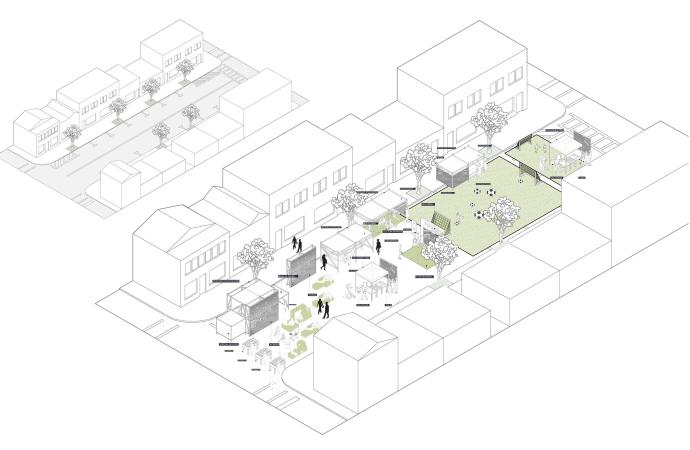
Students presented the concepts to NJTPA’s Regional Transportation Advisory Committee, with the work positioned to inform broader guidance and technical assistance for communities seeking to take part in the tournament atmosphere.
Making the most of a global spotlight
NJIT’s World Cup presence also extended beyond classrooms, studios and project teams. With international visitors and regional audiences focused on New Jersey, the university mounted a broad campaign across the places fans and commuters were already moving.
NJIT was one of only three advertisers featured on official World Cup shuttle buses, with exterior wraps and interior placements reaching tournament visitors. When not carrying World Cup passengers, the buses operated on regular NJ TRANSIT routes across Essex, Hudson and Bergen counties, extending the campaign beyond match days.
The university also established a wide regional presence across NJ TRANSIT and PATH, including high-visibility placements at Exchange Place in Jersey City, where the campaign included interior and exterior print and digital advertising, a static billboard with 100% share of voice and an in-station video billboard. NJIT extended that effort through digital and social media, Bloomberg Live Radio, Audacy streaming and podcasts, and sports and traffic sponsorships on 1010 WINS and WFAN.
NJIT’s Martin Tuchman School of Management added World Cup-oriented advertising across the New York and Philadelphia markets, including streaming audio and podcast spots featuring Tiki Barber live reads during his radio program.
At American Dream, NJIT appeared across kiosks and 11 video displays and maintained a presence at La Plaza de Fútbol, where Saturday’s quarterfinal gathering brought the university community into the middle of the tournament atmosphere.
“NJIT has done a phenomenal job using the World Cup’s global platform as an opportunity to showcase the university,” said Charters. “It’s not only reaching local residents attending these watch parties, but people coming from across the country and around the world.”
Charters pointed to the campaign’s reach across several of the region’s most heavily traveled locations.
“The university has advertising in Jersey City, at the PATH station, on NJ TRANSIT buses and now here at American Dream, which has become a fan zone during these 39 days,” she said. “NJIT is front and center.”
In total, the campaign reached tens of millions of potential students, supporters and partners.
“There are a lot of new relationships being established because of this global event,” she said. “Corporations are taking note and connecting with NJIT, and people in general want to know more about the university.”
For NJIT, the watch party marked one more expression of a World Cup that reached far beyond the field — and a rare global moment the university met through applied problem-solving, public engagement and a highly-visible presence across its own region and beyond.
