
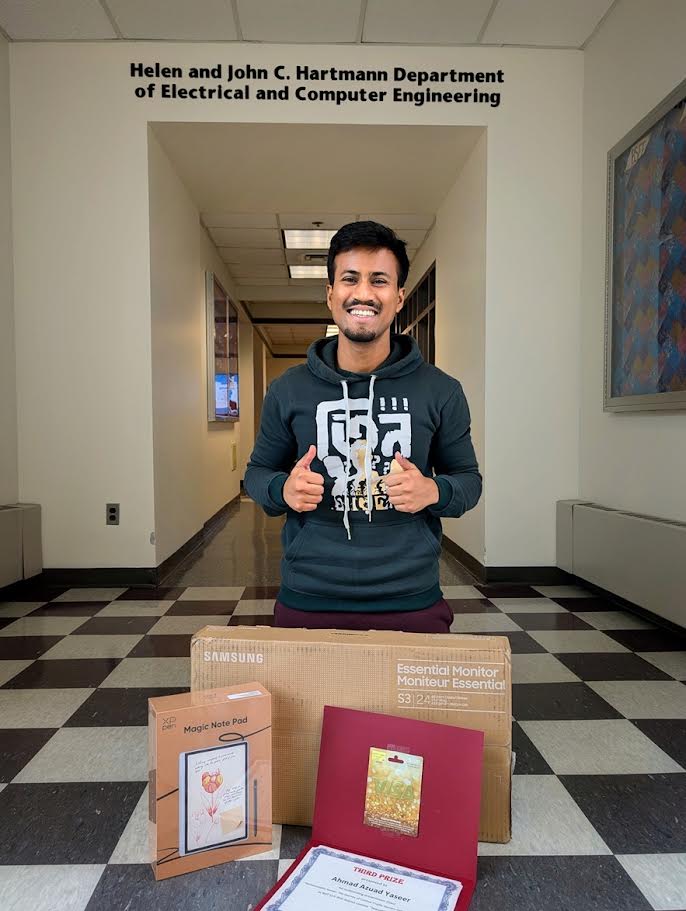
Ahmad Azuad Yaseer is a second-year Ph.D. student in the Helen and John C. Hartmann Department of Electrical and Computer Engineering, where he is advised by Dr. Dong-Kyun Ko. His research focuses on the development of field-effect-gated lead selenide colloidal quantum dot (PbSe CQD)-based photodiode devices for retinomorphic sensing applications, with the goal of advancing next-generation neuromorphic vision technologies. His work explores novel sensing approaches that can contribute to more efficient and adaptive vision systems.
Outside of academics, he is actively involved in the graduate student community and currently serves as the Secretary of the Bangladeshi Graduate Students Association (BGSA). He enjoys reading, watching anime, singing Tagore songs, exploring new places, and photography. When not working on research, he’s usually discovering a new destination, visiting museums or historic sites, enjoying natural landscapes, or capturing memorable experiences through photography. These experiences allow him to embrace lifelong learning, cultivate creativity, and develop a deeper appreciation for different cultures and perspectives.
What would you say that could be the next big thing in your area of research?
The integration of retinomorphic sensing with in-sensor computing, which enables vision systems to process information immediately where it is sensed rather than depending on separate processors, is, in my opinion, the next significant advancement in my discipline. By imitating the human retina, future vision sensors will go beyond conventional image capture and be able to selectively process crucial visual information while consuming less power and data. Faster, more effective, and highly adaptive sensing platforms that can function across several spectral ranges, including infrared, may be made possible by the combination of neuromorphic architectures with cutting-edge materials. These developments are anticipated to have a revolutionary impact on robotics, healthcare, autonomous systems, environmental monitoring, and next-generation AI.
You have experience in sensor design and fabrication. Right now, tactile sensing for dexterous robot hands is becoming the hottest topics in robotics. What type of sensors would you say have the biggest potential for robot hands?
From my perspective, flexible multimodal tactile sensors that can replicate human skin's sensing capabilities are the sensors with the most promise for dexterous robot hands. While vision and proprioception help robots understand their surroundings and their own motion, tactile sensing provides the missing capability of physical interaction, allowing robots to detect slip events, temperature, texture, vibration, pressure, and force with high spatial and temporal resolution. Because of their versatility, sensitivity, and potential for low-power operation, flexible sensors based on improved semiconductor materials, nanomaterials, and neuromorphic architectures hold great promise among new technologies. These sensors may make it possible for robots to sense and react to their environment more organically when combined with edge computing and artificial intelligence, enhancing their capacity to carry out challenging manipulation tasks.
AI has shown impressive capabilities for finding new materials and designs, which are quite related to your area of study. How do you see the potential of using AI in your own research?
AI holds tremendous promises for accelerating the development of advanced materials, photodiodes, and sensor technologies by enabling quicker discovery, optimization, and a more comprehensive understanding of complex systems. Within semiconductor research, AI-driven techniques can assist in predicting effective combinations of materials, optimizing synthesis and fabrication processes, and elucidating the connections between material properties and photodiode performance. Moreover, for photodetectors and sensing devices that utilize quantum dots, AI could aid in the customization of material composition, surface chemistry, and device architectures to achieve greater sensitivity, faster response times, and enhanced energy efficiency. Furthermore, the integration of AI with simulations and the analysis of experimental data could lead to a more efficient research workflow, reducing development time and facilitating the discovery of next-generation sensing technologies.
