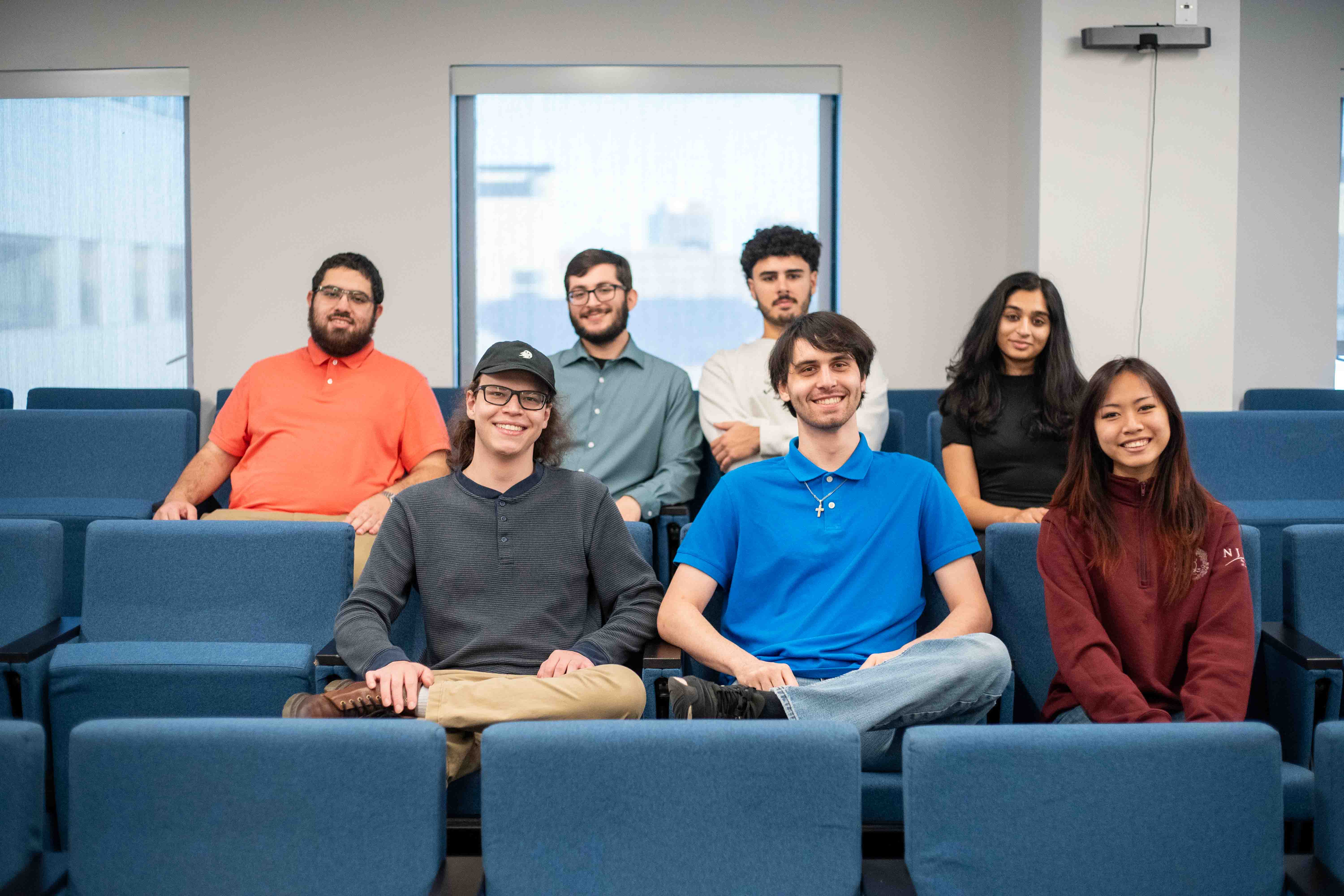
The NJIT Secure Computing Initiative (SCI) has graduated 50 students since its inception as part of the pre-existing CyberCorps® Scholarship-for-Service (SFS) program, funded through a grant from the National Science Foundation (NSF). In return for competitive scholarship awards, which include full tuition, education-related fee coverage, academic stipends, professional training allowances and dedicated career development, students are required to fulfill service to the U.S. Government for each year of scholarship received. NJIT boasts a 100% placement rate for graduates in cybersecurity-related positions with agencies including, but not limited to, the FBI, DHS, CIA, and NSA.
As of fall 2026, the program has been re-designed and is now offered as the CyberAICorps® SFS program, which prepares its scholars to address emerging cybersecurity challenges in the rapidly advancing AI-enabled digital and technology ecosystem. NJIT is just one of only 14 colleges nationwide, and the only one in New Jersey, with the distinction of being accepted into the new elite program.
According to the NSF, “Funded projects aim to prepare students not only to leverage AI to strengthen cybersecurity operations, including threat detection, incident response and digital forensics, but also develop AI systems that are resilient, secure and capable of withstanding evolving cyber threats.”
“I’m really happy we got [the award] because it was highly competitive,” said computer science department chairman Vincent Oria. “It’s not like a renewal. It is a new program, and I’m happy that we were among the first cohort.”
Scholarship recipients will complete the program in three years, combining their senior year and two years of master’s level work, or two years exclusively as master’s students. Graduates will earn either an M.S. in Cybersecurity and Privacy or an M.S. in IT Administration and Security.
The Ying Wu College of Computing (YWCC) at NJIT is proud to welcome the new 2026 cohort, which this year includes Sana Anwar, Noureldin Elhelw, Joseph Juchniewicz, Joseph Kane and Carlin Verano, who will each earn an M.S. in Cybersecurity and Privacy, and Jesse Gonnerman and Hirad Sharifian, who will graduate with an M.S. in IT Administration and Security.
NJIT was only officially awarded the grant during late summer 2026, so Oria along with fellow professors Cristian Borcea, Reza Curtmola and Ali Mili, the four principal investigators who oversee the program, had to work quickly to fast-track recruiting new students in order to build the fall 2026 cohort on time.
The new SFS cohort launched just in time for Sharifian and Kane, class of 2026, to begin the master’s portion of the program after graduating in May.
Sharifian remarked, “I had applied and was accepted into the original SFS program previously but was unable to attend at the time, so when I heard about the new program, I was excited to have another opportunity!”
Kane followed, “I had just finished software engineering as an undergrad, and then I’m contacted on August 4th. In three weeks, I applied, interviewed and was accepted. I’m religious, so this was definitely a blessing from God!”
All in the cohort agreed that different background experiences and similar goals are what make their particular group unique and exciting.
Gonnerman is a dual citizen of the U.S. and Brazil, and the latter country is where his interest in cybersecurity first grew. His father had a career as a programmer and now works as a project manager. Sharifian is an immigrant from a Persian background, which played a substantial role in shaping who he is. He was also a former NCAA Division One swimmer on NJIT’s swimming and diving team as well as an EMT. These experiences helped him develop skills in communication, responsibility and staying composed under pressure. Elhelw is of Egyptian origin.
“Looking back, I think my immigrant background, combined with my experiences in athletics, public service, and technology, have shaped the way I approach challenges and opportunities. I’m excited to bring those perspectives into the CyberAI program and eventually into my career in federal service,” Sharifian said.
Juchniewicz noted that he was home-schooled, having graduated 8th grade at 12 years old, and that going to high school early made him feel slightly out of place because “everyone was older.” As with many people, while usually confident in his ability to accomplish what he sets out to do, a case of imposter syndrome briefly presented itself, and his doubt about being a final candidate for the program became a shared experience with several of his peers.
Even though Gonnerman could boast a résumé that included serving on the executive board of the Cybersecurity Network, working in the student-run NJIT Highlander Watch Security Operations Center (SOC), and leading JerseyCTF VII in 2027 (a cybersecurity capture-the-flag competition that is one of the largest in the North Atlantic Region), he felt he wasn’t “interesting” enough for the program. He also observed that some of his friends were not offered interviews despite being fellow NJIT leaders.
Juchniewicz, meanwhile, was certain that the program would only recruit “seven Jesses” given his peer’s impressive credentials.
Verano, a past participant in CyberStart America and CyberPatriots in high school, as well as an e-board member of WiCS (Women in Computing Society) ( part of a team that delivered GirlHacks 2026, one of the best of many annual hackathons in recent years), told her parents to lower their expectations because her own were low.
Anwar, Verano’s fellow student in Computer Science Honors, Class of 2028, thought she had a “10% chance” of being offered a spot. However, deep down, she was optimistic. She had taken some graduate courses, managed leadership roles in other clubs and events, and was confident that “[the PIs] knew that I would give my best.”
What the candidates did not realize during their interviews was that beyond academic excellence (which all possessed), their overall goals and objectives along with strength in character were being evaluated as well. Having a background in cybersecurity is not even weighted very heavily – but certainly doesn’t hurt, of course.
They all share a strong desire to be in service to the country and others. And protecting our infrastructure extends to what some people take for granted every day.
Anwar has a particular interest in combining her financial knowledge with technology. “We are depending on AI now to accelerate our work, but there are still security challenges that need to be addressed – especially in the financial sector. This is something I really want to explore and affect positively.”
Varano followed this by stating that she wanted to engineer systems that not only worked but worked securely, with a focus on using her skills for “public good.”
Juchniewicz had interned at the Ocean Country Prosecutors Office, and this experience drew him into wanting to have “a more tangible effect on people through seeing the human experience up close.” He added that his love of service began as an Eagle Scout, a distinction he shares with Kane.
“We are two Eagle Scouts named Joseph from Jackson [NJ]!” said Kane with a laugh.
Elhelw then encapsulated what each fellow cohort member was thinking and feeling in the end: “After the interview, my life plan could literally change. I would probably get accepted because I had good cybersecurity experience. But I was still kind of worried. Days later, I saw the acceptance email on my phone. At that point, I thought to myself, ‘Wow. My life really IS going to change from here on!’”
Find out more about becoming a CyberAICorps® SFS scholar: https://sci.njit.edu/scholarship
