The Verizon 5G Smart Competition Presented a Challenge to Students. NJIT Had Solutions.
Emerging partner Verizon Communications, Inc., has an interest in what NJIT, the largest polytechnic university in New Jersey with R1 status (highest level of research), can do to take their technology farther and faster than ever before.
While several current projects are being conducted by faculty, Ph.D. candidates and administration, the company decided to challenge the institution’s undergraduate students with devising innovative ways to make their campus and the world around them a better place using 5G technology. The three teams with the most inspired solutions would win $3,000 each and present their final projects to Verizon senior leadership at the company’s corporate headquarters in Basking Ridge, NJ.
NJIT was one of four schools in the country, along with Rutgers, Northeastern, and the University of Texas at Dallas, to be invited to demonstrate how their students put real-world learning into practice.
The Verizon Smart Campus Competition began on October 9 with 198 NJIT students from all six colleges registering and 33 teams created to introduce their idea in a two-minute video, the genre of which could be anything from straightforward to whimsical.
Round two on February 12 had 15 teams presenting posters and prototypes for everything from campus safety, room availability and networking apps to food re-distribution services around the city of Newark. Along the way, majors in computing, engineering, biology, financial technology, communications and media, industrial design, and business were guided by Verizon advisors and faculty mentors from each of the colleges.
This phase also put the participants’ pitch skills to the test, with each member of the team, dressed in their best interview attire, delivering a portion of the presentation. The judges, comprised of Verizon industry leaders, posed difficult questions, posited suggestions for improvement and provided encouragement for further developing their concepts.
Seven remaining teams each received a $500 stipend and entered the final round on March fifth. Months of dedicated work were demonstrated in a series of superlative presentations that left Verizon and NJIT administration judges astounded and made the prospect of choosing just three winners an almost impossible task.
The difficult decisions were made, and three teams reached the finish line – but every student who participated was a winner in the end, with Verizon and NJIT representatives praising the level of creativity, ingenuity, and maturity of students who are wise beyond their years.
Congratulations to the winners:
Decibel: Anirudh Krishna Ramkumar (data science), Srinesh Selvaraj (computer science), Parth Kabaria (computer science), Yash Parlikar (math sciences), Darren Bonifacio (electrical engineering), Vikaas Dindigal (chemical engineering)
Highlanders 4 Highlanders: Ada Wong (computer science), Emilie Inzinna-Enriquez (computer science), Mia Karpowicz (materials engineering)
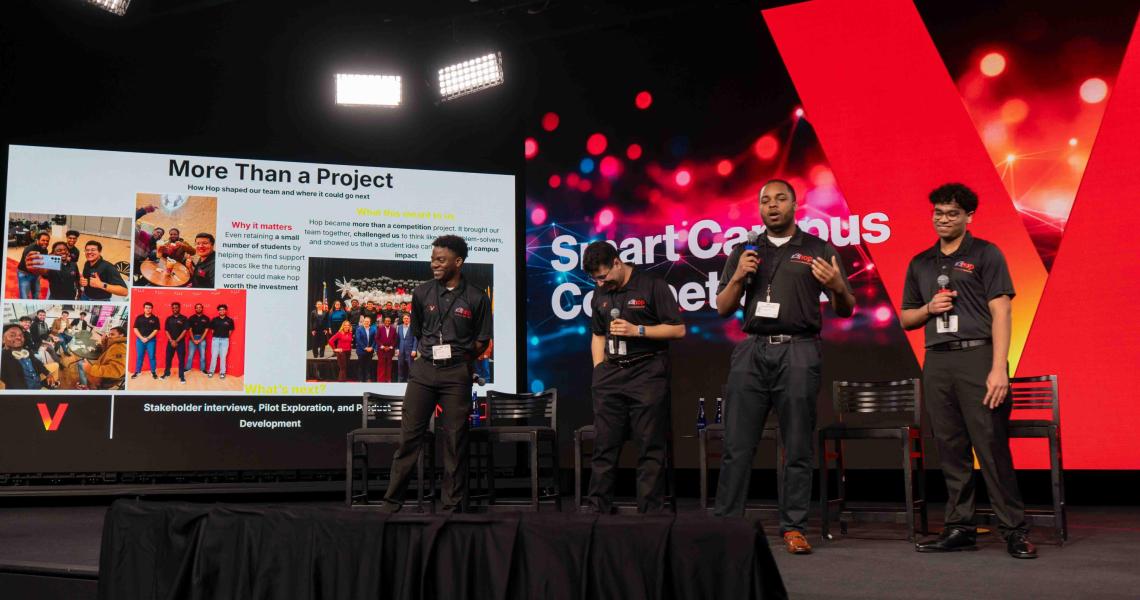
HOP: Ray Sama (industrial design), Ishaan Manoj (industrial design), Muhammad Musa (financial technology), Christopher Lamothe (financial technology), Saad Salman (mechanical engineering), Abhin Gandhi (mechanical engineering)
One of the overarching objectives for Verizon as well as NJIT was to foster experiential learning in an environment that measured critical thinking, creativity, teamwork, and the skill in providing real-world, salient solutions through technology that will give students a leading edge in future careers.
The final phase of the competition had the three teams showcasing their projects before Verizon senior leadership at the corporation’s headquarters in Basking Ridge, NJ.
Suzanne Schnaars, associate director for technical project management at Verizon, who also served as lead coordinator for the competition and is the NJIT liaison for partnerships, said, “This engaging project work benefits all of us,” noting that over 600 students and 150 cross functional teams took part within the four participating schools.
“The work we do with NJIT has exceeded expectations,” she continued.
Verizon Senior Vice President Mike Haberman observed, “These students learn a lot of valuable lessons, in presenting, creativity, team building… This is just like the real world, and the energy and passion they put out is inspiring to all of us.”
He pointed to the fact that the company’s volunteer mentors and judges take part “just because they want to.” When they’re asked why, they respond that the experience is invigorating and allows them to learn along with the students.
Sharon Kelly, NJIT executive director for information security & chief information security officer, infrastructure & security, who was part of a post-presentation panel, echoed Haberman’s sentiment when she stated that “[Students] are light years ahead in learning and understanding. [They] help our knowledge. Experiential learning bridges gaps everywhere.”
She also noted that the Verizon 5G technology partnership is a good fit for the university and “took our old technology and brought it forward.”
Reflections from the Students
Decibel: (An application that utilizes motion and volume sensors to detect current activity in common areas, such as study rooms, resident hall lounges, computer labs, etc.)
“I loved being able to deliver a tech idea in a digestible way. It helped us to speak at a technical level.” – Yash Parlikar
“NJIT has really helped me in learning how to build what we did [with Decibel].” – Anirudh Krishna Ramkumar
Highlanders 4 Highlanders: (An application for class-based group chats, study sessions, and AI moderated discussion boards.)
“While conforming to NJIT’s code of conduct, we were able to explore ways to support safety, develop a sense of belonging for people seeking friends, and provide a way to form academic discussions outside of class.” – Emilie Inzinna-Enriquez
HOP: (An application/website to provide students and visitors with a reliable and efficient way to navigate the campus and locate desired locations, such as rooms, offices, student life facilities, etc.)
“We surveyed pain points from students and parents at NJIT and Rutgers to inform what they needed most in a navigation tool. Working on a team helped us learn how to embrace other opinions and handle issues. Our shared passion is what brought us together and made us closer. We realized we were stronger as a whole. Two former members had to leave the team, so adapting and taking on added responsibility was also a challenge we benefitted from.” – Ray Sama
Christopher Lamothe added, “This was more than a competition. It was an exercise in creating something as a team that really challenged us and helped us grow, not only as technicians but as people.”
NJIT is also currently working on several other partnership projects with Verizon, including developing big data analytics and machine learning methods to improve operational efficiency on the company’s cloud platform under the direction of Professor Chase Wu, associate chair in the Department of Data Science, and a research and implementation framework designed to help Verizon enhance customer retention. Verizon is also working with the university on incorporating a computer vision / artificially intelligent software and hardware-based solution to enhance security cameras using 5G technology.