For Students in NJIT Library Hackathon, There are Maps to the Stacks
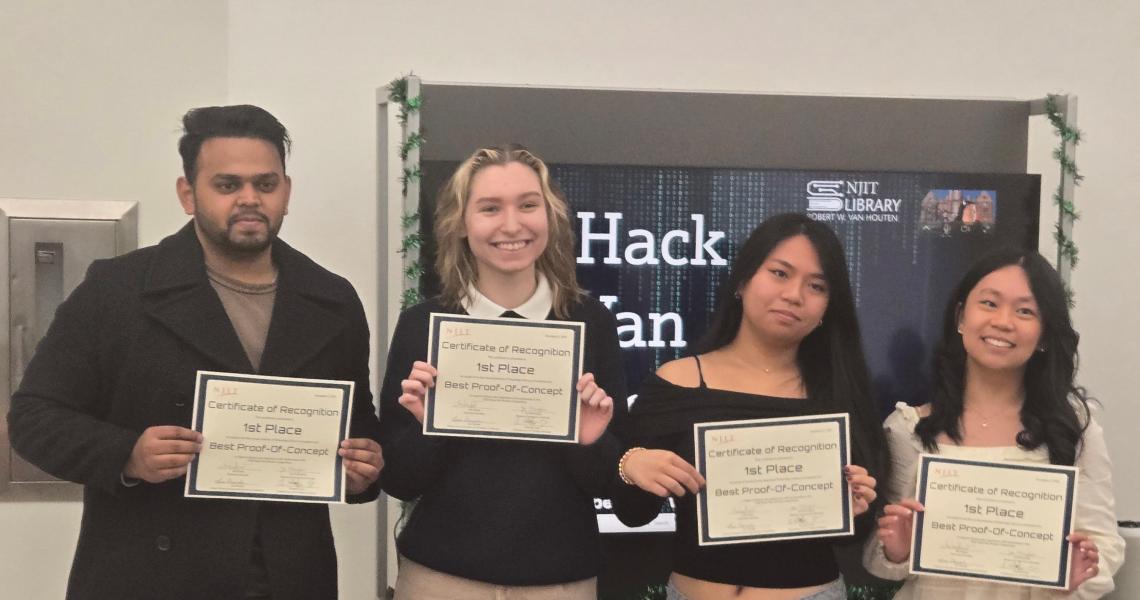
“Where do I find…” is the preponderant question from visitors to New Jersey Institute of Technology’s Van Houten Library — distributed across four levels and 56,000 square feet — so the library staff held a hackathon to find a better solution than just traditional signs.
The winning team, announced Dec. 5, proposed an online, interactive wayfinding application to help visitors locate rooms and resources. Team members were Aayush Chitransh, Emily Koscielniak, Hannah Repuyan and Haylie Repuyan — Chitransh is a doctoral student in engineering science, and his teammates are all undergraduates majoring in human-computer interaction — calling themselves AEH2.
“Two years ago my colleague Luci Parrish and I attended a talk by NYU librarians about their event, Hack Dibner, and we knew immediately we wanted to bring this to NJIT. A library hackathon delivered over the course of a semester rather than all in one day felt like a perfect opportunity to bring students into the library and get them to critically engage with our space,” explained Zoë Mooneyhan, a research librarian focusing on emerging technologies.
Unlike most hackathons during a single weekend, Hack Van Houten lasted all semester. Teams honed their ideas with recurring feedback meetings from library employees.
“As an international student, I felt when I came in the library, it had many things but I was not sure where to go,” Chitransh said. His team developed a prototype application that resides solely on the library website, so no download is required. Users scan a QR code in the library, which would send their location upstream. The application would respond with turn-by-turn directions to your destination, whether it’s a specific aisle in the stacks, a meeting room or a special collection.
The application also has a search feature which could use artificial intelligence and be trained on existing library data. Other hackathon teams proposed a similar feature.
“I like that AEH2's project gives library users a central, mobile friendly application that puts library navigation in the palm of their hands. They were also the only team to choose a digital poster style presentation, which added a specific air of scholarship to their work, but then their hand-drawn wireframes added back a touch of the human in the design,” Mooneyhan added.
“I hope they take this idea and run with it. Wayfinding or library navigation is not just a Van Houten or NJIT problem. There are services or applications that currently exist, but I think their project has a unique perspective that serves them well if they wanted to pursue this as a viable product. I am hoping they help shape the next iteration of Hack Van Houten as well. As participants and winners of the first iteration, they have insight that can help us make this a better competition for the next round.
“The first step is just sitting down with them, talking through their proposal in finer detail, and seeing what is feasible for the library to implement short term and long term. The library does not currently have a mobile app, but potentially we could enhance our existing website to incorporate some of their wayfinding solutions.
Mooneyhan and the hackathon judges were impressed by all four of the finalist teams. “The finished projects blew me away with the amount of time, effort and care each team put into their concepts. Not just the product itself either, but the level of research they did and their ability to field questions from the judges in a professional manner that spoke to their expertise,” she stated.
“One thing that surprised me was how many teams completed their own surveys. I think those that conducted surveys used them to strengthen their proposal, but we didn't require them … The fact that they took it upon themselves to develop their own questions, distribute them, analyze and visualize the responses, felt above and beyond my expectations.”
She intends to make the hackathon annual, with new themes each year based on feedback from library user surveys.