Search-and-Rescue Startup is Three Highlanders and a Robot
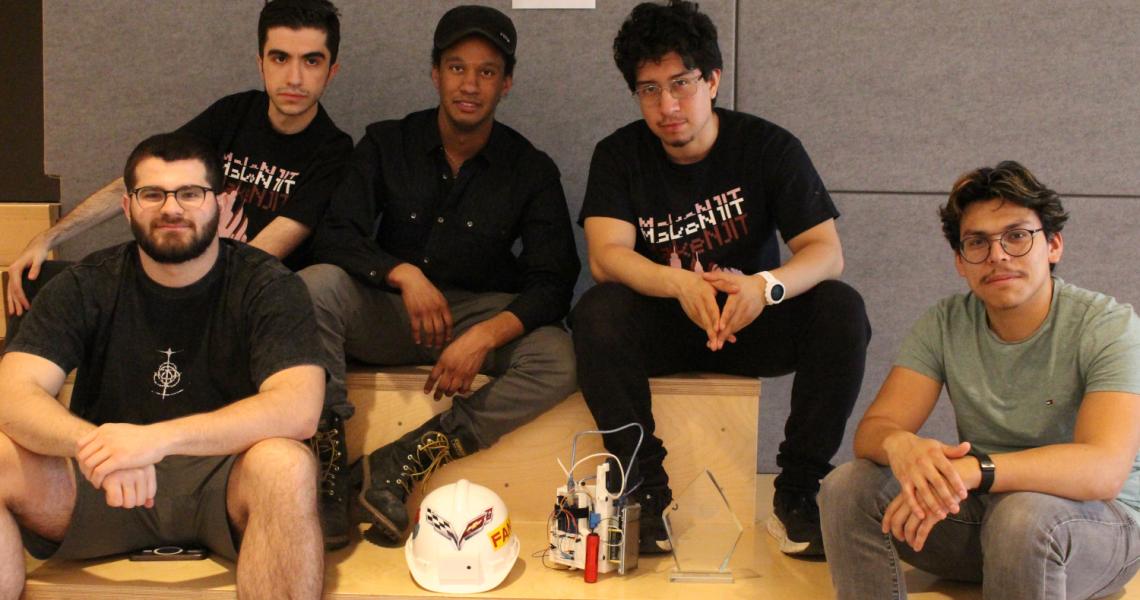
Childhood friends from Bergen County — two seniors and an alumnus — are jointly forming a startup company, MechSense Labs, to apply what they’ve learned at New Jersey Institute of Technology in designing emergency rescue equipment.
MechSense’s first invention is a robotic rover called NodeRover, employing artificial intelligence to make its own decisions and ad-hoc wireless mesh networking to stay in touch, especially in dangerous situations or hard-to-reach locations that are too risky for human responders.
Kevin Navarro graduates this month with a general engineering degree. Cristian Garcia, studying electrical and computer engineering technology, plans to finish in 2027. Hamdi Korreshi received his B.S. in computer science in May 2025, and now works full-time as an associate solutions architect at Phenom People, an HR software company, while maintaining a strong interest in entrepreneurship.
“The three of us have been venturing into creating a company for years. We have always had a focus on giving assistance to people through advancements in technology,” Garcia explained. “While the previous projects had fallen through, we kept researching and realized that there is a void still present in search-and-rescue technology where we could bring our experience and creativity to make something impactful.”
The trio is moving methodically toward their goal of running their own company. Navarro, serving as their leader, signed them up for NJIT’s Innovation Corps Propelus program where they learned from in-house experts like Associate Prof. Michael Ehrlich and Research Prof. Kathy Naasz, both in the university’s Martin Tuchman School of Management. Naasz is also director of NJIT’s Center for Student Entrepreneurship, and she advises the student Entrepreneurs Society, of which Garcia is incoming vice president.
“They displayed ingenuity, innovation and agility with how they changed the project idea regarding customer needs. Throughout the span of the program, they completed around 30 interviews with different industry experts, potential customers, suppliers, competitors, and faculty,” Ehrlich stated. “Cristian and Kevin have been regular attendees at the Center for Student Entrepreneurship … They have brought enthusiasm and an eagerness to apply learning to their startup,” particularly in preparing for business model competitions and pitch preparation, Naasz added.
The group gained additional collaboration skills by entering the 2026 edition of the MakeNJIT hardware hackathon, along with freshman electrical engineering major Ferit Altay and senior mechanical engineering technology student William Otto. They were the top NJIT finishers at the event, second overall, among several dozen teams. Their project was called Emergency Sensor Gauntlet, an arm-mounted device that wirelessly sends vital signs — those of the wearer, or of the people the wearer is assisting — back to colleagues in a safe location. It also senses fire, humidity and temperature.
Navarro said he learned to let people run with their expertise and to keep things in scope by developing viable products, not just inserting every possible feature. By finishing second overall in the hackathon, “We got a total of $1,000, but most importantly, we gained the ability to work together on a project that we feel very proud of. The money is great, but the money was not the reason we entered.”
This summer, rather than take traditional jobs or internships, Navarro and Garcia are moving to Ithaca, N.Y. from after Memorial Day until the end of July, where they’ll work on their concepts at the RevIthaca hardware accelerator program. Korreshi will continue helping out remotely. “Teams are led through a process for determining if their ideas are commercially desirable, technologically viable and economically feasible,” RevIthaca’s website states. Teams are guided through feasibility, proof-of-concept, prototyping/pitching and demonstration phases.
Navarro said his dream job would be working for Boston Dynamics, the robotics company known for its Atlas and Spot robots that mimic human and canine abilities. Regardless of where he winds up, he noted three Highlander mentors — Makerspace Manager Adrian Olmeda, Associate Prof. Laramie Potts and Assistant Prof. Petras Swissler. Garcia’s mentors are Potts and University Lecturer Christian Hansis, while Korreshi cited Assistant Prof. Martin Kellogg.
“If you want to be a good engineer, you have to be a good communicator,” Navarro said. “No engineering project is led by just one man.”