Rupak Bhakta - ECE PhD Student of the Month - October 2025
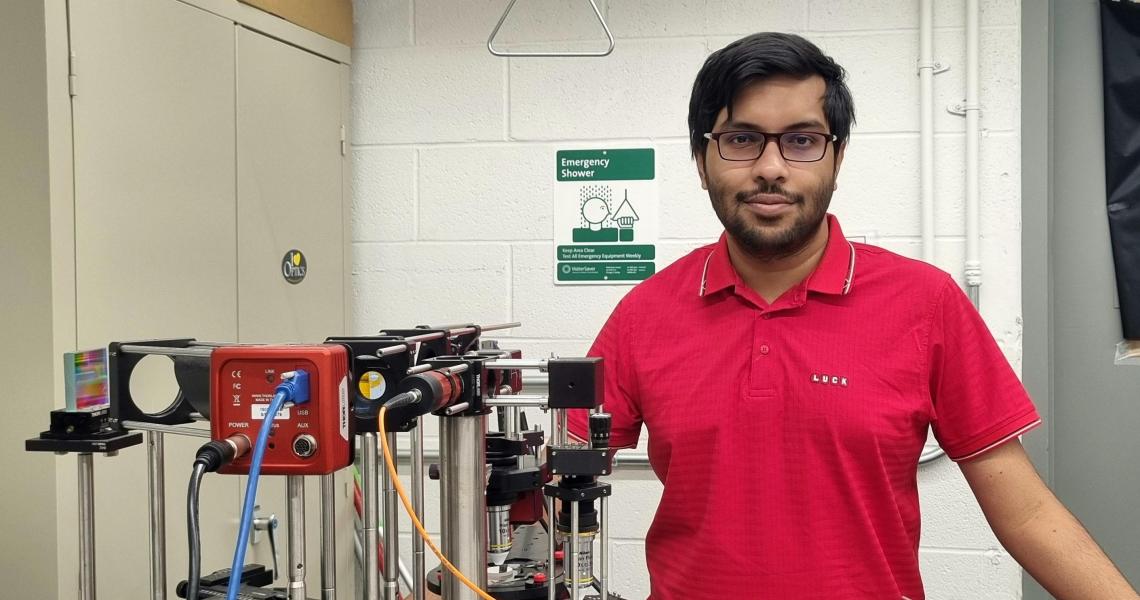
Rupak Bhakta is a second-year Ph.D. student in Electrical and Computer Engineering, working in the Biophotonics Imaging and Sensing Lab with Xuan Liu. His research focuses on deploying advanced interferometric imaging techniques that enable label-free visualization of cellular and nanoparticle dynamics with nanometer-scale sensitivity. Besides research, he enjoys spending time playing video games or watching movies.
What would you say that could be the next big thing in your area of research?
My research involves optical microscopy with the aim of understanding cell-nanoparticle interaction dynamics which is central to developing and optimizing nanoparticle-based drug delivery systems. I believe that the next big breakthrough in this field will come from the combination of artificial intelligence with optical microscopy to enable real-time, nanometer scale observation of dynamic biological processes without fluorescent labeling. With computational optics combined with deep learning and quantitative phase imaging, it will be possible to achieve accurate tracking of intracellular movements, interactions of nanoparticles with cells, as well as biological properties with superior resolution and velocities — ultimately paving the way for breakthroughs in diagnostics and targeted drug delivery.
Optics has been a particular area in ECE. How do you say it is related to other areas in ECE such as communication, computing, power and energy, and so on?
Many people are often surprised to discover that optics goes far beyond lenses and mirrors, as it is closely intertwined with many other areas. It is widely used in sensors, signal processing, and computing, enabling fast, precise and non-contact measurement techniques. It also forms the foundation of fiber-optic communication, allowing high-speed data transfer. Optics further depends on electronics and control systems for modulation, detection, and automation. Optics also has applications in renewable energy technologies such as solar cells.
You started your Ph.D. study as a teaching assistant, which is always a challenge to international students. What advice would you like to share to make it easier for other new students?
As an international student, it can indeed be daunting to handle the first teaching assistantship duties. My advice to the new students is not to be nervous about the classes. Prepare well and never hesitate to ask for guidance from the faculty. If you are doing something new, such as grading, it is a good idea to grade a few samples first and share them with the faculty to ensure everything is on the right track. I would also advise them to maintain a balance between research and teaching, as being overly involved in something other than your own research can sometimes become counterproductive.