Robot Swarms on the Moon: NJIT Student's Concept Wins $10K From NASA
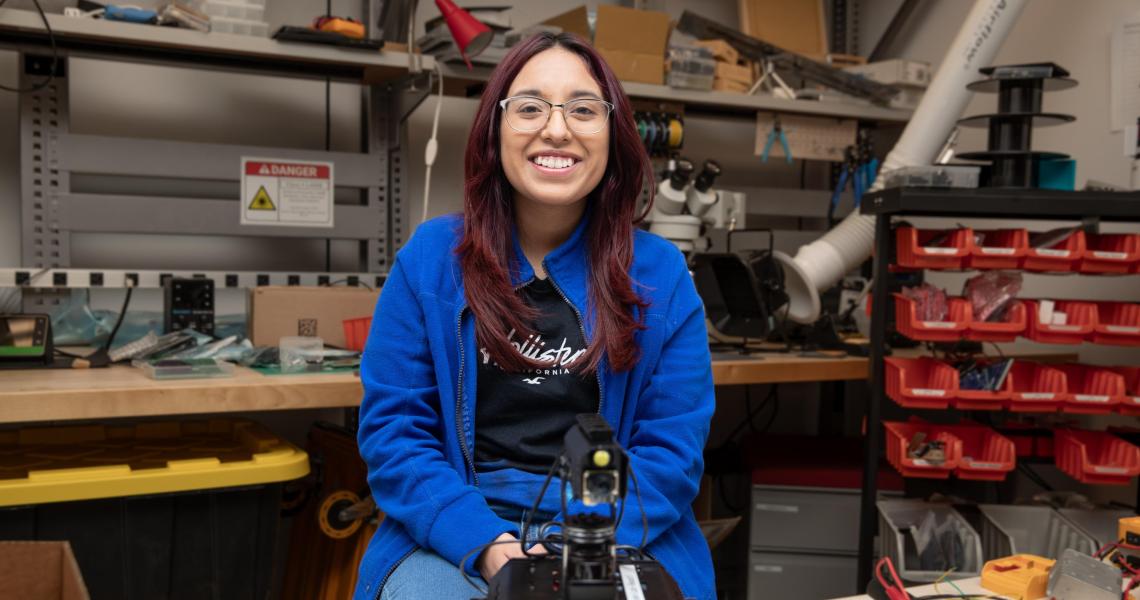
An NJIT student's proposal for robot swarms that can build and service a moon base has won first place at a NASA competition. Led by Tatiana Mejia '27, the winning team received a $10,000 grant to develop a prototype.
Mejia, a mechanical engineering major at NJIT's Newark College of Engineering, is the project's principal investigator. Together with a group of students from universities across the northeastern U.S., Mejia presented the robotic swarm concept at the NASA Proposal Writing and Evaluation Experience (NPWEE) in the fall of 2025. Part of NASA's Lucy Student Pipeline Accelerator and Competency Enabler initiative, or L'SPACE, NPWEE introduces undergraduate and graduate students to mission planning and proposal development for aerospace projects.
Since L'SPACE launched in 2018, more than 15,000 students from institutions of higher learning have participated in its programs. With guidance from industry professionals, participants form teams and pitch projects that address research gaps and priorities for upcoming NASA missions. Students evaluate each other's submissions, learning to assess proposals as well as develop them.
A unified smart system
Mejia's winning proposal described a swarm with two types of robots operating together "as a unified smart system," she says.
One type of robot will focus on maintenance and construction, with a design that draws inspiration from Mars rovers such as Curiosity and Perseverance (though at a much smaller scale). Its rugged chassis is equipped with onboard sensors, actuators and a robotic arm that can operate a variety of tools. Built for mobility and precision, these robots would transport cargo and assemble, install and repair infrastructure.
The second class of robots will be prism-shaped and self-assembling, able to function independently or collectively by following algorithms that coordinate movement. By docking in groups, these robots can form temporary ramps, bridges or other structures to help rovers navigate uneven terrain and access hard-to-reach areas.
"They're going to have different types of algorithms that will allow each agent to autonomously bid on and claim tasks based on their proximity, available energy and capability," Mejia explains. Designing robots to be autonomous means that if one fails, the rest can continue their work. As mission requirements change, the robots can adapt and reconfigure to meet those needs as a cooperative system.
The team's idea, titled "Lunar and Planetary Servicing Swarm Robots," originated with Mejia; the 10-person group selected and developed it from competing proposals, then submitted it for judging. NASA experts picked two winners from about 40 proposals, says Mejia, who learned about the win on an L'SPACE video call that she attended from NJIT's Makerspace.
When Mejia's team was announced, "I think they heard me scream," she says. "I saw the slide, I saw our team's name and team number, and I started yelling in the Makerspace. Thank god I wasn't in the library."
More robots, more productivity
Mejia became interested in aerospace tech through her high school's U.S. Air Force Junior ROTC program, and she learned about robot swarms at NJIT's Swissler Innovative Robotics Lab (IRL), which she joined in 2023. Run by Petras Swissler, an NJIT assistant professor of mechanical and industrial engineering, IRL designs and develops robots that can work together to tackle complex tasks that are beyond the capabilities of robots working alone.
For example, says Swissler, an algorithm could direct a swarm of vacuuming robots to clean a large area more efficiently. Some robots could be "explorers," finding the dirtiest corners, while other robots focus on cleaning. In a swarm, even worn or damaged robots can still be useful; if a robot's vacuuming power is weak, perhaps that robot can instead empty its neighbors' waste buckets.
"You don't need every single robot to do every single thing," Swissler says. "It is enough for a given system to help another system be more efficient."
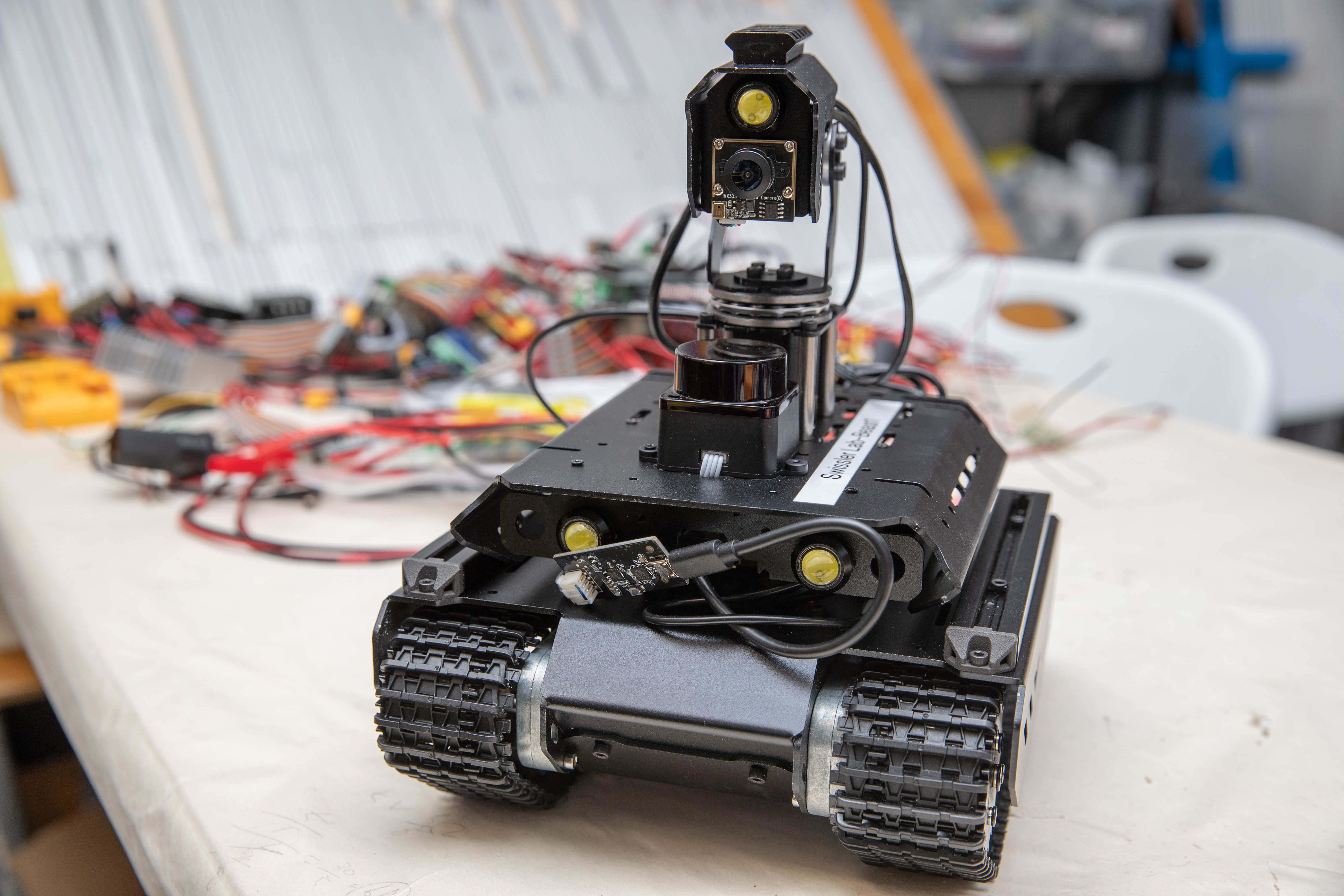
Swarm robots can also link together to create new shapes and structures. In simulations inspired by swarming behavior in fire ants, Swissler's FireAnt3D robots connected to form chains, bridges and towers. And the more robots you have, the more they can accomplish.
"Doubling the number of robots more than doubles the amount of productivity you're able to get from them," Swissler says. "That's really the core premise of swarm robotics: that working together enables efficient, effective scaling for these systems."
In September 2025, NJIT was awarded a $5 million National Science Foundation grant to develop autonomous, self-assembling robot swarms for cleanup and infrastructure repair after natural disasters. The same principles that make robot swarms useful for disaster recovery can also be applied to work in hazardous environments on the moon or on other planets, Swissler says. He provided guidance for Mejia during the proposal writing stage, and IRL will support the team as they develop their robot prototypes.
I wanted to focus on the technology
At IRL, Mejia's introduction to swarm robots sparked the idea that she brought to L'SPACE. With planning already underway at NASA and other space agencies for multiple moon missions, robot swarms offered a promising solution for supporting the first wave of people who would one day live and work on the moon.
As the L'SPACE project's PI, Mejia leads a multidisciplinary team of more than 25 members. She oversees systems architecture, computer-aided design (CAD), swarm algorithm development, prototyping and testing, and manages the project's $10,000 budget and 12-month schedule. Mejia will coordinate work assignments across all L'SPACE team members, who hail from Florida Polytechnic University, Florida State University, Georgia Institute of Technology, Harvard University, North Carolina State University, New York University, Purdue University and the University of North Carolina at Chapel Hill. She also aims to recruit help from engineering students at NJIT.
As the project progresses, Mejia is looking forward to expanding her own knowledge of practical engineering applications through the design and manufacturing process, by creating something new from start to finish to address a real-world need.
"I think of this project as a chance for me to learn hands-on engineering," she says. "You figure out the problems you want to solve, then you try to make a solution."