Optimizing Rain Gardens in a Flood-Prone City
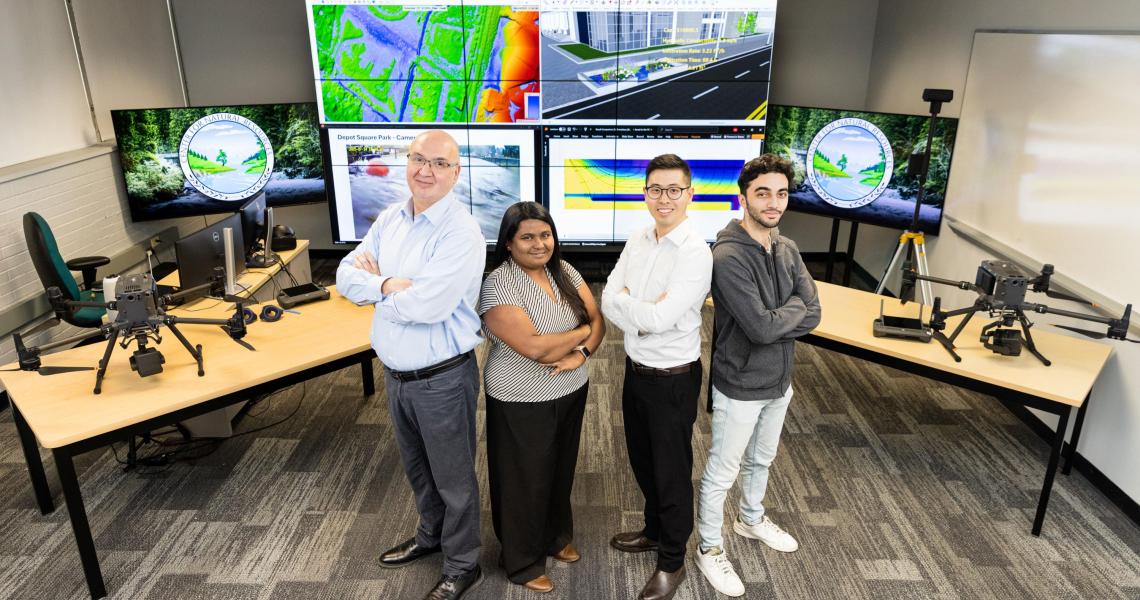
With nearly $1 million in state funding, NJIT’s Center for Natural Resources (CNR) is leading a team of engineers, modelers and construction designers who are developing rain gardens in public areas of flood-prone Paterson, N.J., such as parks, schools and community centers.
The city’s many combined stormwater and sewage systems struggle to manage increasingly frequent, powerful rainstorms, as well as flooding from the Passaic River, which snakes through its commercial and residential neighborhoods. Contaminated water spills onto city streets and into the river when they overflow.
“Rain gardens include plants with a higher capacity to absorb water and layers beneath that are designed to retain and filter it, such as a top layer of mulch, and under that, the bio-retention media of sand, silt and clay,” explained Meghana Parameswarappa Jayalakshmamma, a postdoctoral researcher at CNR and a member of the team.
“Our plan is to reduce flooding and prevent pollutants from reaching the city’s residents, its groundwater and its waterways, where outlet pipes drain,” she added.
The rain gardens will include a novel mulch developed at Stevens Institute of Technology that is engineered to absorb more pollutants than regular varieties. The NJIT team will monitor the gardens’ overall effectiveness in removing common stormwater contaminants, such as phosphorus, nitrogen, metals and particles of organic and inorganic matter, by collecting samples from the water flowing into and out of the garden and by analyzing the mulch.
In addition to Stevens, CNR is working with partners at Rutgers Cooperative Extension’s Water Resources Program, The Nature Conservancy and city officials. The team expects to break ground in early 2027.
Before the project begins, CNR is conducting simulations that will help them locate and design the gardens. Using drones with LiDAR, the team is surveying the city’s topography to create a comprehensive ground profile, including elevations and gradients. Plugging that data into their software program, they will be able to predict in granular detail how fast water will move in a given spot, in what direction and how much will accumulate.
The team also plans to correct a significant design flaw that limits rain gardens’ effectiveness. Water typically enters these systems at a single point and fails to spread across the soil surface, leading to localized pollutant overloading near the inlet. This prevents the bioretention media from effectively filtering pollutants before they enter the groundwater or discharge to water bodies. Plants in underutilized areas of the garden often die from dehydration.
“We plan to re-engineer how water flows into these systems by virtually optimizing and testing new designs, such as distribution channels, to ensure water reaches all of the plants before we break ground,” said Viravid Na Nagara, a postdoctoral researcher at CNR.
Michel Boufadel, the center’s director, noted the rise in frequent, inundating rainfall.
“Nuisance rain events are now increasingly intense over shorter durations. Places that used to see an inch of rain per hour are now seeing that amount in half the time,” said Boufadel, a distinguished professor of environmental engineering. “The water collection system can’t handle it; this erodes quality of life for residents, profits for businesses and access for emergency response vehicles.”
Boufadel is part of a couple of New Jersey teams focused on reducing climate impacts on municipalities throughout the state by installing green infrastructure, such as rain gardens and green porous pavement, that will moderate flooding and the urban heat island effect.