For NJIT’s Master’s and Doctoral Class of 2026, a Charge to Adapt, Persist and Lead
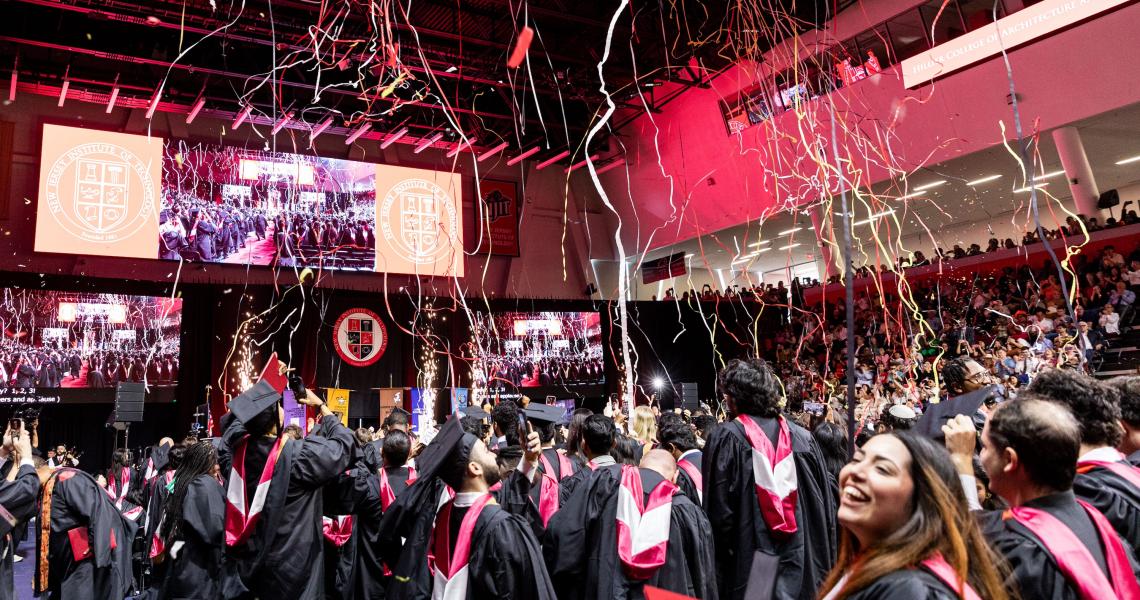
NJIT celebrated its master’s and doctoral graduates in two commencement ceremonies that joined academic tradition with messages about resilience, uncertainty, knowledge and the responsibility to use advanced education in service of others.
The ceremonies, held May 20 at NJIT’s Bloom Wellness and Events Center, recognized master’s degree candidates in the morning and doctoral candidates in the afternoon. Together, they marked a milestone for graduates across NJIT’s colleges and schools, while reflecting the university’s applied research mission and its growing network of alumni leaders.
Provost John Pelesko opened the master’s ceremony by welcoming graduates from the Newark College of Engineering, J. Robert and Barbara A. Hillier College of Architecture and Design, Jordan Hu College of Science and Liberal Arts, Martin Tuchman School of Management and Ying Wu College of Computing.
Pelesko, himself a 1997 alumnus of NJIT as the very first Ph.D. graduate in mathematical sciences, praised the faculty that had helped students reach the milestone through “valuable classroom instruction” and by contributing to their intellectual growth “in labs, in the field, and in the community.”
A master’s message about uncertainty and adaptation
The master’s ceremony featured commencement speaker Jordan Hu ’89, founder and CEO of RiskVal Financial Solutions, a fintech firm he founded in 2001 after a career on Wall Street that included vice president roles at Salomon Brothers, Goldman Sachs and Citigroup.
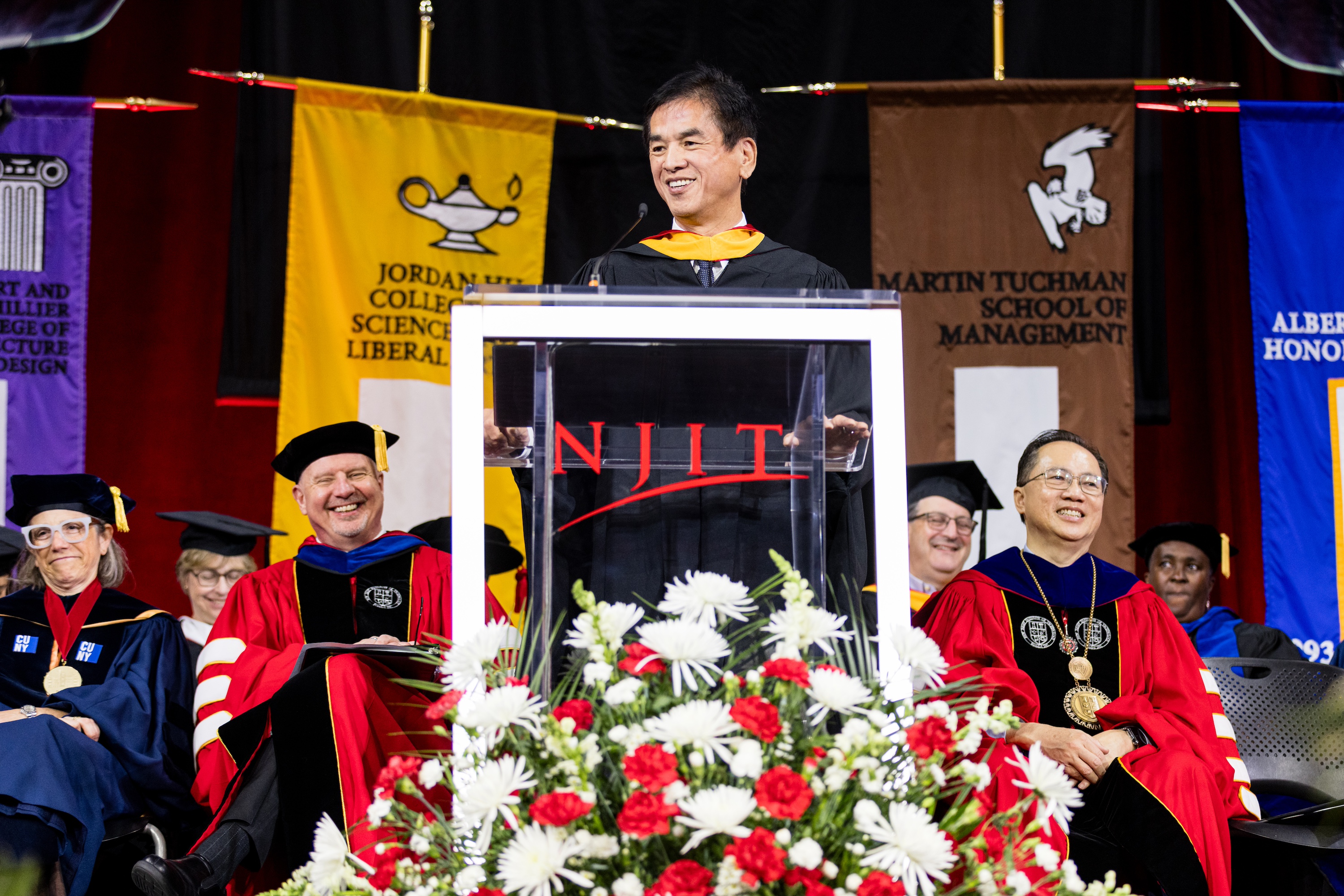
Jordan Hu '89 with Provost John Pelesko (left) and President Teik Lim (right)
Hu, who earned his master’s in computer science from NJIT, returned to a theme that has shaped much of his life: learning how to walk into uncertainty.
He recalled arriving from Taiwan in 1987 with a one-way ticket, limited English and his family’s hopes on his shoulders. NJIT, he told graduates, became his first home in the United States — a place that gave him not only an education, but the confidence to solve problems he had never seen before.
That lesson carried into his career. After joining Salomon Brothers, Hu worked on technology modernization at a time when firms were still learning how to use the internet to change business. Later, after his team was shut down in 1998, he chose not to search for another job. He started a company — with no formal experience between him and his wife. They embraced the uncertainty and challenge of building a company while raising a family.
“What this degree has given you isn't just knowledge — it's proof that you can learn, adapt, and figure things out when the path isn’t clear,” Hu told graduates. “This is exactly what you need to face the various uncertainties of your future.
“You will change something. For yourself. For the people around you. For a world that needs what you have to offer. I have no doubt about that. “
Hu’s message also built on his recent return to campus for a fireside chat with President Teik C. Lim, where he spoke about entrepreneurship, preparation, trust in leadership and giving back to NJIT. Hu, benefactor of the Jordan Hu College of Science and Liberal Arts, has continued to mentor students, faculty and staff, and has described NJIT as the place where his American dream began.
“So do the work. Stay curious,” Hu told the Class of 2026. “And when disruption comes — and it will — ask yourself what it’s opening up, not just what it’s taking away.”
Provost Pelesko then initiated the conferring of master’s degrees by welcoming Adam Shain, a 2007 graduate of NCE and a member of NJIT’s Board of Trustees, who wasn’t able to walk in his ceremony. Shain received the first degree of the day in what would be a flurry of celebration.
Doctoral graduates hear from one of their own
The doctoral commencement and hooding ceremony included two speakers — student speaker Sunny Kwon and alumni speaker Dr. Paul Rogers — and a roll call of doctoral research spanning fields such as solar physics, biomedical sensing, artificial intelligence, cybersecurity, PFAS remediation, drug delivery, environmental science, materials science and mathematical sciences.
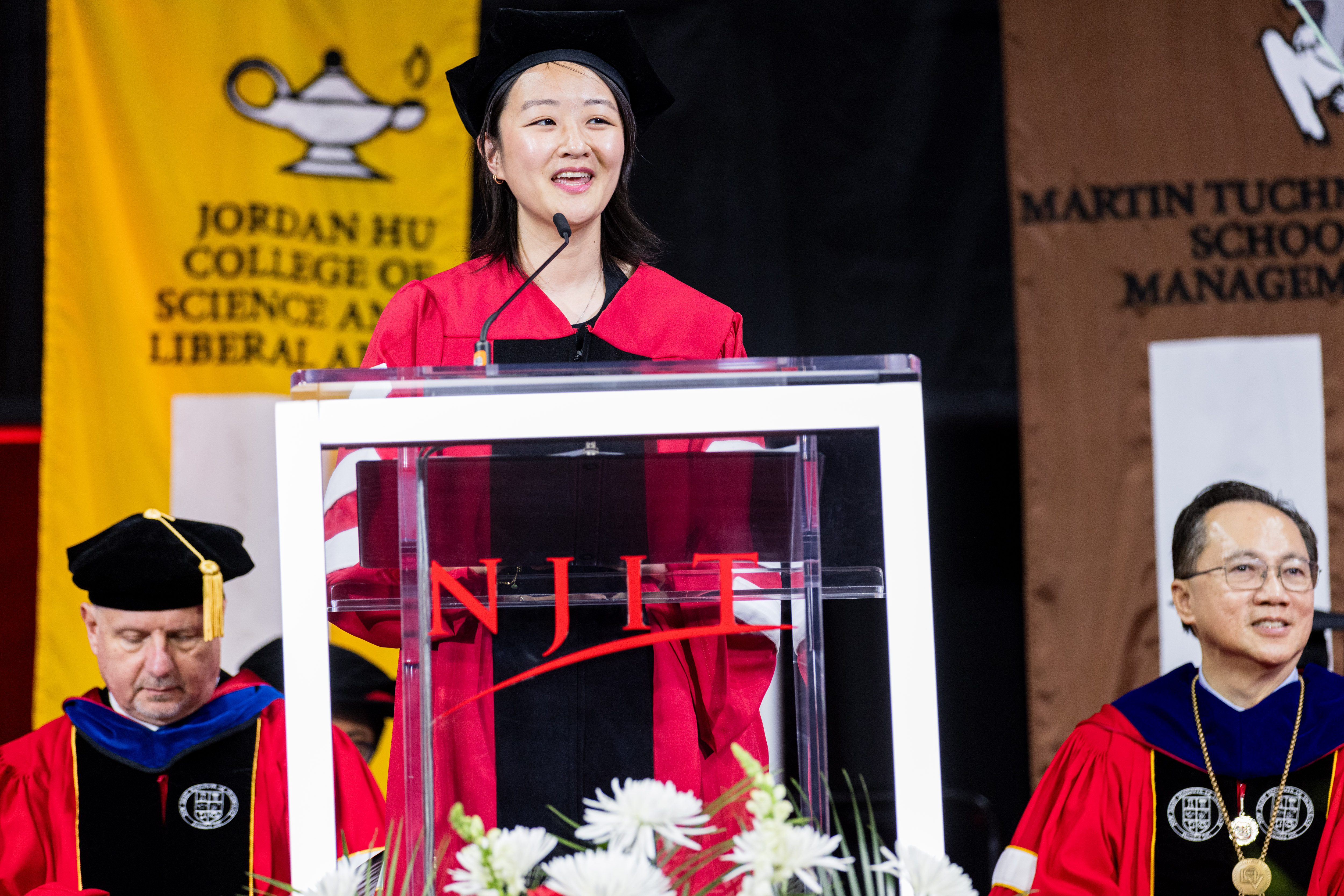
Ph.D. student speaker Sunny Kwon
Kwon, introduced as a Ph.D. graduate in mechanical engineering, focused her remarks on the reality behind the doctoral journey: persistence, failure and the decision to keep going when research does not move in a straight line.
Her own work reflected that path. At NJIT, Kwon specialized in wearable biomedical sensors and flexible bioelectronic systems for health monitoring. She worked in the Functional Materials & Biomedical Devices Laboratory, led by Lin Dong, assistant professor of mechanical and industrial engineering. Advised by Dong, Kwon wrote her dissertation on “Integrating Self-Powered Nanofibrous Sensors and Machine Learning for Cardiac Monitoring,” and will continue her research at NJIT.
Her recent research includes “Flexible Piezoelectric Sensor for Real-Time Comprehensive Cardiovascular Monitoring,” published Jan. 2, 2026, in ACS Applied Electronic Materials. The work describes a wearable sensor platform designed to capture cardiovascular signals through body-conforming electronics, pointing toward more practical tools for real-time heart monitoring outside traditional clinical settings.
That research background gave added weight to Kwon’s message about the difficult, iterative nature of discovery.
She thanked her family, friends, colleagues and Dong, whose guidance, she said, helped push her beyond what felt comfortable. Then she turned to a subject familiar to anyone who has spent years in a lab: failure.
“Failure is something that we all have experienced, and something we will continue to encounter throughout our lives,” Kwon said.
Kwon spoke candidly about paper rejections, unsuccessful experiments, repeated iterations, imposter syndrome and years of commuting from Bergen County to NJIT. In hindsight, she told graduates, those experiences were formative.
“They forced me to redefine my way of thinking, to strengthen my resolve, and to continue moving forward even when progress crawled forward at a snail’s pace,” she said.
Her central message was not that doctoral graduates had mastered every answer, but that they had built the capacity to keep trying.
“It is not perfection that defines us,” Kwon said, “it is our persistence and our willingness to try even against insurmountable and unpredictable odds.”
Turning knowledge into power
Rogers brought the perspective of an alumnus whose NJIT connection spans graduate study, college leadership and philanthropy.
Founder and president of Sumach Enterprises, LLC, Rogers previously served as managing director and a member of the Board of Directors at RHV Capital. He earned his M.S. (2008) and Ph.D. (2011) in Applied Physics from NJIT, after earlier earning degrees from the Royal Military College of Canada and Harvard Business School.
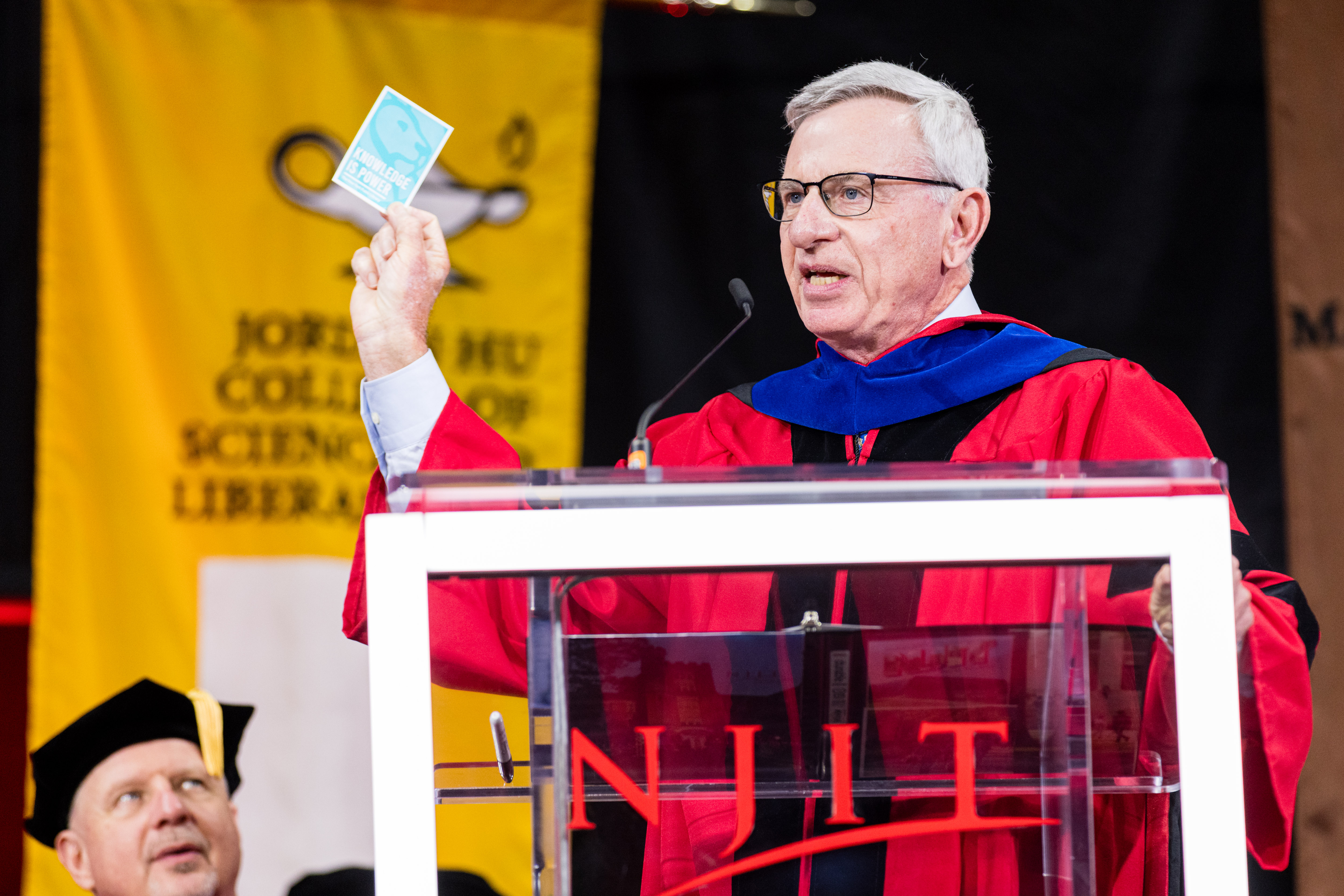
Rogers holding up his "Knowledge is Power" decal.
He also chairs the Board of Visitors for the Jordan Hu College of Science and Liberal Arts and helped found NJIT’s master’s program in Mathematical and Computational Finance. This year, the Dr. Paul Rogers ’08, ’11 and Caroline Rogers Endowed Scholarship for Interdisciplinary Studies was established to honor Rogers’ time at NJIT and his lasting connection to the college.
Speaking to the doctoral graduates, Rogers described the Ph.D. as both an intellectual achievement and a test of character.
“This has been a long and demanding road,” Rogers said, noting the coursework, qualifying exams, teaching responsibilities, research plans, publications, conference presentations and dissertation defenses that brought graduates to commencement.
The work, he said, explained why so few people voluntarily take on the process. It takes people who are “lovers of wisdom and knowledge,” he said, pointing to the meaning behind the title Doctor of Philosophy.
But Rogers’ larger message was not simply about earning knowledge. It was about what graduates should do with it, he said while holding up a “Knowledge is Power” decal he’s held onto closely after receiving it as a gift from the New York Public Library nearly 25 years ago.
“Knowledge — true understanding and insight — is not just an accumulation of facts,” Rogers said, “but knowledge is a force that fuels progress, ignites creativity, empowers individuals and strengthens communities.”
Rogers also placed the doctoral degree in the context of artificial intelligence, telling graduates that human expertise matters more, not less, in an era when advanced AI systems can appear to place “a team of Ph.D. level experts in your pocket.”
“In a world immersed in AI, your Ph.D. level expertise is needed more than ever,” Rogers said.
Others will call on them, he said, to validate AI’s results, assess and explain its limitations, correct biases, protect research integrity and monitor ethical use.
“These are all human responsibilities that cannot be outsourced,” Rogers said.
In his 46 years in business, Rogers said he's been fascinated by what the key characteristics are that have made businesses and enterprises successful. These observations can be related to individual success, he commented. He urged graduates to carry tools with them: focus, trusted relationships and lifelong learning. Their Ph.D. training, he said, had given them the ability to dig into complexity with confidence and precision.
“Graduates, this is the moment you have worked tirelessly for — you have earned your Ph.D. degree. And we challenge you to use the wealth of knowledge that you have accumulated, the amazing talent that you have developed, and the strong, strong characters that you have honed as fuel for your imaginations to not only envision a better world, but to actively create it."
Recognizing doctoral achievement
Changshi Zhou and Ranyang Zhou are this year’s winners of the Hashimoto Prize for the best doctoral students in electrical and computer engineering. The Hashimoto Prize is part of an endowment that recognizes the generosity and vision of Dr. Kazuo Hashimoto, who is known for more than 1,000 patents and applications related to the invention of the telephone answering machine and other devices in electronics and telecommunications.
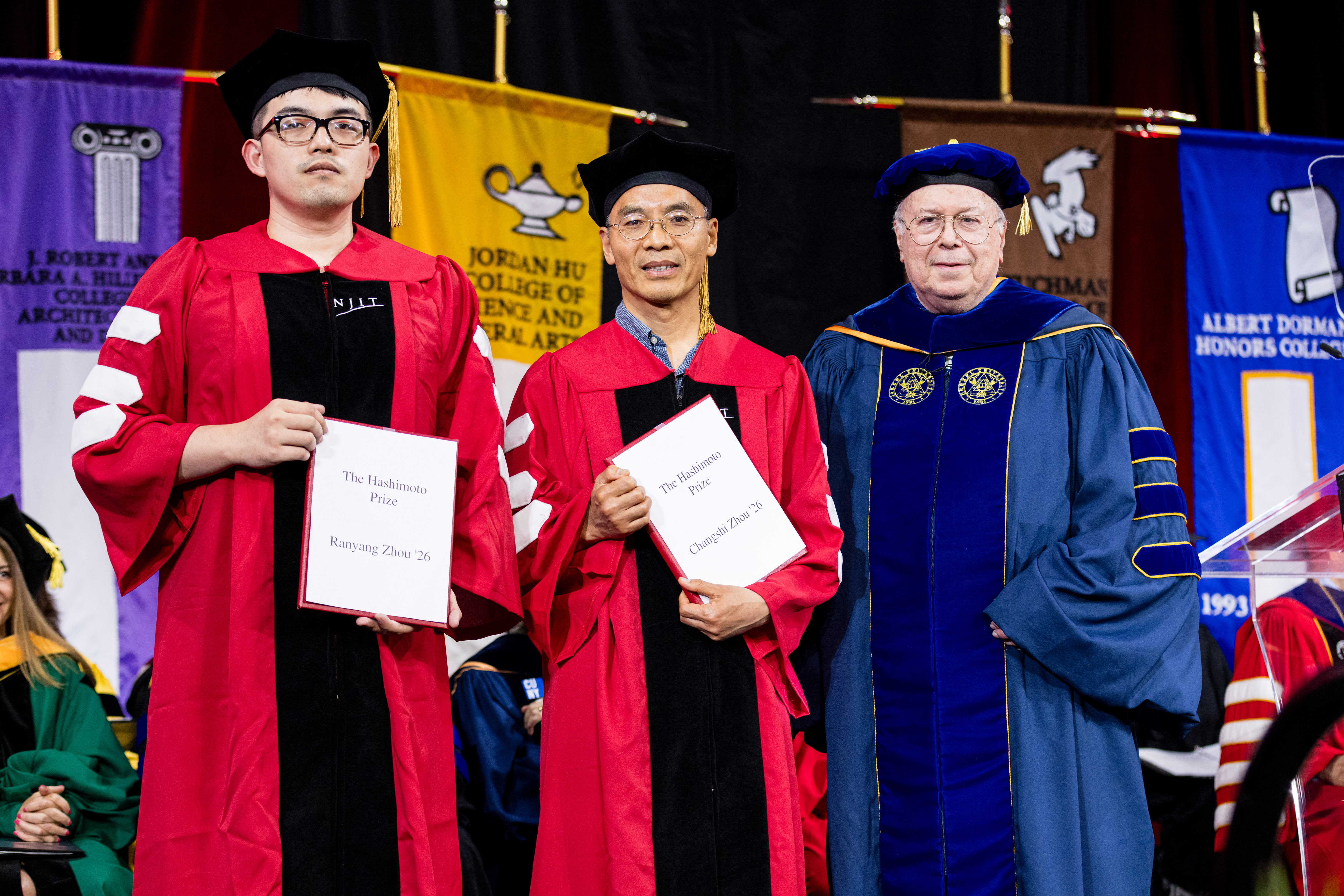
Hashimoto Prize winners Ranyang Zhou and Changshi Zhou, with NCE Dean Moshe Kam.
Changshi Zhou, a university lecturer in the physics department, joined NJIT in 2017 after working in the telecommunications industry.
“Modern communication technologies increasingly combine physics, computing, AI and engineering, so pursuing a doctorate in electrical engineering became a natural progression for me. Physics gave me strong analytical and modeling foundations, while engineering allowed me to apply those ideas to practical systems and real-world problems,” he said.
For his dissertation under Distinguished Prof. Nirwan Ansari, he researched how AI and machine learning models can be securely developed and used across networks, even with limited bandwidth.
Ranyang Zhou said he chose NJIT for the combination of strong research, hands-on opportunities and close mentorship. Working under Assistant Prof. Shaahin Angizi, Zhou studied computer architecture, memory systems and hardware security.
“NJIT gave me the opportunity to grow in a research environment where I could contribute to technologies that may shape the future of computing,” he noted. “My dissertation focused on addressing a major challenge in computing known as the memory wall — the growing gap between how fast processors can compute and how slowly data can be moved from memory. In simple terms, modern computers can process information very quickly, but they often spend too much time and energy waiting for data. My research explored ways to make memory smarter, so it can help perform computation and improve both efficiency and security,” all while keeping the data safe from security hacks.
Meiqi Wang was recognized with NJIT’s Outstanding Ph.D. Dissertation Award for her six years of research into how high energy electrons are accelerated and transported during powerful solar eruptions. Her dissertation, Multi Messenger Diagnostics of the Origin and Transport of Solar Energetic Particles, integrated radio imaging from the Expanded Owens Valley Solar Array with NASA X-ray and spacecraft observations to investigate why only a small fraction of energetic particles escape the Sun and travel into interplanetary space. The findings provide new insight into particle acceleration during solar flares and could ultimately improve forecasts of space weather events that threaten satellites, deep-space technologies and future human exploration missions.
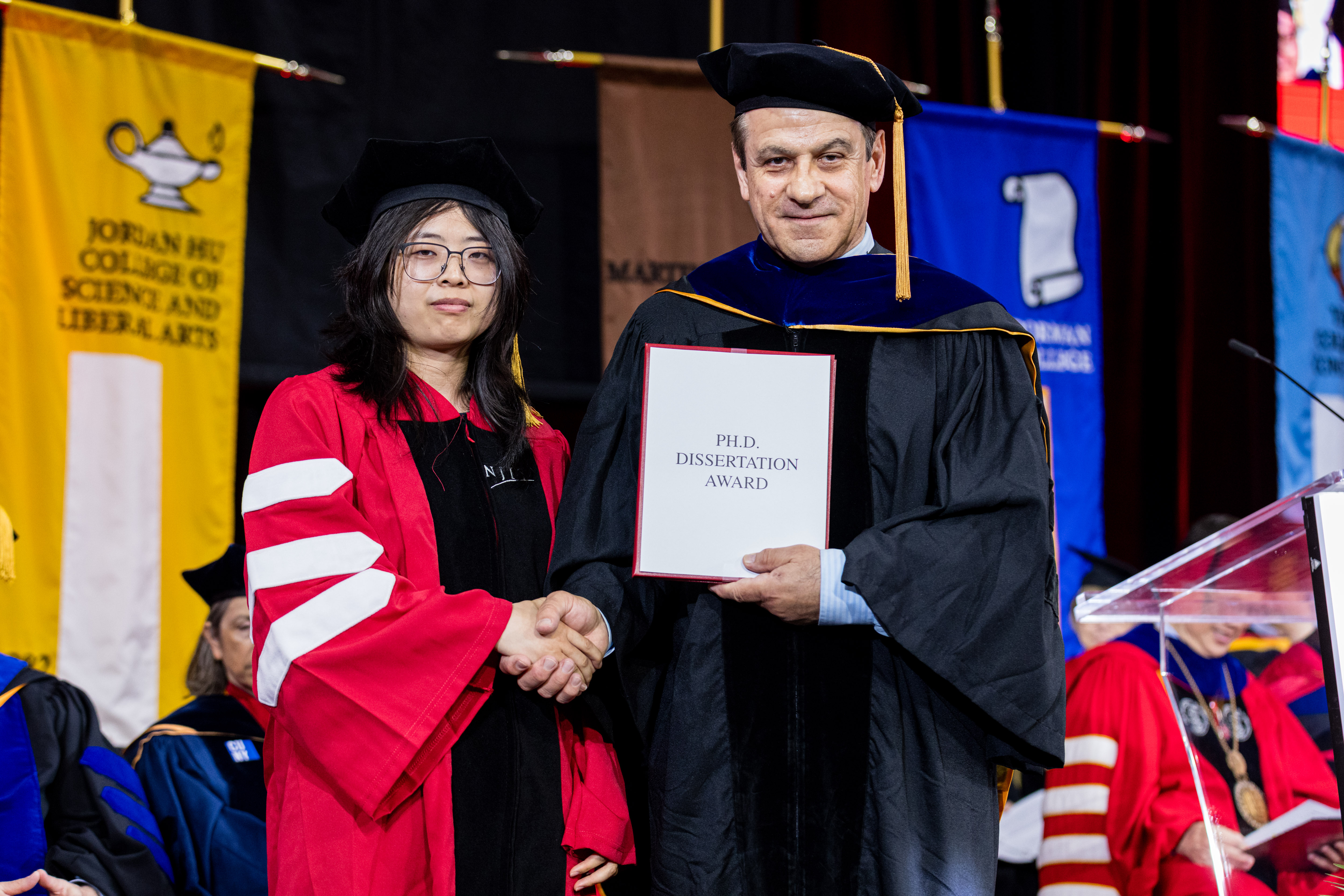
Ph.D. graduate Meiqi Wang
A milestone earned through difficult work
President Lim closed both ceremonies by asking graduates to take in the significance of what they had achieved.
At the master’s ceremony, he told graduates they would be among the less than 14% of the world’s population to have earned a master’s degree. At the doctoral ceremony, he told graduates they would be among the less than 2% of the world’s population to have earned a doctoral degree, and that the figure falls below 1% for STEM Ph.D. recipients.
“This is a milestone you have worked toward for many years,” Lim said, urging graduates to store the memory of commencement somewhere they could return to when they had occasion to doubt themselves, “because you already have demonstrated the ability to do difficult things.”
He also connected the day to what graduates would do next.
“Remember to pursue noble goals and use your talents to lift others and improve our world,” Lim told the master’s graduates. “That is how you lead a life of true consequence.”
With their degrees conferred, NJIT’s newest advanced-degree alumni joined a Highlander network shaped by research, professional achievement and service — and left with a charge repeated in different ways across both ceremonies: keep learning, keep adapting and use what they know to help build what comes next.