NJIT Students Win Top Awards in Princeton Kiosk Design Competition
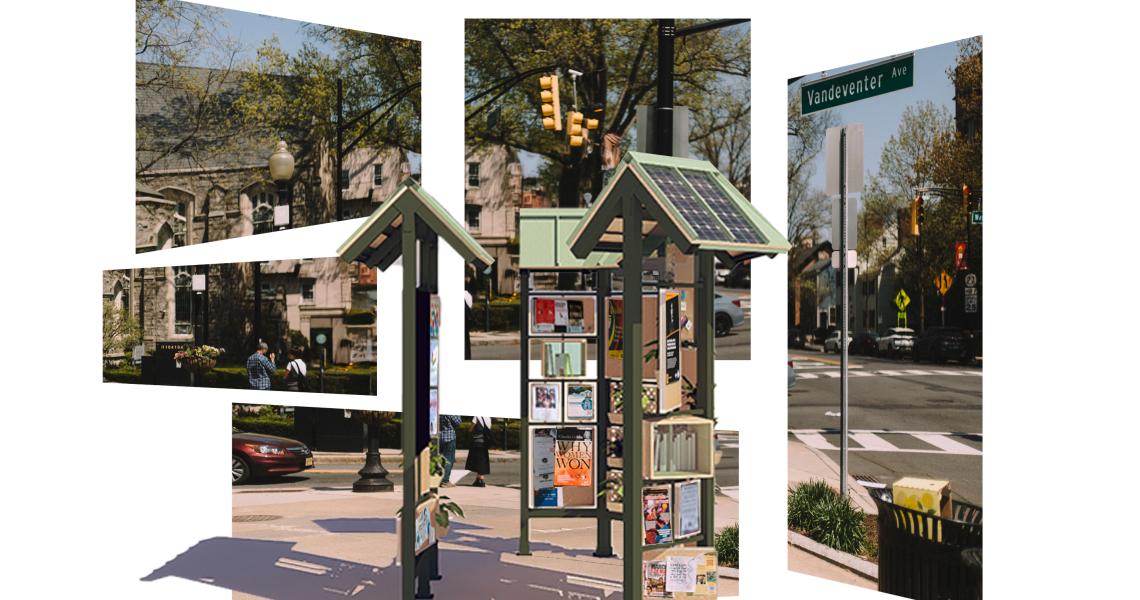
Two teams from NJIT's New Jersey School of Architecture won top awards in the Princeton Kiosk Design Competition. The design competition is one of several of American Institute of Architects (AIA) New Jersey 125th anniversary events. Launched in May of 2025 in collaboration with the municipality of Princeton, submissions were juried in March of 2026.
Hillier College was well represented. In the student category, architecture and Honors College students Jonathan Chu and Jonathan Fenton took first place with "Revolve." Sofia Kolta, Aisha Awad (also a member of the Honors College) and Mahum Azim placed second with "Beacon Kiosk." Studio Hillier, the firm of college benefactors J. Robert and Barbara A. Hillier, won first place in the professional category.
The kiosks are long time fixtures in Princeton public space and serve as a central location for community information sharing. If built, the new kiosk will be located at the corner of Nassau Street and Vandeventer Avenue and be part of the revitalization of Nassau Street. Continuing the tradition of a shared public space for communication, it will also provide way finding for visitors and digital access to all things Princeton.
Competitors had to meet several requirements outlined by AIA New Jersey: compatibility with materials already in use in the Nassau Street Streetscape Project, built-in flexibility to adapt to "future environmental, technological and social changes," as well as analog and digital maps for way finding. Criteria for judging included lighting, solar power, space for paper postings, resilient materials and construction costs.
With specifications to design a structure no larger than 14 feet by 8 feet and no taller than 12 feet within the total allocated site, the two winning student entries fulfilled on requirements and presented unique and complimentary options for the Princeton streetscape.
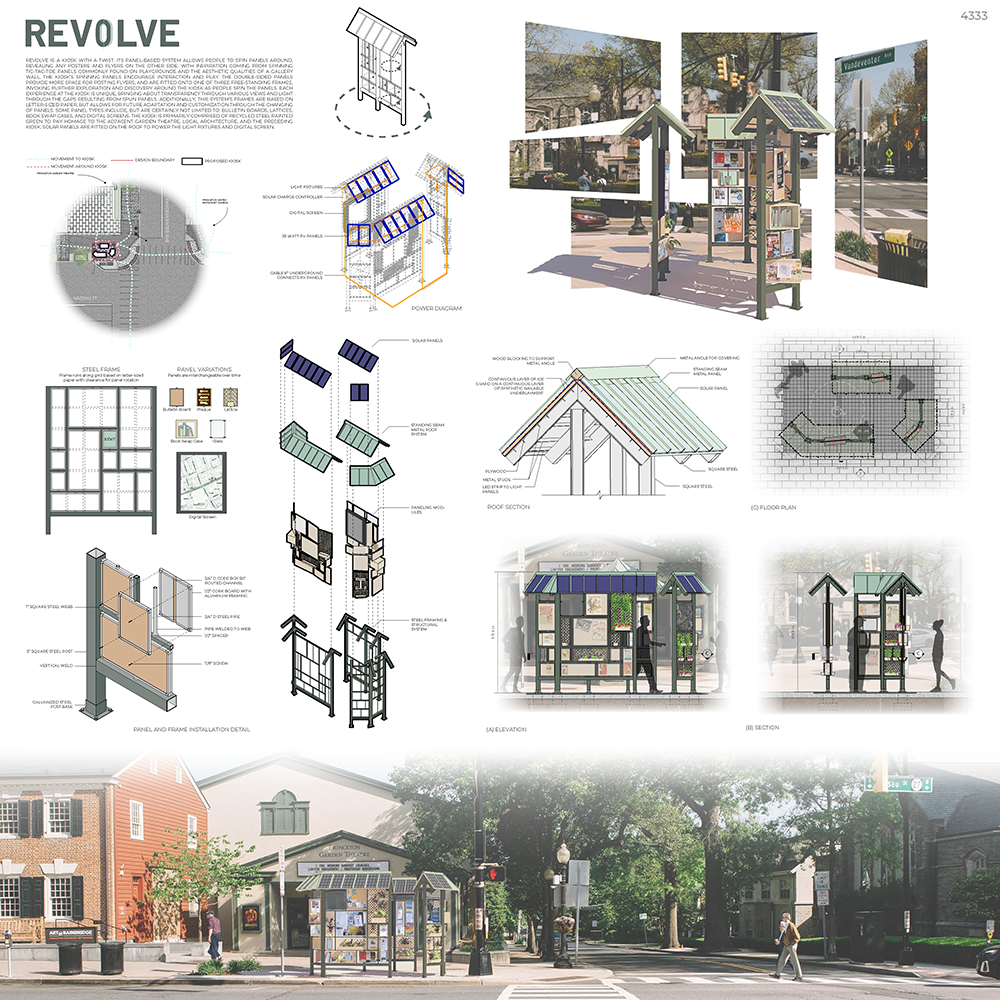
Jonathan Chu and Jonathan Fenton presented "Revolve," a kiosk with a twist.
“The panel-based system allows people to spin panels around, revealing any posters and flyers on the other side. The inspiration is coming from spinning tic-tac-toe panels commonly found on playgrounds and the aesthetic qualities of a gallery wall, we want the kiosk’s spinning panels to encourage interaction and play. The double-sided panels provide more space for posting flyers and are fitted onto one of three free-standing frames, invoking further exploration and discovery around the kiosk as people spin the panels,” said Chu.
“Each experience at the kiosk is unique, bringing about transparency through various views and light through the gaps resulting from spun panels,” said Fenton. “Additionally, this system’s frames are based on letter-sized paper and allow for future adaptation and customization through the changing of panels. Panel types include bulletin boards, lattices, book swap cases, and digital screens. The kiosk is primarily comprised of recycled steel painted green to pay homage to the adjacent garden theatre, local architecture, and the kiosk that’s being replaced. Solar panels are fitted on the roof to power the light fixtures and digital screen."
The second-place team, Sofia Kolta, Aisha Awad and Mahum Azim presented the "Beacon," an oasis for the common city-dweller, and/or tourist that craves community and relaxation, but does not know where to find it.
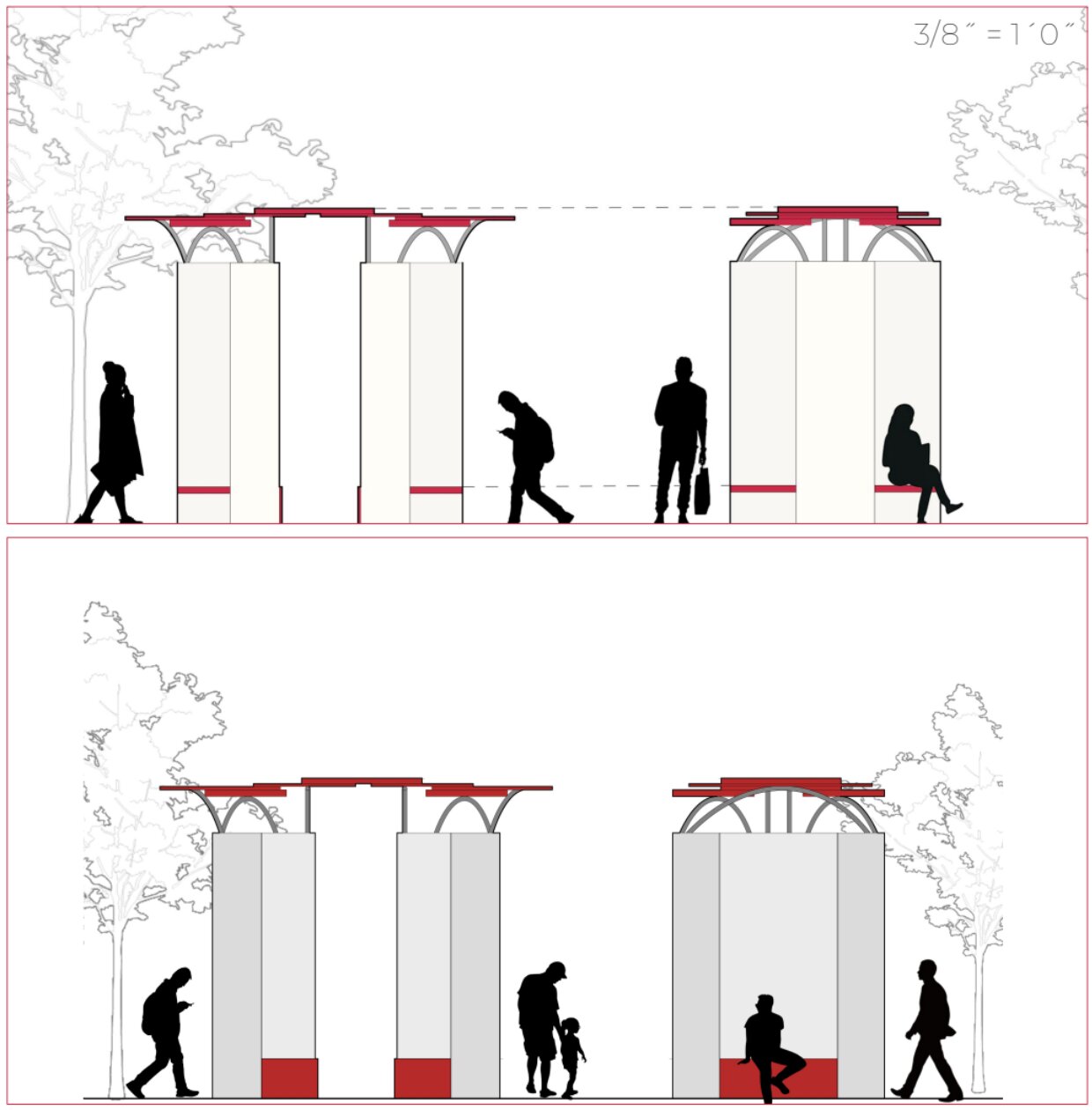
"Beacon," the Princeton Kiosk Design submission by Sofia Kolta, Aisha Awad and Mahum Azim.
The team describes their project like this, “The Beacon is more than a structure — it’s an interruption. A call for the Princeton community to come together. It reimagines what a kiosk can be: not just functional, but poetic; not just a point of exchange, but a place of gathering. It serves as a reminder that even in the most fast-paced environments, community and connection are still possible, and necessary. In the midst of the urban rush, where moments of rest, community, and help with navigation can be hard to come by, our kiosk offers a solution. Inspired by the idea of a lightbulb attracting flies, the Beacon draws people in with the soft warmth of community. Its layered circular roof structure plays with shadow, sunlight, and form, sparking visual interest from afar, up close, underneath, and above - all while providing shade on hot and bright days.”
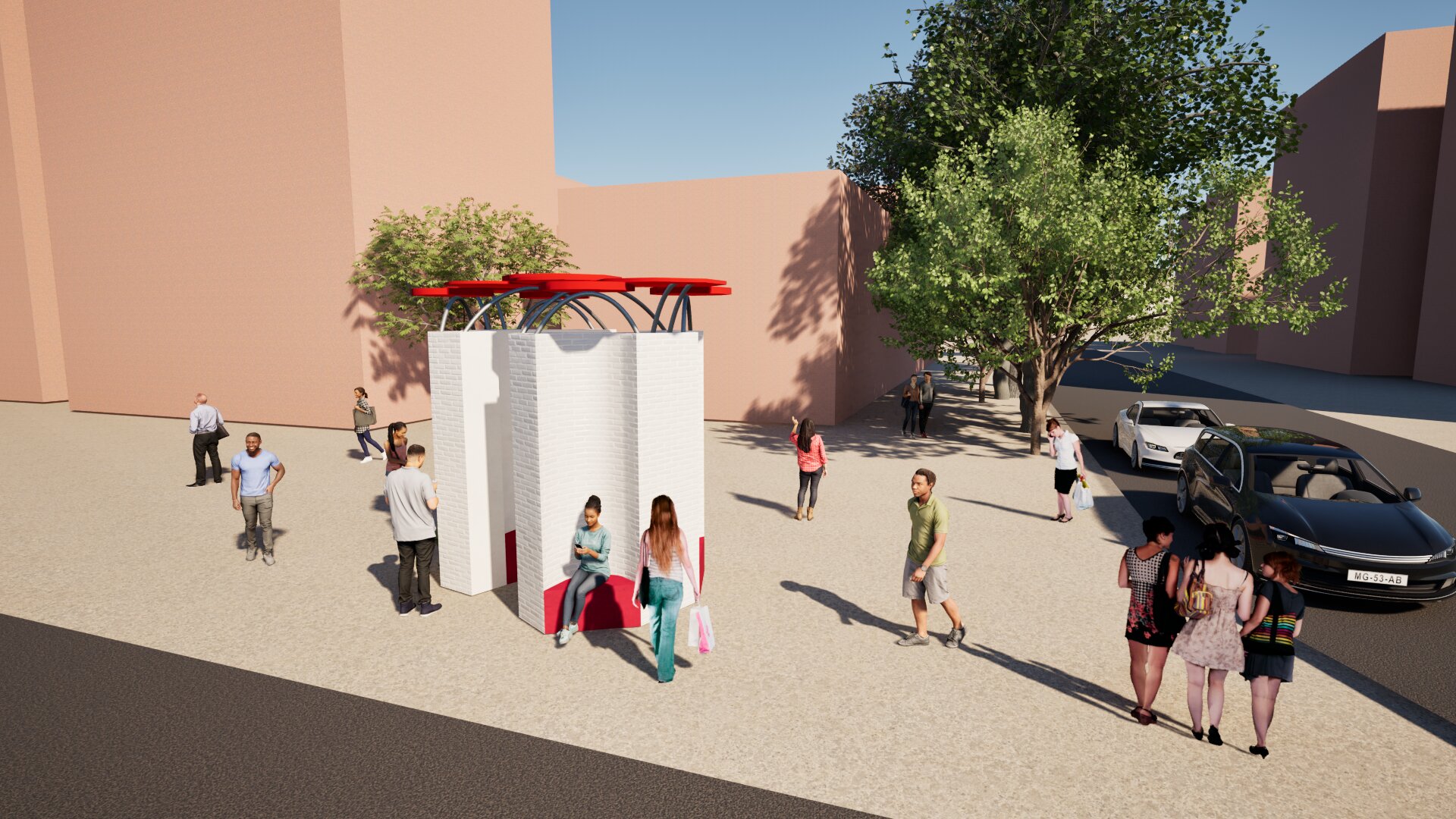
“With seats around the exterior and open-air interior, we intend for people to stay a while, chat with each other, take the time to look at the posters or simply enjoy the rest. These ever-changing displays enable the community to take ownership of the space and use it to suit their ever-changing needs and wants,” said Azim.
Support for cash prizes provided by the Bank of Princeton and Roundview Capital, with $1,500 going to the first-place team, and $1,000 to the second-place team.