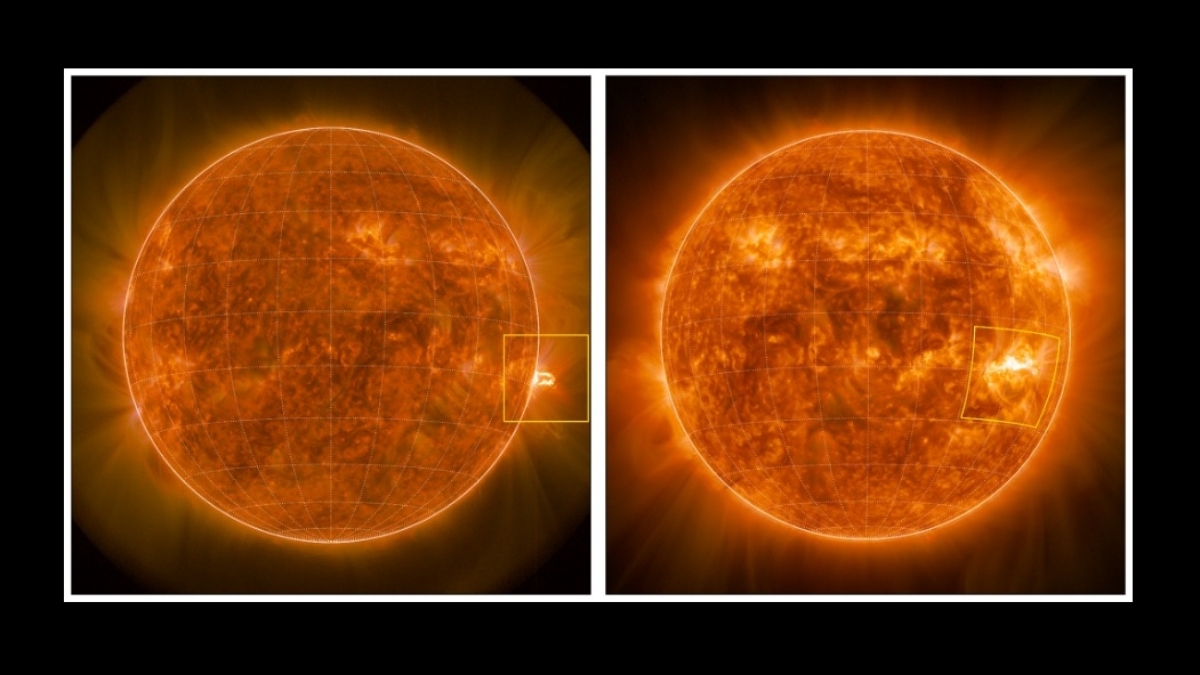
A solar eruption that seemed poised to blast into space instead stalled and collapsed — and radio observations from NJIT’s Expanded Owens Valley Solar Array (EOVSA) helped reveal the magnetic forces that brought it down.
In a new study, published May 20 in Nature Astronomy, an international team of researchers has described one of the clearest multi‑view observations yet of a “failed” solar eruption.
This phenomenon, observed by scientists for decades but still not fully understood, occurs when erupting solar material is abruptly halted instead of escaping the Sun as a coronal mass ejection (CME).
The study was led by the Center for Astrophysics | Harvard & Smithsonian (CfA), which has detailed the findings in a press release.
“While successful solar eruptions are of particular interest as they may strongly impact the near-Earth space environment and assets such as satellites and GPS — known collectively as ‘space weather’ — understanding why some of the most energetic ones ‘failed’ is crucial in improving future predictions,” said Bin Chen, NJIT professor of physics and director of EOVSA, who co-authored the study.
The March 2024 event began with a strong solar flare from a magnetically complex active region, where a prominence — a structure of relatively cool, dense plasma suspended in the Sun’s atmosphere by magnetic fields — rose above the solar surface before slowing and ultimately falling back.
The event was observed from multiple vantage points in space and from the ground, spanning ultraviolet and extreme ultraviolet (UV/EUV), X‑ray and microwave wavelengths.
The team combined data from NJIT’s EOVSA with observations from NASA’s Solar Dynamics Observatory, the European Space Agency’s Solar Orbiter, the Hinode satellite and NASA’s Interface Region Imaging Spectrograph — creating a detailed picture of how the eruption evolved.
The combined observations revealed that multiple magnetic processes were acting in parallel, simultaneously driving and suppressing the eruption.
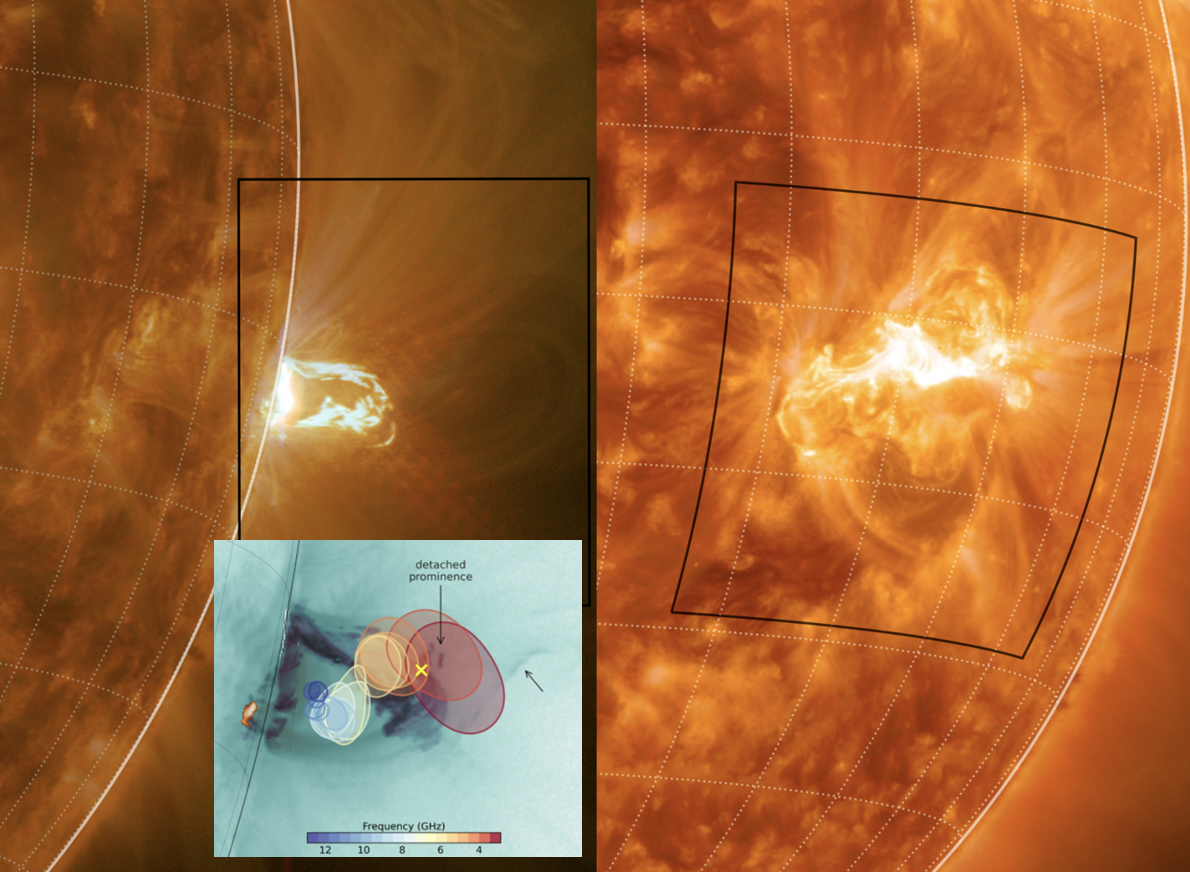
Above: Close-up views of the failed solar eruption observed in March 2024. The EOVSA inset overlays microwave emission sources, color-coded by observing frequency, highlighting energetic electrons near the detached prominence. The larger panels show hot plasma structures captured by space-based solar observatories from different viewing angles, including the Sun’s face as seen by Solar Orbiter. Credit: Tingyu Gou; EOVSA/NJIT
Chen, NJIT Assistant Professor of Physics Sijie Yu, and postdoctoral fellow Xingyao Chen contributed microwave imaging analysis from EOVSA, which detects radio emission from energetic electrons moving through the Sun’s atmosphere.
Unlike visible‑light observations, solar radio measurements directly probe populations of energetic electrons and changing magnetic conditions in the Sun’s corona — the outermost layer of the solar atmosphere.
By tracking how energetic particles evolve across both space and frequency, EOVSA provides a detailed view of the otherwise “hidden” magnetic processes driving solar eruptions.
“Radio observations let us see parts of the eruption that are otherwise invisible,” said Yu, who also serves as EOVSA project scientist at NJIT’s Center for Solar-Terrestrial Research. “In this event, EOVSA captured intense magnetic reconnection above the eruption during its early stages. While reconnection is often thought to help eruptions escape by eroding the overlying magnetic field, here it actually weakened the structure, preventing it from escaping as a coronal mass ejection.”
The team says the findings not only improve understanding of how solar eruptions evolve and why some fail, but may also have broad implications for studying stellar eruptions on distant Sun-like stars.
For now, Chen and Yu say the next step is to determine how often this kind of magnetic erosion occurs, and whether radio observations can help identify failed eruptions earlier.
Future solar-dedicated radio facilities, such as the proposed next-generation Frequency Agile Solar Radiotelescope, could provide the coverage and detail needed to track these processes more routinely.
EOVSA is operated through NJIT’s Center for Solar-Terrestrial Research (CSTR) with support from the National Science Foundation under grant No. AGS-2436999. CSTR spans instrumentation from the United States to Antarctica to study the Sun, the heliosphere, and space weather using advanced observational and computational tools.
