Solar flares are among the most violent events in the solar system, releasing energy equivalent to millions of hydrogen bombs and propelling particles to near-light speed in seconds.
Yet only a small fraction of those particles ever escapes into interplanetary space. Why do so few make it out of the Sun’s atmosphere — and what happens to the rest?
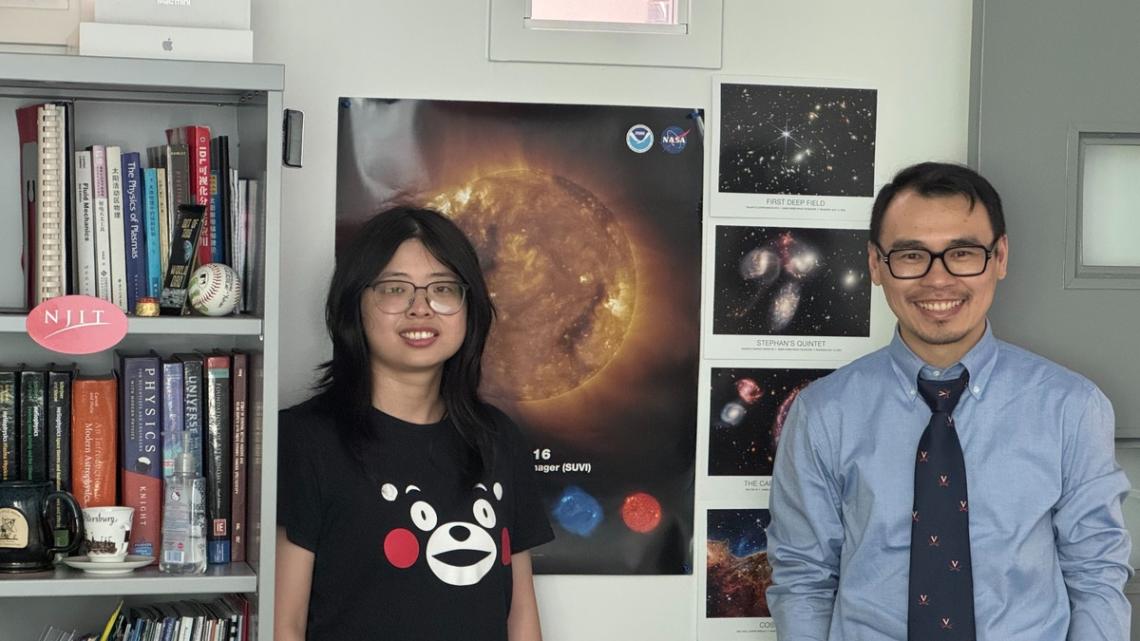
Those questions have driven Meiqi Wang’s research since she arrived at NJIT as a Ph.D. student in 2019, years of work that earned her NJIT’s Outstanding Ph.D. Dissertation Award at Commencement 2026.
Her dissertation, Multi-Messenger Diagnostics of the Origin and Transport of Solar Energetic Particles, focused on impulsive solar energetic electron events— rapid bursts of high-energy electrons produced during solar flares and other eruptions on the Sun.
After six years of research, her findings could improve scientists’ understanding of how solar energetic particles are accelerated and escape from the solar corona during these events — insight that is essential for forecasting space weather hazards that threaten deep-space technologies and human exploration missions.
“The honor means a lot. It caps my six years of study and makes it feel that much more meaningful,” said Wang, originally from Shanghai, China. “Studying solar energetic electron events is a niche field — only a small group of people in the world combine multi-instrument observations to study this topic. We have a lot to learn about the activity of energetic electrons during violent solar events.”
To learn more, Wang combined radio imaging data from the Expanded Owens Valley Solar Array (EOVSA) — directed by NJIT Physics Professor and Wang’s mentor, Bin Chen — with NASA hard X-ray observations and deep-space satellite measurements.
Because EOVSA only began operating in 2017, Wang had access to relatively new microwave imaging data to analyze how energetic electrons behave in the solar corona at the site of a flare.
“Previously, scientists used hard X-ray data combined with spacecraft measurements,” said Wang, whose work was supported by NASA and NSF grants. “But no one really combined radio data with hard X-ray and spacecraft observations. Adding EOVSA to the mix makes this more comprehensive than previous studies, letting us capture the signatures of the electrons right near the Sun.”
“Combining all these instruments and trying to create the whole physics picture in my mind — that was the most challenging part,” Wang said of bridging the massive datasets. “I would spend weeks studying one specific event, only to find it wasn't scientifically useful. It could be frustrating to have to start over, but persistence paid off.”
Using Python algorithms, Wang narrowed an initial catalog of more than 1,000 flares recorded in the EOVSA database to three distinct solar events captured simultaneously across all instruments.
Each event became the focus of a successive paper published in The Astrophysical Journal between 2023 and 2026.
New Insights Into Solar Energetic Electron Events
In her first study, which analyzed a 2019 solar eruption captured by NASA's Parker Solar Probe, Wang investigated how electrons escape during rapid eruptions. Scientists had long assumed the particles streamed outward in narrow beams associated with solar jets — eruptions of plasma from the Sun’s surface.
“It turns out, high-energy electrons escape at a much broader angle. That result was a surprise,” Wang said, adding that this wider spread may explain why multiple spacecraft, separated by millions of miles in space, have been able to detect particles from the same eruption.
Wang’s next study, centered on a massive X-class flare from July 2021, identified a two-stage particle acceleration process — showing that energy release during powerful flares can unfold in multiple episodes of particle acceleration rather than a single burst.
“I found two particle phases associated with separate peaks in microwave and hard X-ray emissions,” Wang explained. “These two peaks are related to two distinct stages of energy release from the Sun and give a new picture of how these electrons can escape from the solar surface.”
Her final research paper tackled a long-standing paradox in solar physics: the stark mismatch between the large number of energetic electrons accelerated during solar eruptions and the small fraction that ultimately reach interplanetary space.
In her study, Wang confirmed that spacecraft detect only 0.1 to 1 percent of the energetic electrons inferred near the Sun.
“Why spacecraft receive such a small fraction is still an unsolved question and under debate,” Wang said. “Our observations suggest the electrons are trapped in the solar corona. Simulation models indicate this may happen in a ‘magnetic bottle’ region in the low corona, where turbulence or strong magnetic mirroring possibly prevents the particles from easily following magnetic field lines outward.”
Now a postdoctoral researcher in Chen’s solar radio group within NJIT’s Center for Solar-Terrestrial Research, Wang continues to study how high-energy electrons propagate through space.
Working alongside the same team where she completed her doctoral research has made the transition to postdoctoral work a natural next step, she said.
“I’m still studying the transport of high-energy electrons,” she said. “That could help improve solar energetic particle forecasts and better understand their potential impact on humans and technology in space.”
“The most exciting part of my whole Ph.D. life was working with my advisor and our group,” Wang added. “Every week we get together and discuss our data. We all have one goal—to better understand the Sun through radio observations. That really excites me.”
