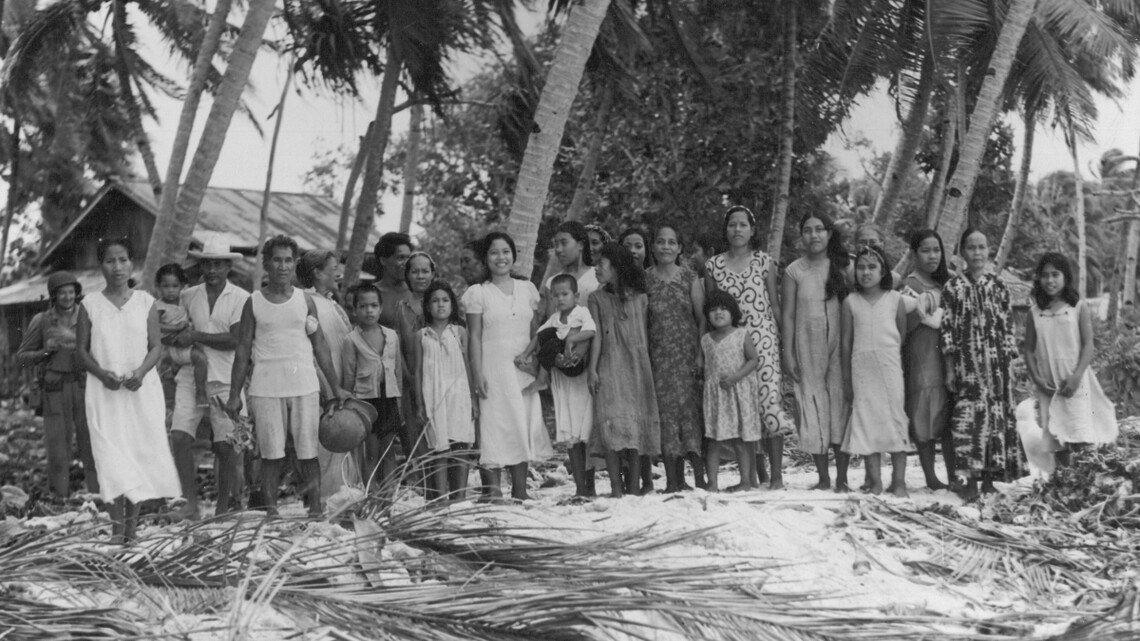
Less than nine years after the atomic bombing of Hiroshima, the United States detonated a nuclear weapon roughly 1,000 times more powerful roughly 2,600 miles away, in the Marshall Islands.
The March 1, 1954, Castle Bravo blast at Bikini Atoll — the largest nuclear detonation in U.S. history — sent radioactive fallout across inhabited Marshallese islands, even reaching a Japanese fishing vessel about 80 miles away.
While radioactive fallout spread in hours, the legal and political fallout unfolded over decades.
NJIT historian Mary Mitchell has cast fresh light on that history in her new book, Unsettling Sovereignty, recounting how Marshall Islanders spent nearly four decades pushing back against U.S. control — using American, international and Marshallese law to fight for control over their own islands.
“People are surprised to learn that the United States effectively had colonies that it acquired after World War II and kept long afterwards,” said Mitchell, an assistant professor of history. “These were extraterritorial colonies, so the archipelagos were not part of U.S. territory, but the U.S. governed them up through 1986. There was dissent from Islanders the whole time.”
Mitchell spent more than 10 years researching the book — combing through court records, government documents and archival collections from the Library of Congress to presidential libraries and repositories in Oceania.
Mitchell says it all stretches back to an unusual postwar arrangement in 1947, when the United Nations placed the Marshall Islands and other former Japanese-held Pacific islands under U.S. administration — without making them U.S. territory.
It was the U.N.’s only “strategic” trusteeship.
“The United States was required to promote the development of places and peoples and help Islanders prepare for self-government, but it also argued that trusteeship conferred a pretty much an unvarnished right to do whatever it wanted to do militarily,” Mitchell said. “In the end, we see that those two things didn’t really work together.”
Between 1946 and 1958, the United States conducted 67 nuclear detonations in the Marshall Islands. Castle Bravo’s radioactive fallout, in particular, spread far beyond what U.S. scientists had expected.
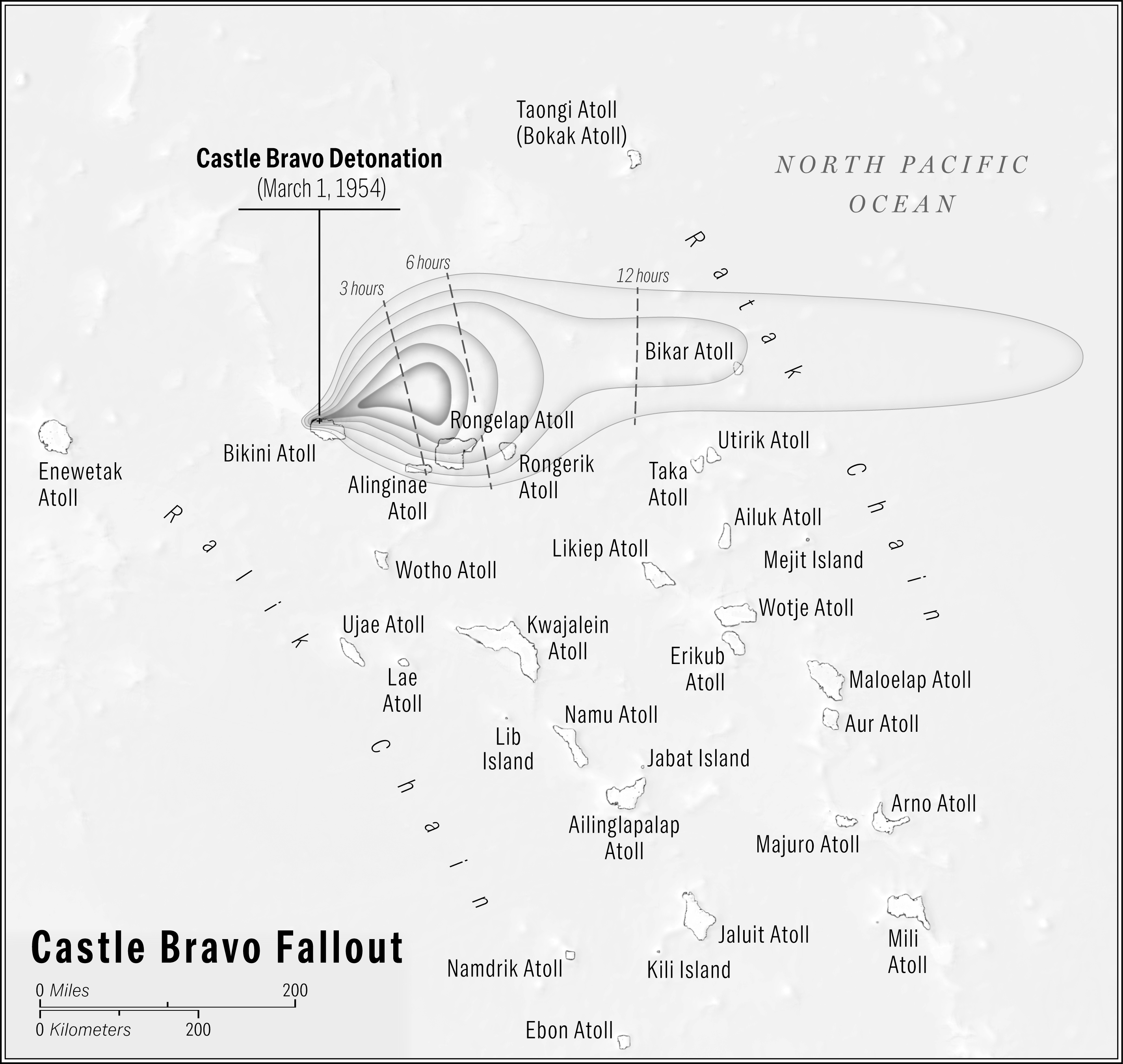
Above: A map of local radioactive fallout from the March 1, 1954, Castle Bravo detonation at Bikini Atoll shows the plume extending across neighboring Marshallese islands. Map by Margot Dale Carpenter, Hartdale Maps.
But when Marshall Islanders sought compensation for their injuries and contaminated lands, they faced a problem — where could they make their case?
“US federal courts initially held in the 1950s that Islanders couldn’t claim under the Constitution and had no constitutional rights,” Mitchell said. “They tried to bring their cases in the Trust Territory High Court, but the U.S. argued that the territory was technically a foreign country — even though the U.S. ran it — and refused to accept the court’s jurisdiction.”
Because they were not a state, they also couldn’t bring a case before the International Court of Justice.
However, pressure on Washington was growing elsewhere. Castle Bravo’s fallout exposed the 23-member fishing crew on Japan’s Lucky Dragon No. 5.
“Unlike the Islanders, Japan had recently emerged from U.S. occupation as an independent state that could threaten international legal action,” Mitchell said. “A threat of a lawsuit can only have power if you can actually file a lawsuit. That brought the U.S. to the table faster, and Japan received compensation and even access to nuclear-power technology.”
Marshall Islanders continued petitioning the United Nations and pursuing claims in court. Even when their cases failed, Mitchell says the possibility that future claims could reach trial eventually gave Islanders leverage.
“The U.S. was afraid a full trial would bring a lot of negative publicity,” Mitchell explained. “That possibility induced the U.S. Atomic Energy Commission not to resume blasting in the Marshall Islands in the early 1960s.”
The Marshall Islands emerged from U.S. trusteeship under a Compact of Free Association in 1986, but their claims did not disappear with it.
As part of decolonization, the United States set aside a $150 million settlement fund. The Republic of the Marshall Islands created a Nuclear Claims Tribunal to determine how much Islanders were owed.
However, the claims approved by the tribunal would vastly exceed the money available.
“There’s about a billion dollars of claims that have been properly adjudicated through the tribunal but not paid,” Mitchell said. “Still, the damage done can’t just be captured by money alone.”
That legacy remains visible today at places such as Bikini Atoll, which is still too contaminated for residents to return.
Marshall Islanders also face another threat to their land — rising sea levels driven by climate change.
“Islanders talk about the nuclear legacy and climate change impacts on their atolls as inherently related — both technology-based harms they never benefited from,” Mitchell said. “They see their bodies as part of their atolls, and their atolls as part of their bodies, so harm to an ancestral atoll they can’t go back to is like losing a part of themselves.”
“Their leaders are now making the case that their sovereignty as a state should continue to exist, even if their homelands become uninhabitable or submerged,” she added. “Their statehood should endure beyond or after territory — fluid sovereignty.”
“The most striking part of Marshall Islanders’ history is that they didn’t give up when contesting the most powerful country in the world, even when it would have been easy to,” Mitchell said. “By refusing to give up, they’ve kept open the possibility for change.”
Unsettling Sovereignty: International Law, Nuclear Weapons, and US Extraterritorial Power in Postwar Oceania was published Oct. 12 by the University of Chicago Press.
