From NJIT to Harvard, Austin Chen Designs for a More Sustainable Future
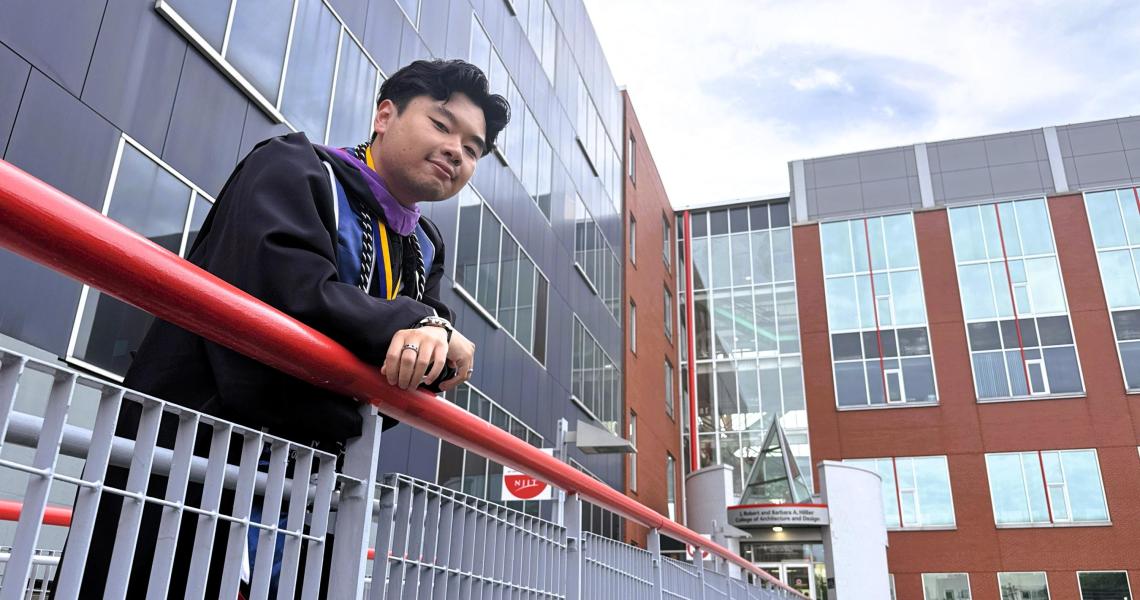
Austin Chen ’26 arrived at NJIT with an interest in architecture, but he leaves with something more defined: a belief that the built environment must be measured not only by its form, but also by its function, performance, and how it responds to people who inhabit it.
Chen, an Albert Dorman Honors College scholar and architecture graduate of the Hillier College of Architecture and Design (HCAD), will continue that work at the Harvard Graduate School of Design, where he plans to deepen his focus on sustainability and building science. His path, however, did not begin with a fixed plan. It began during the COVID-19 pandemic, when he found himself watching architecture videos and becoming fascinated by “how buildings are made” and “how buildings can impact people.”
NJIT appealed to him because it offered a version of architecture education that felt different from the purely artistic or abstract approach he saw elsewhere.
“One thing that brought me here was that NJIT is a polytechnic school, and it focuses on technology, looking at the digital side of architecture, which a lot of schools don’t really do,” said Chen. “NJIT’s program really was interesting for me – to look at buildings in a more technical way.”
Learning to think like a designer
NJIT’s New Jersey School of Architecture quickly challenged Chen’s expectations. He had been used to traditional classes, exams and predictable academic rhythms. Studio culture was different. Full days in the studio, constant critique and a willingness to revise ideas based on feedback.
“Architecture school is very different from any other major, where it’s not really exam based, it’s more project based,” he said. “This kind of teaching helps you adjust to the industry, [where]you’re not really getting tested through written exams. You’re giving presentations to your clients, and adjusting based on their feedback.”
That adjustment shaped the way Chen began to see architecture — not simply as the design of buildings, but as a discipline built around questions of impact. He credits his first-year experience, particularly his work with Tom Ogorzalek, with helping him understand how an architect’s perception can influence the field and how space can be used to express a larger idea, how architecture is not just about the building themselves
Those lessons stayed with him as his interests moved toward sustainability and building performance.
Finding a technical language for architecture
Chen did not enter the bachelor of architecture program expecting to focus on building science. That direction emerged through opportunity, especially after taking an environmental control systems course with Hyojin Kim, associate professor and associate dean for research at HCAD and faculty advisor for the NJIT Student Chapter of the American Society of Heating, Refrigerating and Air-Conditioning Engineers (ASHRAE). Kim invited him to attend an ASHRAE conference, introducing him to a professional and research community that connected architecture with the more technical systems behind building performance.
“I first met Austin in environmental control systems, a large lecture course where students were asked to submit weekly one-minute reflections on the lecture,” said Kim. “What stood out to me was how consistently he approached even these small, completion-based tasks with curiosity and care, which I believe gradually shaped his engagement with sustainability over time.
“Austin is someone I would genuinely enjoy working with. Beyond strong academic ability, he brings a thoughtful and collaborative mindset to his work,” she added. “He is consistently open to feedback and able to engage with ideas in a way that improves both his own thinking and the quality of discussion around him.”
“I don’t think I would have had the same opportunity at any other school,” said Chen.
That experience led to undergraduate research, continued work with Kim and a deeper interest in the quantitative side of design. One of the best hands on learning experience came through Hillier College’s submission to the 2025 ASHRAE Setty Family Foundation Net Zero Energy Design Student Competition, where Chen worked with Jacob Swanson ’25 and Ph.D. students Jeongseo Lee, Minkyeong Park and Mingzhe Li under Kim’s guidance.
The team designed a medical office building in Manchester, England, with the goal of approaching net-zero performance. Their work integrated architectural design with data-driven decision-making, meeting ASHRAE Standard 189.1-2020 prescriptive requirements, achieving partial WELL Building Standard compliance and reaching net-positive operational energy.
For Chen, the project stood out because it brought design imagination into direct conversation with measurable performance.
“This project created a bridge between [architecture] and the engineering side, where you actually have to look at numbers, how the building actually performs, how the building is set based on the benchmarks and standards in the field,” he said.
It also pushed him to think about collaboration differently. Unlike the individual nature of most architecture studio work, the ASHRAE project required students with different areas of expertise to work together more like a professional design team.
“In the field, you’re not going to know everything,” said Chen. “You’re always going to be working with a team.”
For Chen, that combination has become central to his identity as a young designer.
“I come from a unique background where I have the architectural background, but I’m doing more quantitative research,” he said. “Students who come from the engineering side don’t have that architectural understanding of how people feel in buildings.”
The bridge — between technical performance and human experience — is where Chen sees his future work taking shape.
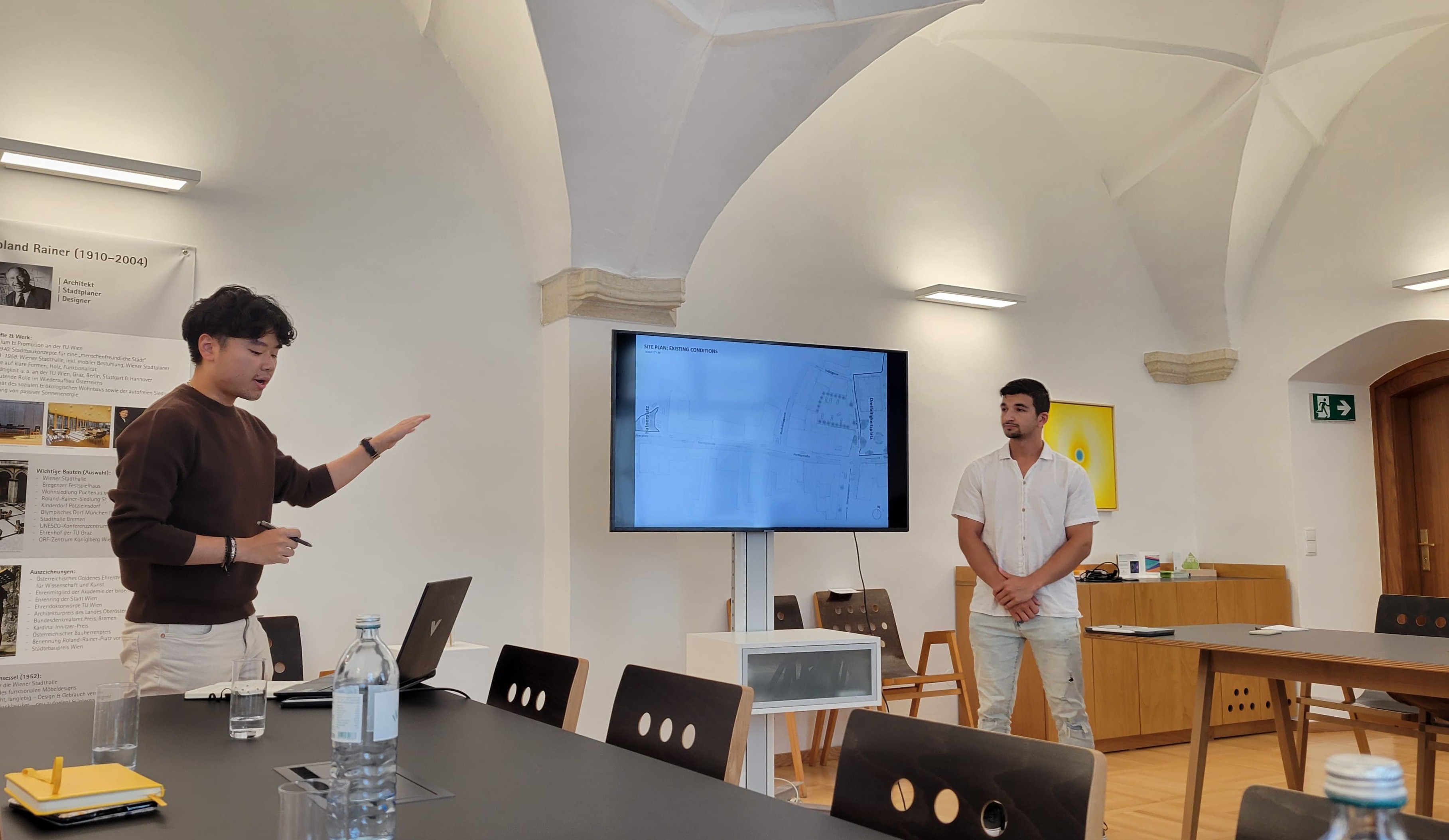
As a Gilman Scholar, Chen traveled to Austria and Italy, an experience that gave him his first opportunity to study architecture in Europe and present work connected to real communities.
His perspective also expanded through the Hillier College study abroad program. As a Gilman Scholar, Chen traveled to Austria and Italy, an experience that gave him his first opportunity to study architectural issues of climate change in Europe and present work connected to real communities. In Krems, Austria, he worked on a future-oriented urban proposal involving local officials, an experience he described as “truly surreal” because it allowed him to present solutions to the people who directly pose the concerns.
The trip also changed what he knew about urban life.
“Going over there, just seeing the lifestyle there is so different, and I think that’s shown through the architecture,” he said. “Most people just walk everywhere. There’s not really cars, and the cars aren’t the main focus.”
Designing for the future
As Chen prepares for Harvard, he sees graduate school as a testing ground — a place to sharpen his research interests and explore how sustainability can move from theory into practice. He was drawn to the Harvard Graduate School of Design because of its faculty and the freedom it gives students to pursue ambitious questions in the built environment.
“Harvard Graduate School of Design gives so many opportunities to the student,” said Chen. “They have opportunities to help students pursue whatever research they want to do, fund their research and get their research out there into the public.”
For Chen, the urgency is clear. Architecture, he believes, cannot treat climate change as a secondary concern.
“For me, I’ve always talked about sustainability and climate change as the foundation of what design should be,” he said. “Especially in this world, we have to think about sustainability, about how the building is going to perform.”
His goal is not only to design better buildings, but to help shift how architecture is taught and understood.
“Hopefully in five or 10 years, I hope to have some type of impact in that discourse, especially in architectural education, that sustainability is a bigger focus,” he said. “It cannot be neglected in the [design] process.”
Looking back, Chen sees NJIT as the place that helped him discover that path. Through studio, research, study abroad and faculty mentorship, he found a direction he may not have imagined when he first arrived.
“I would say it’s been revolutionary," said Chen of his time at NJIT. “It impacted my life… NJIT really carved the path of where I’m now going.”