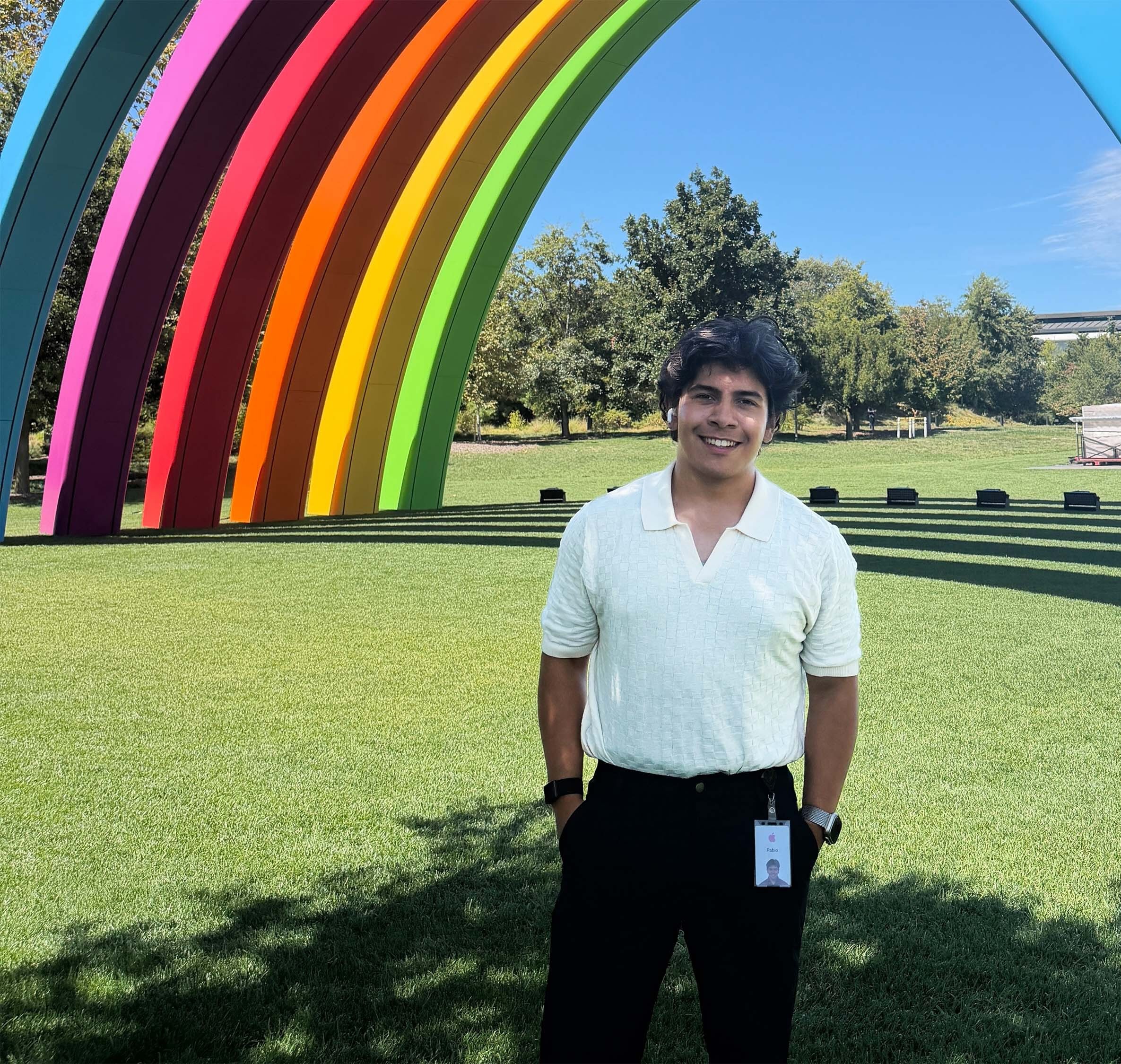
During his second summer as an Apple intern, Pablo Leyva worked at the point where artificial intelligence meets the person holding an iPhone. The NJIT applied mathematics and computer science double major contributed to a customer-facing project involving Apple Wallet’s 18 products, Siri modeling and frameworks, and other native Apple apps.
Rather than developing the underlying AI models, Leyva is focused on the user experience — and on questions that may shape how people live with the technology.
“What does it mean for a human to interact with AI?” Leyva said. “Should you need to talk to a chatbot? Can the AI talk to you first? Should you even need to prompt it?”
Leyva, who expects to graduate in May 2027, can move easily from technical detail to product strategy. Yet the sentence that best explains how he reached Apple has little to do with code.
“A lot of people ask me, ‘How did you get here?’” he said. “It’s not how did I — it’s how did we,’ because the only way to get ahead is to get that support from community.”
Choosing an NJIT future
Technology did not dominate Leyva’s childhood in Tlalpan, Mexico City. His friends met on the street to play soccer rather than organizing through a group chat.
That changed when Leyva moved to the United States around 8 years old. In his new school, a teacher handed him a laptop and told him his classwork would be there. “I was like, ‘What is going on? Where is the whiteboard?’” he recalled. “That was my first exposure to how the world is interconnected.”
At Cranford High School, Leyva took computer science courses and built projects like a nutrition tracker and a text-based chess engine. He later enrolled at a college in Virginia, where he played NCAA Division III soccer and studied applied mathematics. After one year, he chose to return to New Jersey and be closer to his family.
The move meant leaving college soccer behind.
“Soccer has always been my life, and soccer was my past and my present at that moment in 2023,” he said. “But I knew soccer was not going to be my future. I knew an NJIT education was my future.”
NJIT offered the double major and career preparation he wanted. Still, as a new transfer student, Leyva often ate lunch alone in the Bloomberg terminals, in the Ray Cassetta Financial Analysis Laboratory, or completed assignments in the library. His experience changed at the involvement fair, where he encountered the Society of Hispanic Professional Engineers (SHPE).
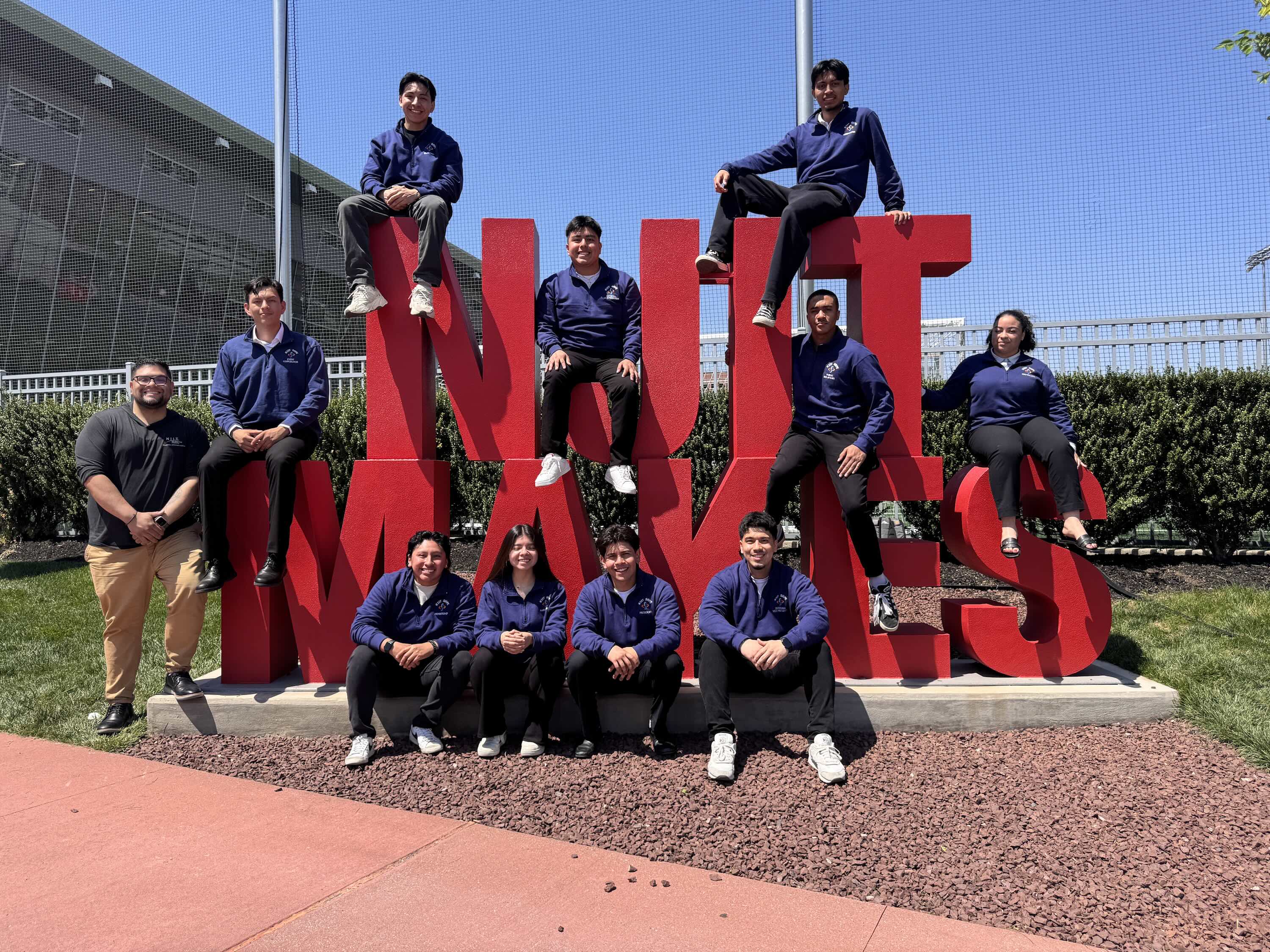
“SHPE was important to me because it was a representation of my identity on campus,” he said. “I could spend time with people who faced the same struggles and feel a place of belonging on campus unlike anywhere else.”
Turning opportunity into a system
Leyva became a SHPE event coordinator during his first semester. At a SHPE National Convention, he secured a software engineering internship with Caterpillar, where a manager first asked him to consider whether AI could analyze a data pipeline he had built.
His initial response was simple: “What is AI?”
The question changed his academic direction. He enrolled in NJIT’s Introduction to Artificial Intelligence course and built an AI project that later helped prepare him for Apple. Meanwhile, as SHPE’s external vice president, he helped connect the chapter with companies including Microsoft and NVIDIA.
At another national convention, Leyva interviewed with Apple but didn’t receive an offer. He continued pursuing the company, waking at 2 a.m. to be among the first students in line at the career fair and repeatedly revising his resume. A second Apple team interviewed him and offered him an internship.
After that first summer back at NJIT, Leyva was determined to turn his experience into a structure others could use. As SHPE president, he created internSHPE, which allowed freshmen and sophomores to shadow the chapter’s president and vice presidents. All three students he directly mentored later earned chapter leadership positions; more than 35 students ran for the 13 executive roles, and the chapter’s gala drew more than 220 people.
Leyva also led a team of 3 undergraduates to build an SHPE NJIT app for iOS and Android in 27 days. It grew to more than 350 active campus users.
More important to Leyva, each student he guided received more than seven internship interviews as sophomores.
“Those students are probably going to be five steps farther than I was when they get to my age,” Leyva said. “College is not just about what you get, but what you give.”
Building an AI experience through conversation
During his first Apple internship, Leyva joined the Apple Pay and Wallet Partnerships team. He worked on an internal agent-based tool designed to help merchants, banks and payment service providers move more efficiently through the Apple Pay onboarding process.
Leyva also treated Apple’s campus as a classroom. To place his assignment within the company’s larger goals, he sought perspectives beyond his immediate team. SHPE relationships helped him connect with Hispanic engineers and join a Latino employee group chat within his first week in California.
“Oftentimes, you’re the only brown person in the room. You’re the only Spanish-speaking person in the room,” Leyva said. “If you don’t feel a sense of belonging in a place, your work is going to be much harder.”
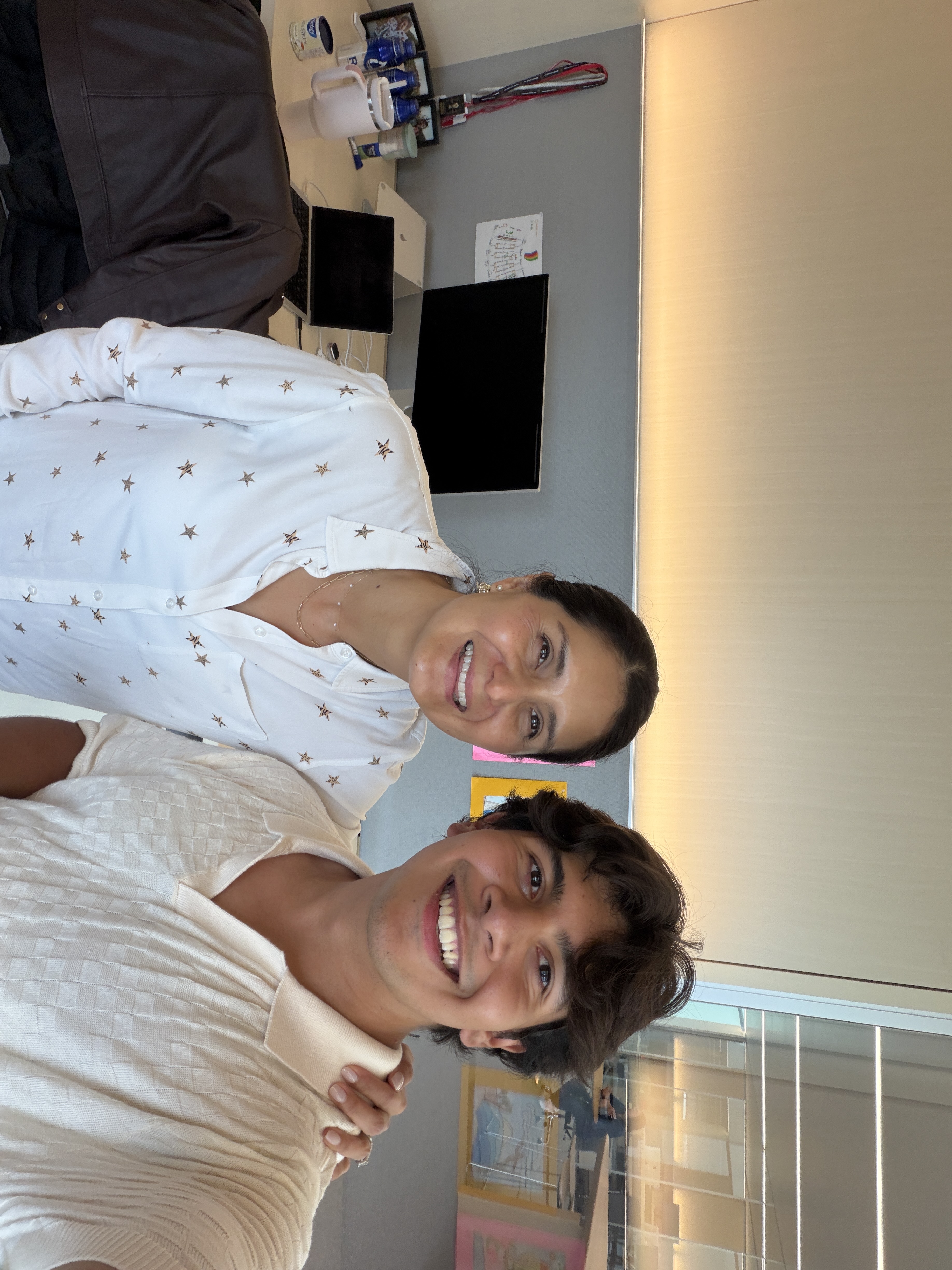
His most consequential connection was Lilian Rincon, Apple’s vice president of product marketing for AI, who took Leyva under her wing and listened to his proposals. Rincon moved from Venezuela to Canada at age 9, found confidence in mathematics and built a computer science career. After working at Skype and Microsoft, she spent nine years at Google, helping build Google Assistant and later leading its global Shopping product organization before joining Apple.
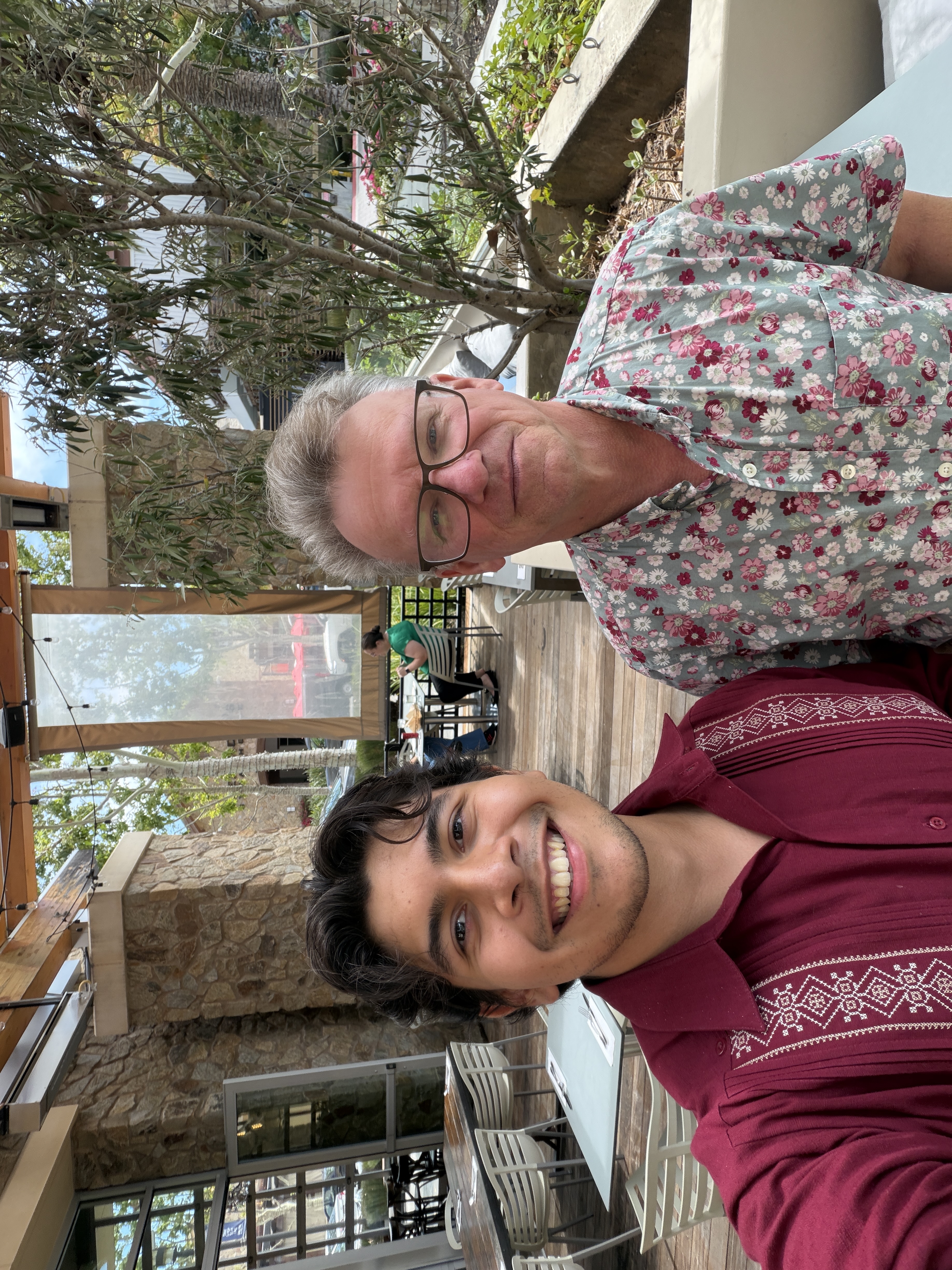
During his time at Cupertino, Leyva also met Apple co-founder Steve Wozniak and Chris Espinosa. Espinosa began working with Apple in 1976 at age 14, and became employee No. 8. Leyva had heard that Espinosa rarely answered unsolicited messages, but he wrote anyway. Espinosa replied, met with him, and listened to an idea connected to Leyva’s internship.
This summer his assignment moved him closer to the customer experience, requiring collaboration across Wallet, Siri and other Apple apps. Leyva sees the work as part of a larger question about how an AI system that travels with users should enter their lives.
“We’re talking about the relationship between an AI system that lives on our phone and comes with us everywhere,” he said. “How much of an impact should it have in our lives, and what type of impact is meaningful?”
Success measured in the plural
For Leyva, education has never felt automatic. Growing up in Mexico City, he saw how strongly classmates and neighbors valued the possibility of attending the National Autonomous University of Mexico, UNAM. After moving to the United States, he understood that even a difficult assignment represented access someone he knew in Mexico would have welcomed.
“Simply doing the boring, repetitive math problems that the kids next to me complained about — for me, it was a privilege,” he said. “I was given an opportunity to be in a place where other people would love and trade anything to be in.”
That awareness shapes the standard he sets for himself.
“I have to work not as hard as Pablo can work,” he said. “I have to work as hard as anyone who would be in my position. That means my ten friends in Mexico. That means my 20 cousins in Mexico. How do I work as hard as they would work here — or harder?”
Leyva is also quick to credit the mentors who showed him what was possible. One of the first was Roberto Saenz ‘24, then an NJIT senior studying mechanical engineering, who reviewed Leyva’s resume, introduced him to LinkedIn, taught him how to prepare for an interview, and introduced Leyva to SHPE. Saenz later connected him with alumni working at NVIDIA, Google and a medical technology company.
Those mentors helped Leyva prepare presentations for Apple leaders and develop a strategy for earning a full-time opportunity. Their example also led him to think about how mentorship can become lasting support. NJIT alumnus Daniel Vargas ‘15, a leader in the Hispanic and Latinx Leadership Council (HLLC), created a scholarship for students — an example Leyva hopes to follow.
Every single alumnus I’ve met at NJIT has taken the time to make an impact on me.
He also highlighted how alumni Nick Fuentes-Zuluaga ‘19, co-chair of HLLC, and John Canela ‘15 have been influential in the process of him obtaining internships that have transformed his career. Both have spent countless hours writing referrals as he applied to multiple internships.
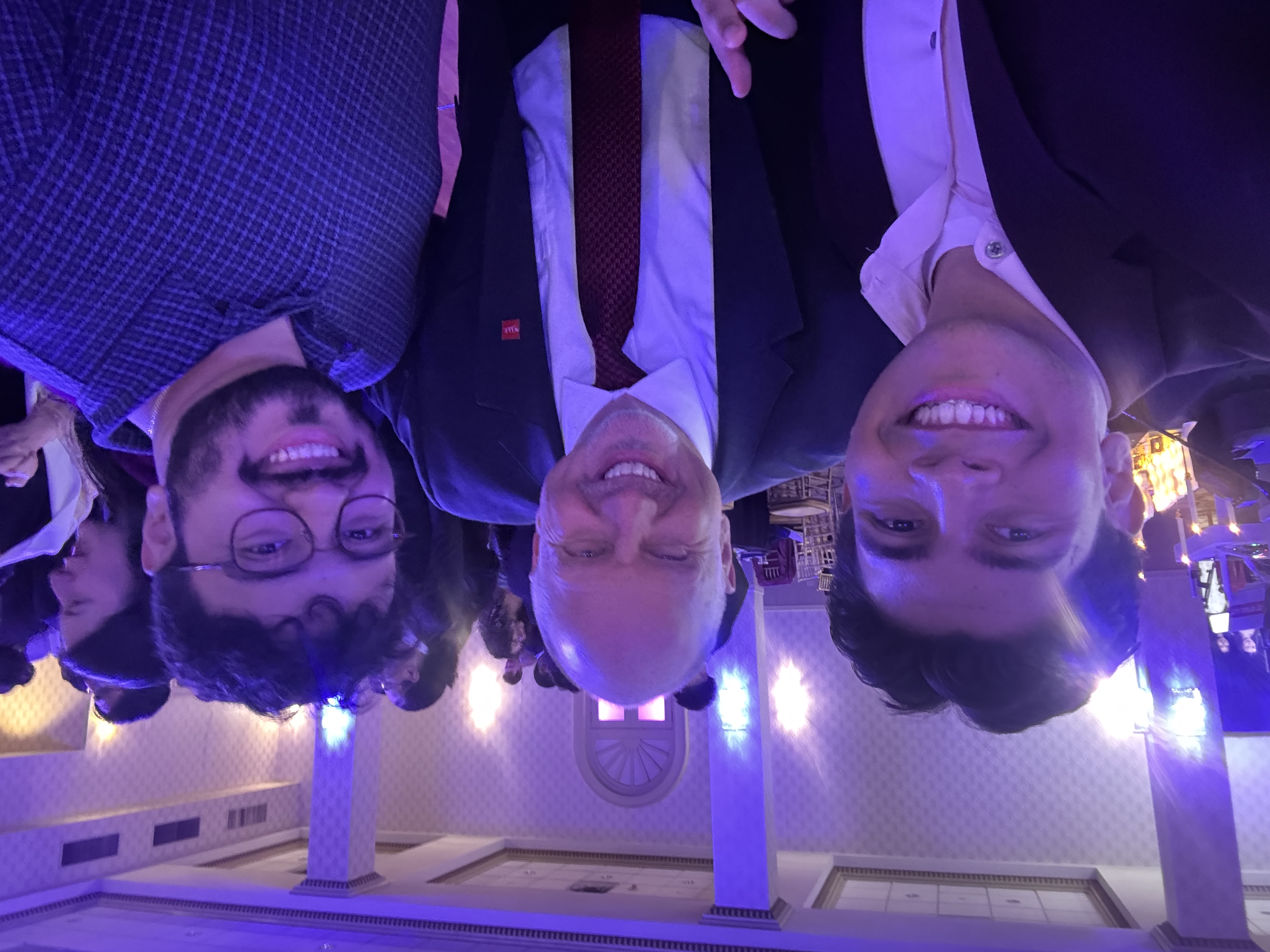
“Every single alumnus I’ve met at NJIT has taken the time to make an impact on me — someone who is not a blood relative — and yet they chose to believe in me and give me a shot,” Leyva said. “I think about all the people who were not in the right place at the right moment to meet them. How do I serve them?”
Leyva imagines creating scholarships, offering internships to high school students and eventually building companies that provide jobs. His immediate goal is to earn a full-time return offer from Apple after graduation. Beyond that, entrepreneurship and AI ethics represent other ways to create the access his mentors created for him.
“The NJIT community has served me, and I have served it,” he said. “Now I’m graduating with that experience, with the goal of: How is the world going to serve me, and how am I going to serve it?”
For Leyva, the road from Mexico City to Newark to Cupertino is not simply proof of how far one student can travel. It is evidence that a path exists — and a responsibility to make it wider.
