From NJIT to Colgate-Palmolive: PhD Student and Alum Advance the Science of Touch
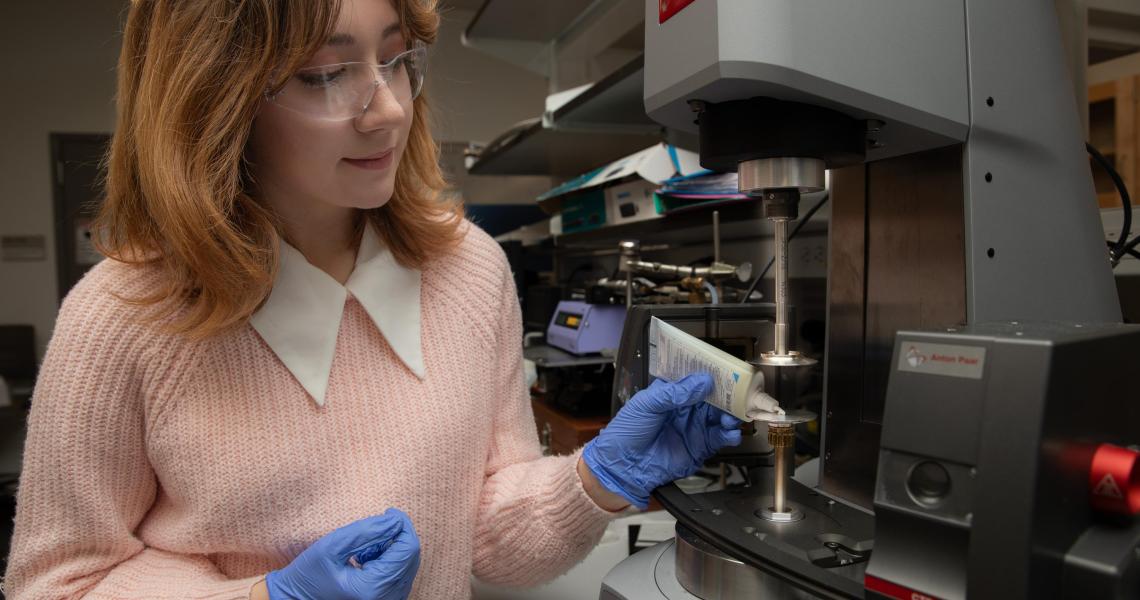
New Jersey Institute of Technology Ph.D. student Günel Nabiyeva has co-authored a new study in the International Journal of Cosmetic Science that demonstrates how engineering tools can accurately predict how sunscreens “feel” on the skin — bridging scientific measurement and human perception.
The collaboration, which began through a National Science Foundation (NSF) INTERN supplement and continued under NJIT’s Experiential Learning Opportunity Program (ELOP), connects academic research with industrial product development at Colgate-Palmolive.
Quantifying Sensory Perception
The paper, “Sunscreen Sensory Attribute Prediction via Textural, Rheological and Tribological Tests,” published in International Journal of Cosmetic Science, identifies instrumental methods that can replicate the subjective judgments consumers make when evaluating skincare products. Using texture analyzers, rheometers, and tribometers, researchers compared the physical behavior of eight commercial sunscreens with sensory ratings from trained human panels.
The results revealed that mechanical properties such as yield stress and friction coefficient could predict perceived attributes including thickness, spreadability, absorption and stickiness — with strong statistical correlation.
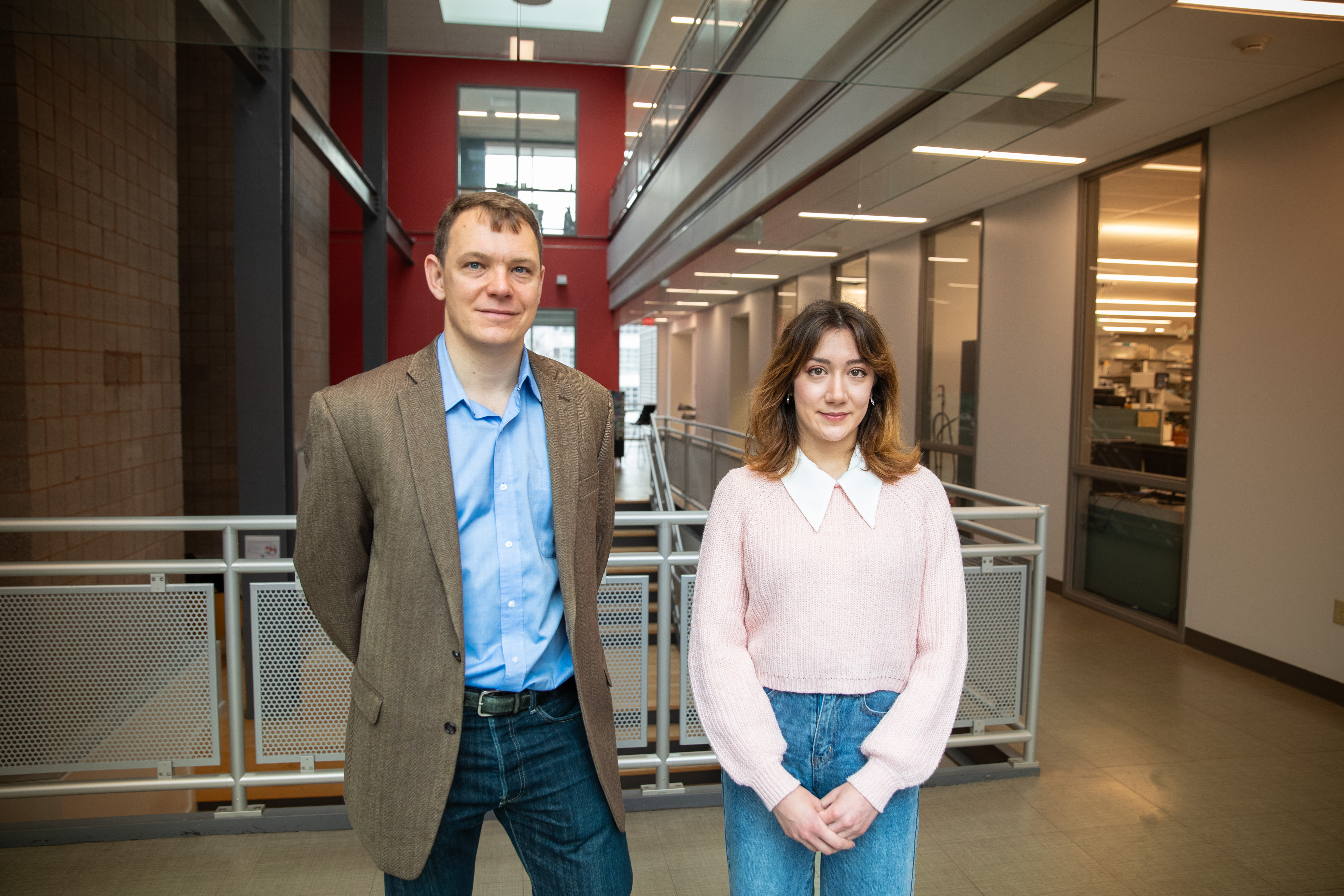
Professor Gennady Gor and Ph.D. student Günel Nabiyeva
“We trust our senses when we assess various properties of materials, solids or fluids,” said Gennady Gor, associate professor in NJIT’s chemical and materials engineering department. “If something is heavy we say it has high density. If something flows very slowly, we say it has high viscosity.
“However, there are more complicated senses. Let us consider sunscreen. It is easy to say that one sunscreen is ‘thicker’ than the other, or one spreads better than another. These senses are harder to quantify as they often involve a combination of properties. And these are the sensory attributes we went after,” Gor said.
From Academic Curiosity to Industrial Application
Nabiyeva joined Colgate-Palmolive in July 2024 for a six-month NSF INTERN placement under the supervision of NJIT alumnus Baran Teoman and Andrei Potanin. She later continued through the ELOP program with Tatiana Brinzari in 2025. At Colgate, Nabiyeva expanded her expertise beyond the mechanical analysis of porous materials to explore rheology — the study of flow and deformation in soft materials.
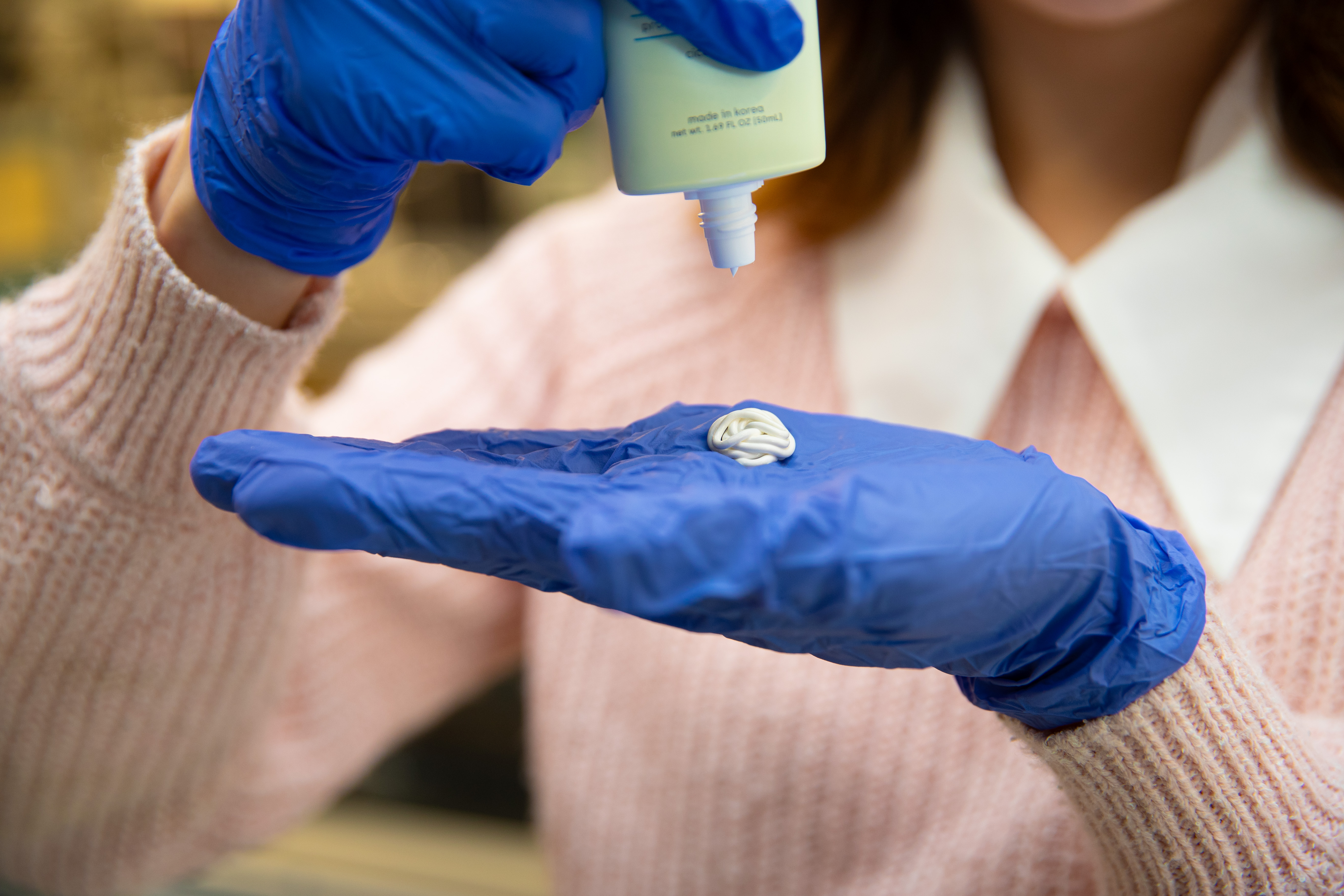
The research is bridging scientific measurement and human perception.
“While I had experience studying the mechanical properties of soft and porous materials at NJIT, rheology was a completely new direction for me,” she said. “At Colgate … I worked in the rheology lab with Dr. Baran Teoman and Dr. Andrei Potanin. It was a cool experience to correlate the thickness of skincare products, such as sunscreens, with sensorial attributes evaluated by panelists. Through this work, we were able to identify a clear boundary beyond which consumers either liked or disliked the products.”
Her efforts contributed directly to the paper’s findings, showing how a few measurable parameters can serve as proxies for complex sensory feedback traditionally obtained from costly, subjective human studies.
Engineering Collaboration Across Sectors
The project also highlights the growing partnership between NJIT and Colgate-Palmolive, which has supported several NJIT graduate students through ELOP. For Gor, the collaboration represents a new experimental direction for his research group and a model for experiential learning in engineering education.
For Teoman, it’s an extension of the path he forged years ago as one of the first doctoral students to collaborate with Colgate, predating the ELOP. The progression of Ph.D candidate to research scientist to mentor has given him an experiential full-circle moment.
“As an NJIT alumni, I am proud to be the pioneer of this collaboration between NJIT and Colgate,” said Teoman, who earned his M.S. pharmaceutical engineering and Ph.D. in chemical engineering at NJIT. “This collaboration helped me not only publish several papers during my Ph.D. studies … it helped me secure a postdoc position at Colgate and a permanent research scientist position afterwards.”
Reflecting on Nabiyeva’s role, Teoman added: “Günel is a very dedicated, smart, and hardworking Ph.D. student … She rapidly developed rheology, tribology, and texture analysis skills … and helped train other students at Colgate. We were able to obtain quite interesting results on sunscreen sensory analysis within 6 months or so, which ended up as a solid paper in International Journal of Cosmetic Science. I have to say that I learned a lot from Günel as well, and this collaboration helped me to become a better mentor or supervisor.”
He further noted the mutual value of applied research: “We, in industry, are mostly focused on developing scientific methods, supporting product development, and eventually, pleasing the consumers with high quality products. This often contradicts with academic perspective. However, just like in the case of Günel’s research, as long as there is a mutual benefit and direct link between academic research and the applicability of the results to the industry, the collaboration becomes really fruitful for both sides.”
Advancing Applied Research at NJIT
The collaboration now extends beyond sunscreens. Through ELOP, Gor’s team is applying its expertise to other consumer products and testing new ultrasonic methods for characterizing materials. The project has also inspired students to pursue application-driven research with direct industry impact.
“If we could quantify all the sensory attributes, it would accelerate the development of any product,” Gor said. “Now when any consumer product is developed … it should go through a lengthy process of evaluation by human panels. The overall goal is to come up with simple instrumental testing which could measure something like the ‘gloppiness’ of a soap.”
As NJIT and Colgate build on this partnership, projects like Nabiyeva’s highlight how academic inquiry and industrial problem-solving can reinforce one another — translating laboratory discoveries into practical advances that shape both research and consumer innovation.