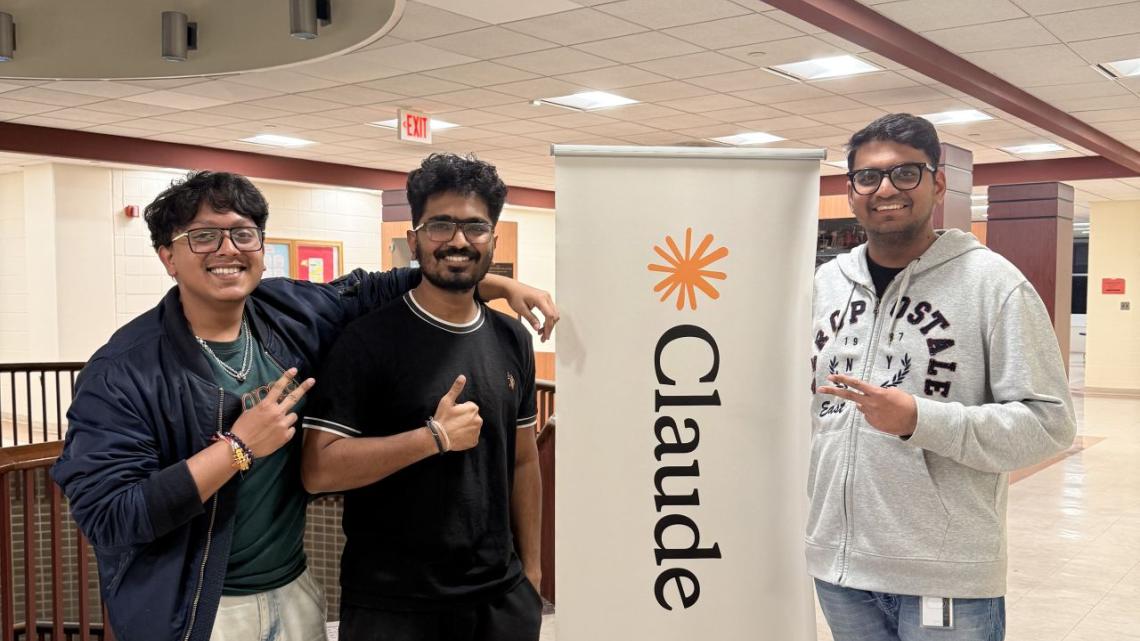
When four graduate students in the Ying Wu College of Computing aim to win consecutive, highly competitive hackathons by producing two working prototypes in a matter of hours – they “mean it.”
M.S. in Computer Science students Dev Trivedi and Aakash Singh, along with Pruthvi Kadam M.S. ’26 (Data Science), won Creative Flourishing Track at the Claude Builder Club Spring 2026 Hackathon at NJIT for Mean It, a Claude-powered guided writing companion. They were joined by M.S. in Data Science student Niharika Jadhav for Concord Lite, a diagnostic and repair layer for multi-agent AI workflows, which won Open Track and Overall Best Build at the AG2 Hackathon at Fordham Gabelli School of Business.
The Claude Builder Club Hackathon at NJIT dictates a 10-hour time limit to bring an idea to working prototype within the theme of social impact that demonstrates creative thinking as much as code acumen.
The event is part of a global Claude Builder Club event that occurs across 78 universities in 12 countries and is sponsored by Anthropic.
Mean It, which came with an award of $500 API and $100 cash, assists users with composing emotionally difficult messages, such as those for apologies, eulogies, farewell letters, et al. It was built around the belief that AI should not replace a person’s individual expression and voice and uses agentic helpers (personalities) to prompt questions and guide the user.
“Mean It asks thoughtful questions and helps the user surface their own words,” said Trivedi. “The final message is meant to feel personal, honest and human.” Live Demo.
AG2, formerly AutoGen, is an open-source framework for building multi-agent AI systems created by former Microsoft employees, some of whom act as judges for the hackathon. The AG2 Hackathon at Fordham is a full day event which includes a hands-on workshop to prepare participants, followed by a day-long marathon for building working prototypes and demoing them at the end.
Concord Lite helps developers understand why an AI agent workflow failed, identify the root cause, suggest a repair, and validate the fix through testing.
“The project was built for AI systems where multiple agents work together. In these systems, failures can be difficult to debug because each agent may pass information, assumptions or incomplete context to another agent,” Singh explained. “Concord Lite makes the workflow easier to inspect, debug and repair.” Live Demo.
Trivedi and Singh credit Professor Ioannis Koutis with encouraging them to participate in hackathons in the first place.
“Dr. Koutis has taught us how to think. He does this in a manner that makes us feel comfortable, and he is the first professor to do this in our opinion,” Trivedi observed. “He motivated us to think less academically and concentrate more practically on use cases and suggested that hackathons would be a good way to do this.”
