Honors Scholars Turn Research, Service Learning Into Real-World Impact
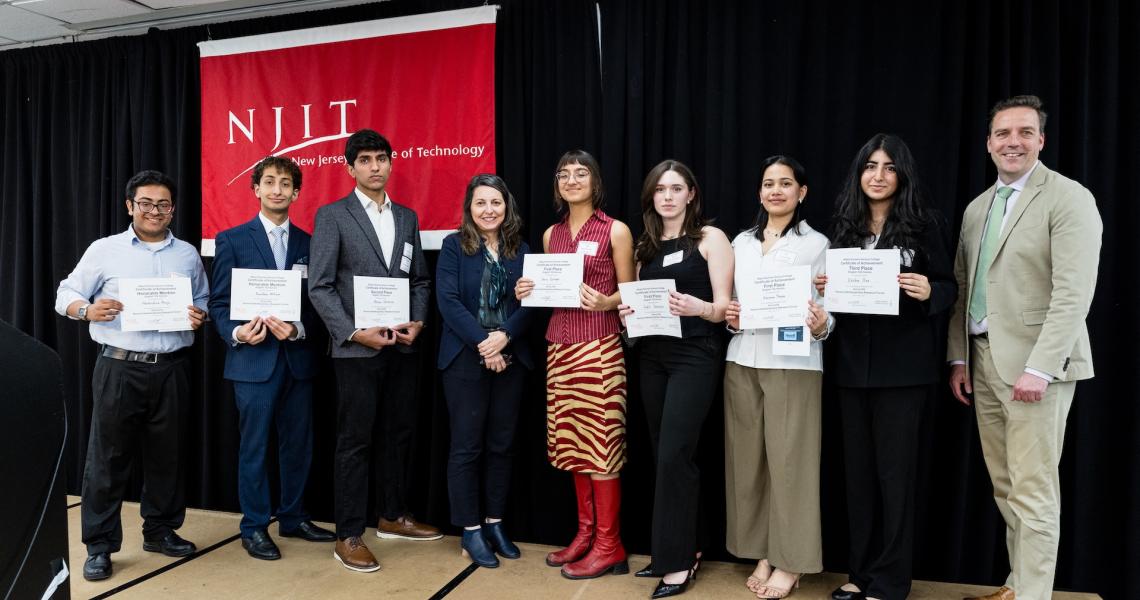
Students from Albert Dorman Honors College courses presented their semester’s research during the fifth Honors Interdisciplinary Research Forum, showcasing projects that ranged from bias in generative artificial intelligence to engineering responses for environmental challenges along Newark’s waterways.
The forum brought together scholars from four honors courses: Introduction to Research Writing, Introduction to Research Methods, Introduction to Entrepreneurship, and Service Learning Experience for Engineers: Life on the River. The event also welcomed parents and family members, giving them a close look at work that extends beyond a single assignment or course grade.
“Applied learning is a hallmark of the Honors education, and we've been embedding research opportunities, global studies opportunities and service learning opportunities throughout the curriculum here in the Honors College,” said Louis Hamilton, dean of ADHC. “I want to thank everyone who's helped bring this together and participated.”
Provost John Pelesko also recognized the family members in attendance, noting that about 30 parents and relatives were present to support students.
“What you see your students doing is the kind of work that doesn't fit deeply into a single grade or a single assignment,” said Pelesko.
The work presented at the forum came from 69 scholars in Introduction to Research Writing, where students take a problem and examine it from multiple perspectives; 24 scholars in Introduction to Research Methods, who were paired with faculty mentors across nearly every college on campus and developed summer research proposals; 19 scholars in Introduction to Entrepreneurship, working in five teams on real entrepreneurial projects; and 22 scholars in Service Learning Experience for Engineers: Life on the River, taught by Emily Tancredi-Brice Agbenyega, university lecturer in civic engagement in the Honors College and Ashish Borgaonkar, assistant professor of engineering education in the Newark College of Engineering. Stewart Abrams of Langan Engineering and Carl Anderson of the National Oceanic and Atmospheric Administration (NOAA) served as course advisors as well.
Those service learning students have been developing engineering responses to environmental problems in Newark as part of the College’s Life on the River initiative.
“These students have been working on real engineering responses to real environmental problems in Newark as part of our Life on the River initiative — engineering students working alongside industry and federal scientists on the river that runs through our city,” said Pelesko. “That's what experiential learning looks like when it's at its very best.”
Pelesko praised the students for taking on work that many undergraduates do not experience until much later in their academic careers.
“Most students at most universities go four years without doing what you're doing here today,” he said. “You spent a semester on a real problem, and you're here to talk about it. That deserves tremendous recognition. We're all proud of you, and I hope each of you feel proud of the work that you've done.”
Student Research Takes on Technology and Bias
Across the Introduction to Research Writing presentations, students treated research as a way to enter larger public conversations — from Newark food deserts and public housing to telehealth, public transit, sustainable AI and the ethical risks of algorithmic systems.
Architecture student Sarla A. Iyengar won first place with her project, “Bias in Generative AI,” which examined how training datasets shape AI-generated design outputs and the narratives those images communicate.
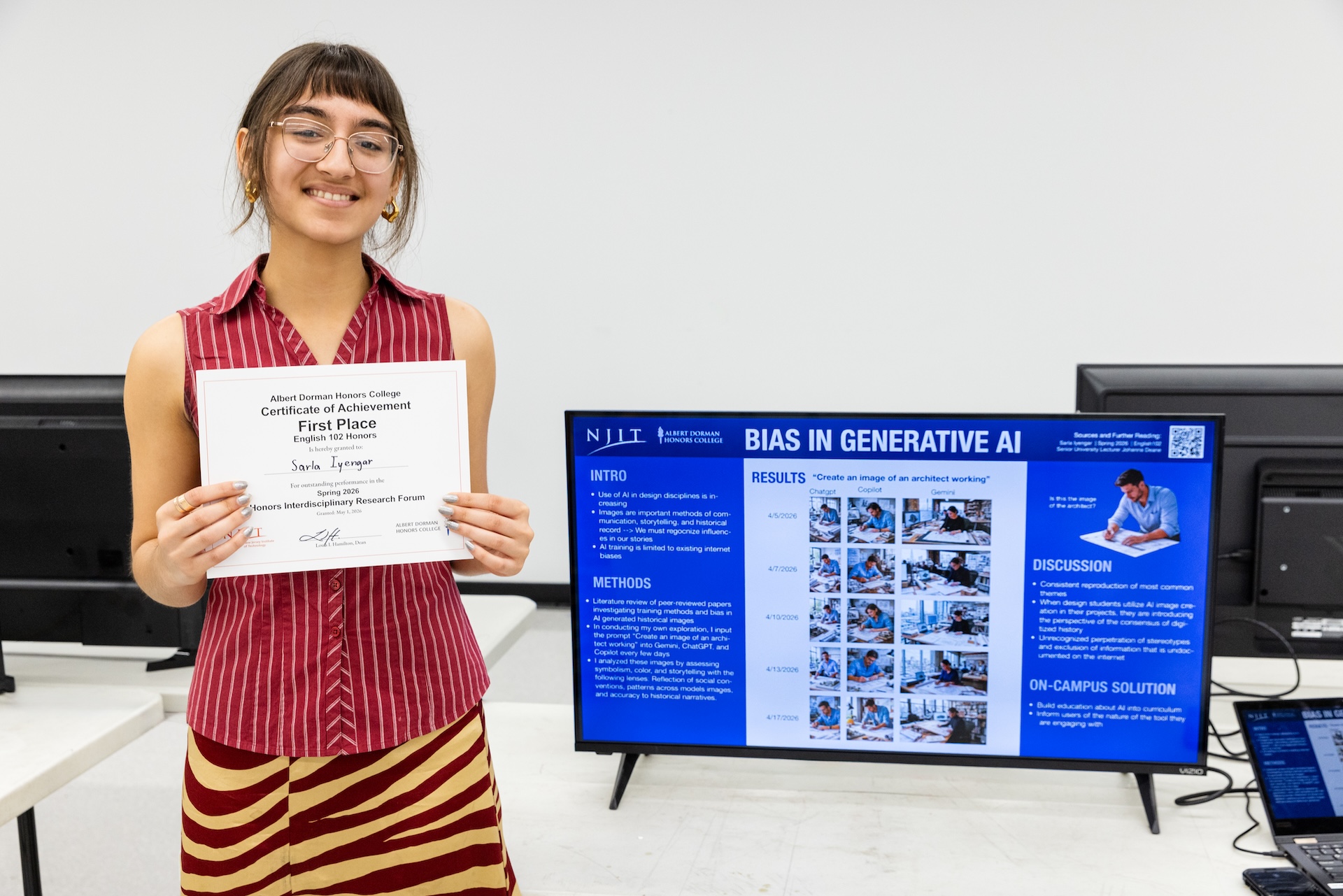
Sarla A. Iyengar explored how AI-generated renderings can carry hidden bias in design work.
“I was looking at bias and generative AI specifically in design disciplines,” said Iyengar. “I looked at how training data sets influence outputs and what the effects of that are changing — like narratives, in the way we look at images, in the way that images communicate, especially if they’re AI based.”
Iyengar said the topic came from watching students turn to AI tools to finish renderings under deadline pressure, sometimes without fully understanding the bias behind the images being produced.
“So often, it’s little parts of a project that people will just give up their identity and their agency over and just give to AI to render for them because it saves time,” she said.
The win carried extra meaning because her father was there to see it.
“I was surprised. I didn’t know he’d be here,” said Iyengar. “I wasn’t expecting to win, so I’m really glad that he was here to see me.”
Service Learning on the River
Students in the Service Learning Experience for Engineers course presented projects connected to Newark’s waterways as part of the Life on the River initiative. Though their work was not judged as part of the competition, the course reflected the forum’s emphasis on applied learning and community engagement.
One group proposed improvements to a section of Branch Brook Park near the Second River, a tributary of the Lower Passaic, including a bridge overlay structure, crosswalk, native plantings, a rain garden and a dock area to make the site safer, more accessible and more welcoming.
Senior Construction Engineering Technology student and Newark Mayor’s Scholar, Kaily Valentina Peixoto, one of the team leads, said the project gave her a new connection to a major park in her own city.
“For me personally, I’m from Newark, but I have never really interacted with Branch Brook Park,” she said. “It was interesting for me to get involved with this class and really impact the community.”
Michelle Andreina Caceres, a mechanical engineering student from Union City, said the first site visit helped the team understand the need for the project.
“When we did our first site visit, we realized how chaotic it was,” she said. “We had a broken path, and there was so much going on that we didn’t really notice until we went inside.”
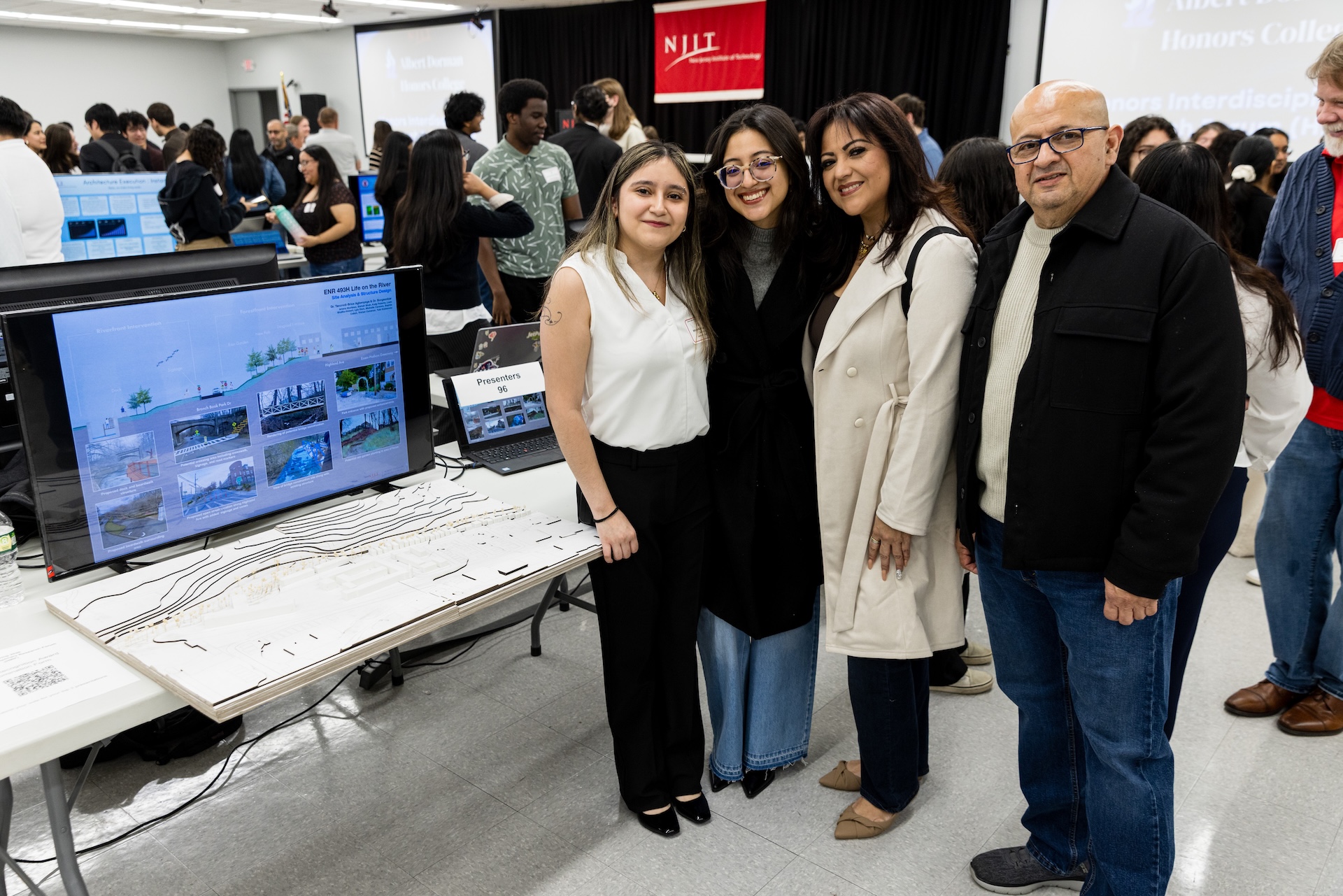
Michelle Andreina Caceres with her family during the fifth Honors Interdisciplinary Research Forum.
Her father, Omar Caceres, said seeing his daughter present work tied to community and environmental improvement made him proud.
“It’s very exciting for me to be here, where she’s presenting projects that are supporting humanity,” he said. “It makes me feel very proud to see all the effort she’s putting into this project, so she can achieve her goals.”
Winners
Introduction to Research Writing
First Place
Sarla A. Iyengar, “Bias in Generative AI”
Judit Escofet Sánchez, “AI-Mediated Environments and the Changing Psychology of Life in Digital Hyperreality”
Garima Thapa, “Can thoughtful deployment of AI models deliver equity for the underprivileged?”
Second Place: Rehan Ibrahim, “Operationalizing Predictive Control in University Dining: IoT-Based Waste Tracking and Data-Driven Forecasting as a Framework for SDG Alignment”
Third Place: Eesha Miraj Oza, “The Multifaceted Challenge of Prehospital Stroke Delay: Bridging the Gap Between Knowledge and Action Among College Students”
Honorable Mentions
Jonathan William, “Smart Contract Infrastructure, LLMs, and Game Theoretic Incentive Structure for Health Insurance Claims Processing”
Harkrishna Ahuja, “Advanced Process Treatment and Policy Frameworks for Contemporary Contaminants in the U.S. Water Cycle”
Introduction to Research Methods
First Place
Anne Therese Parana Argonza, Kien Ho, Shreya S. Kamath, Yashasvi Nekkanti, “Leveraging a Convolutional Neural Network to Analyze Brownian Particle Trajectories for Gastrointestinal Health Applications”
Honorable Mentions
James Christopher Halpern, “The Relation of LLMs & Empathy”
Emilia Mikhnevich, “Ultrasonic Monitoring of Epoxy Resin Properties with Varying Humidity Conditions”
Ria Mansi Saketh, “Examining the Association Between County-Level Gender Pay Gap and Intimate Partner Violence Victimization During the COVID-19 Pandemic in the US”
Introduction to Entrepreneurship
First Place
Rehan Ibrahim, Ariana Kyazze Nakyazze, Aleen Riaz, Eva M. Tomasheski, “Glowie: a device to analyze and prevent acne infections”
Peer Recognition Award
Alisha Hada, Arjun Merchant, Jaylen Phipps, Colin Salandy, “Sounder: a solution to enable friends to connect while at events, where WIFI fails”