HCSLA Researchers Take Visitors on AI Exploration: From Space Weather Forecasting to Ethical AI
If you wanted to see how AI and research across the humanities and sciences are reshaping each other in real time, NJIT’s Jordan Hu College of Science and Liberal Arts (HCSLA) offered a front-row seat during the university’s first AI Exploration Day.
The all-day AI takeover of campus highlighted the college’s diverse faculty and student research — covering everything from what the future holds for ethical AI design and robotics, to the latest AI-assisted efforts to alert Earth of eruptions on the Sun.
Among the major topics of the morning’s breakout sessions were ongoing research within HCSLA’s Department of Physics into AI-driven space weather forecasting, aimed at better predicting solar storms that can upend daily life on Earth.
NJIT has been leading such efforts nationwide, securing National Science Foundation (NSF) funding last year for an AI-Powered Solar Eruption Forecasting System, along with a $5 million NASA grant to launch an AI-Powered Solar Eruption Center.
Bin Chen, professor of physics and director of NJIT’s Expanded Owens Valley Solar Array (EOVSA), offered a session describing how AI is transforming radio studies of the Sun and space weather research. One project presents detecting and classifying solar radio bursts in near real time — a feat that was unimaginable just a few years ago.
Chen said these bursts — intense energy eruptions from the sun his team detects through NJIT’s radio telescope array stationed in California — have the potential to significantly disrupt technologies on Earth.
His team has turned to AI models to automate processes for detecting these events, which he said have enabled real-time visualizations and alerts that could guide scientific missions and space weather responses aligned with priorities outlined in the National Space Weather Strategy and Action Plan.
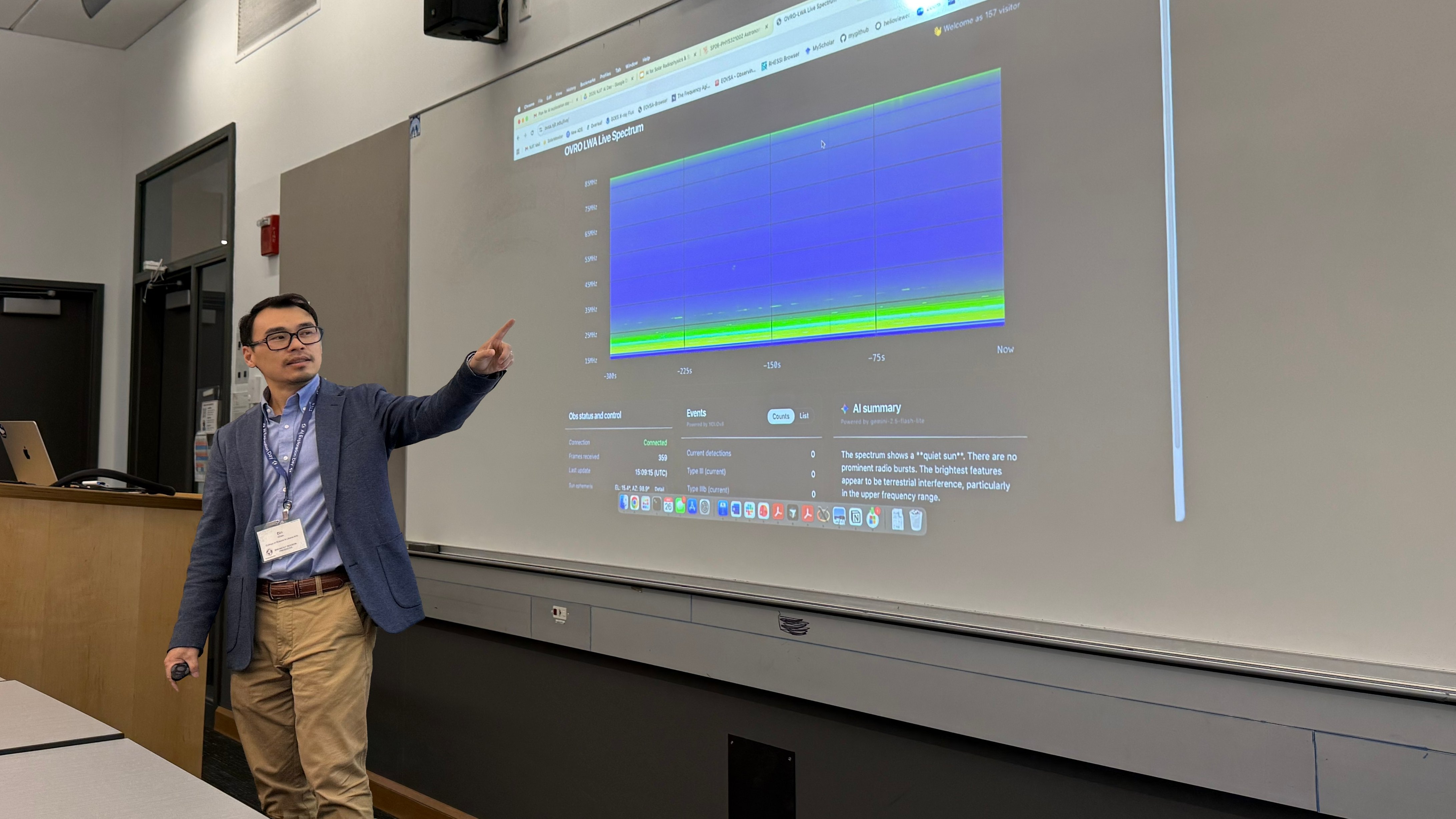
“We’re moving from AI as a tool for efficiency to AI as a transformative force in space weather observation,” Chen said. “With traditional methods, recovering a single image could take one to two hours. Using AI, we can do it within a second.
“While we’re still working to ensure the AI-generated products are scientifically sound and meet all physical constraints, this leap in speed makes real-time space weather alerts achievable in ways not possible before.”
AI’s increasing role in precision medicine was also highlighted, with Assistant Professor of Mathematics Chong Jin discussing AI-led advances in mass spectrometry, a tool used to identify proteins for disease detection and drug development. While the technology can identify molecules accurately, measuring their quantities often requires costly chemical standards.
However, Jin said his collaboration with chemist Hao Chen at NJIT’s Mass Spectrometry Center is now applying AI models trained on vast chemistry datasets to uncover patterns that make measurement more accessible. “Large foundation models have the power to fundamentally improve our understanding of chemical space, and accelerate biomedical discovery,” Jin said.
Humanities and ethics professor Daniel Estrada shifted the focus from technical advances to AI’s social dimension.
His presentation introduced richROT, a semi-autonomous trash-can robot he built in 2015 that has since traveled the country with him and appeared at festivals like Burning Man, sparking spontaneous interactions and friendships along the way.
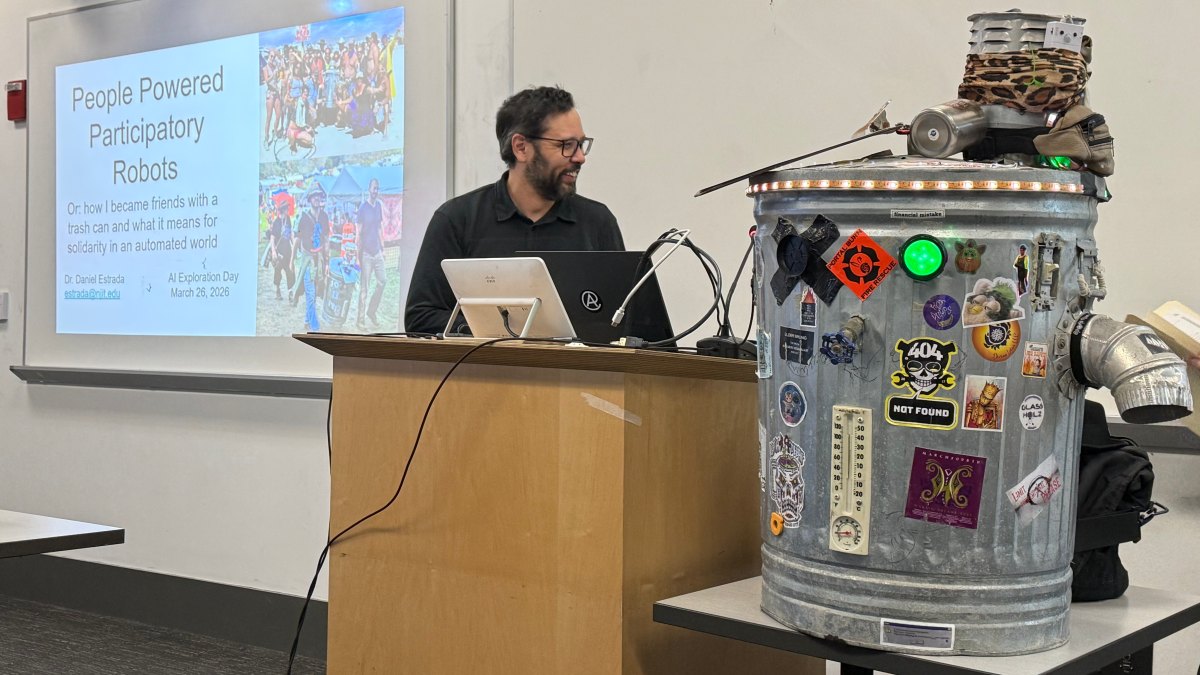
Estrada posed a pointed question to attendees: What if cooperation, rather than intelligence, should be AI’s defining benchmark?
“What might function as a Turing Test-like analog for cooperation rather than intelligence? … richROT has no ulterior motives or interested third parties controlling its behavior. It represents no interests beyond bringing people together and having a good time,” Estrada said. “By caring for richROT, people are indirectly showing care for each other, creating community bonds that go beyond the transactional interactions common in most of today’s chatbots and other AI products.”
By mid-afternoon, the focus turned to students.
KET-A Williams ’26, a McNair Scholar and cyberpsychology major, was among the undergraduates presenting at the showcase.
Her research explores how underground fungal networks known as mycelium — which distribute nutrients and chemical signals without centralized control — might inspire new models for AI design.
“My interest in mycelium began while working on a medicinal mushroom farm,” she said. “What struck me most was their drive toward symbiosis — sustaining not just themselves, but entire ecosystems through relational exchange. That shifted how I began thinking about intelligence more broadly.”
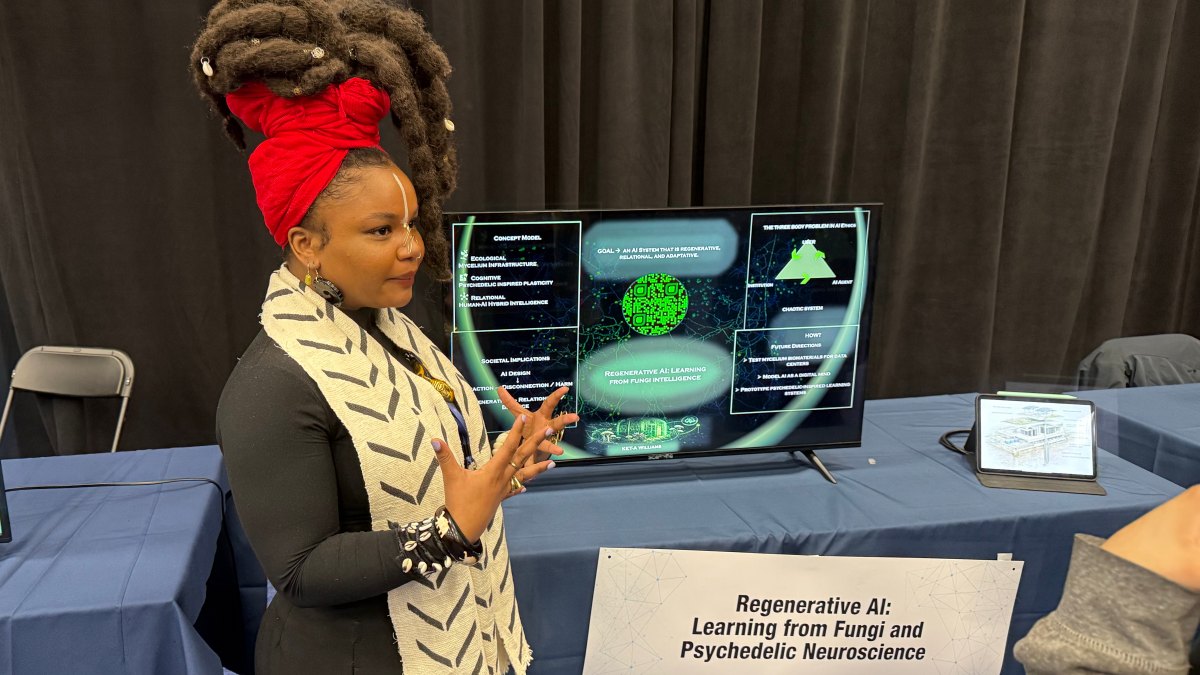
Williams said she is interested in such AI systems that may function as adaptive, distributed networks — redistributing computational load, responding to environmental constraints and minimizing extractive energy use. She refers to this approach as “regenerative AI,” drawing on biological systems that sustain balance rather than maximize output.
“My work asks how AI can be designed not just as isolated machines, but as systems that grow and adapt in harmony with their environment,” she said.
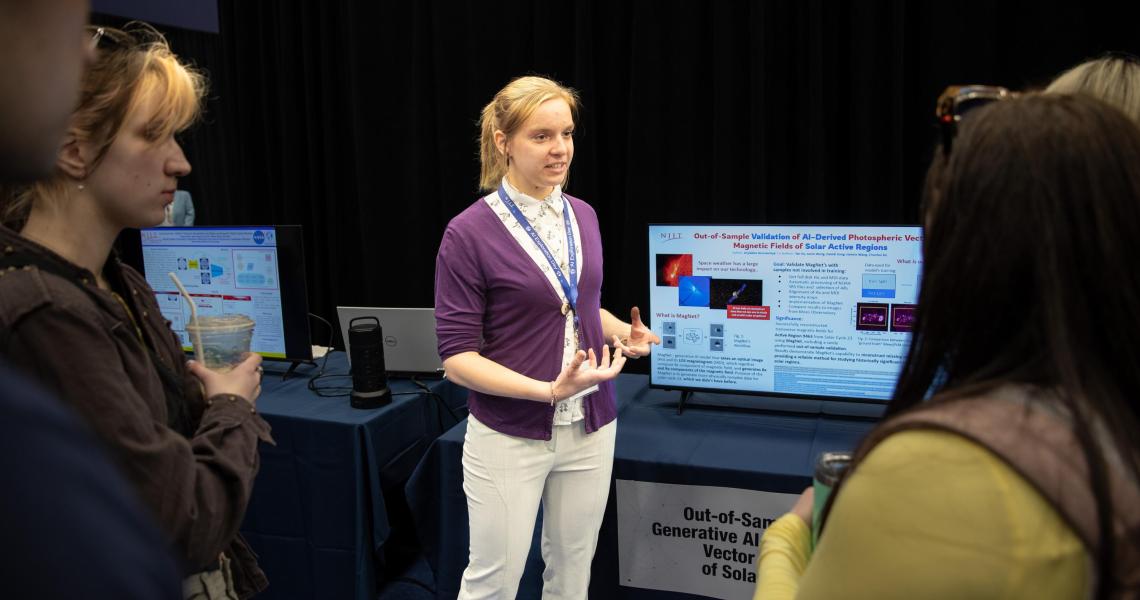
Ariadna Yesmanchyk ’27, an applied physics major, was also among the presenters — showcasing how she’s harnessed generative AI to revisit, and rediscover, some of the Sun’s most extreme eruptions from decades ago.
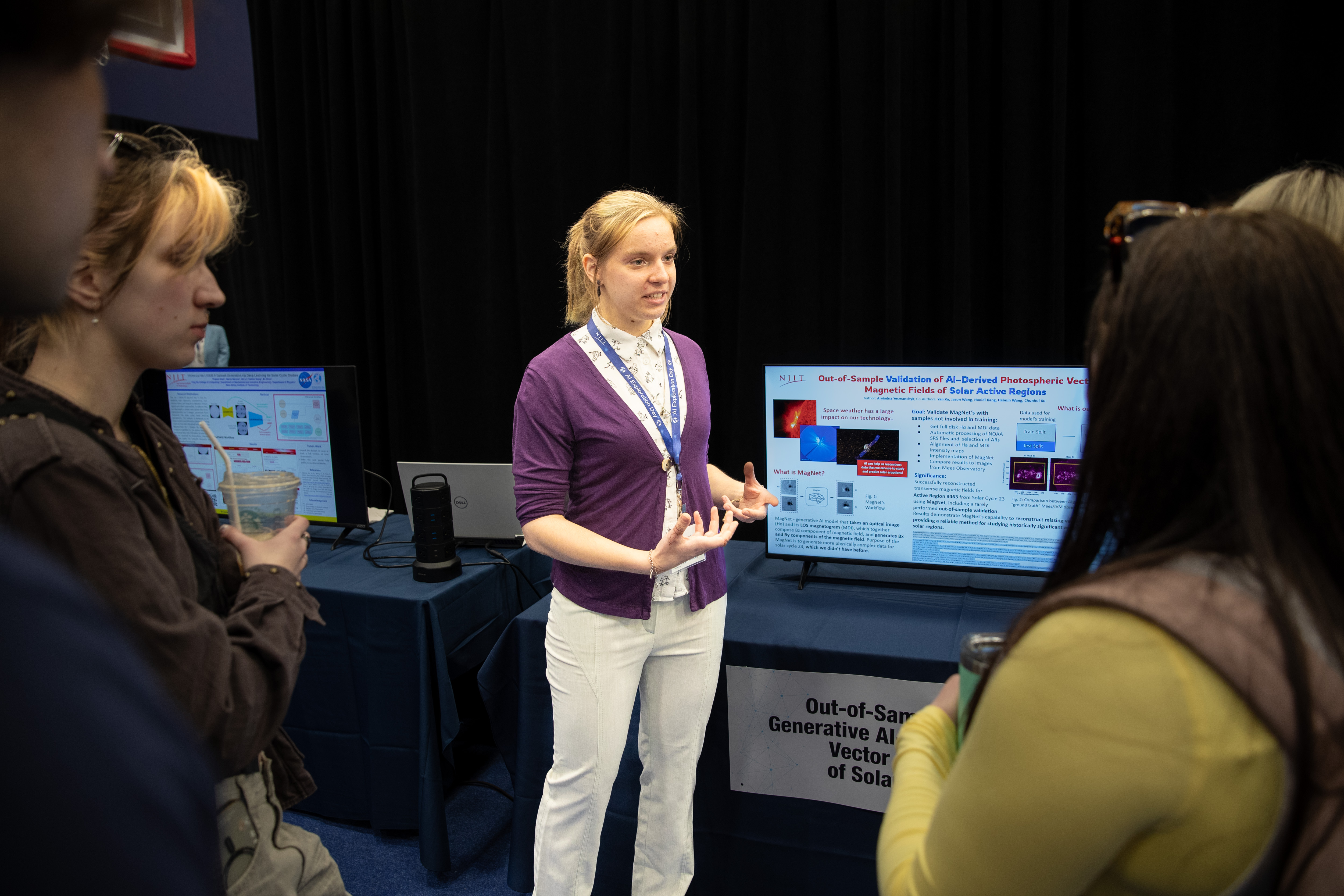
Using an NSF-supported model called MagNet, she’s reconstructing detailed magnetic field maps of solar active regions — the source of powerful flares and coronal mass ejections — from periods before today’s high‑resolution instruments existed.
Her research has recently reconstructed Active Region 10486 on the Sun as it triggered the “Halloween storms” of late October and early November 2003 — among the most intense solar events of the space age. On Nov. 4, 2003, the region produced an X‑class flare later estimated as high as X40.
Yesmanchyk says her recent efforts helped generate what she described as “one of the first” detailed magnetic maps of that active region, allowing researchers to better understand the event.
“It’s exciting to see doors to discoveries that can be opened as AI is applied more in solar physics,” said Yesmanchyk, an Albert Dorman Honors Scholar who has spent two years verifying and refining the model’s output using independent observations. “It gives us a way to recover and understand data from periods we couldn’t fully observe before.”