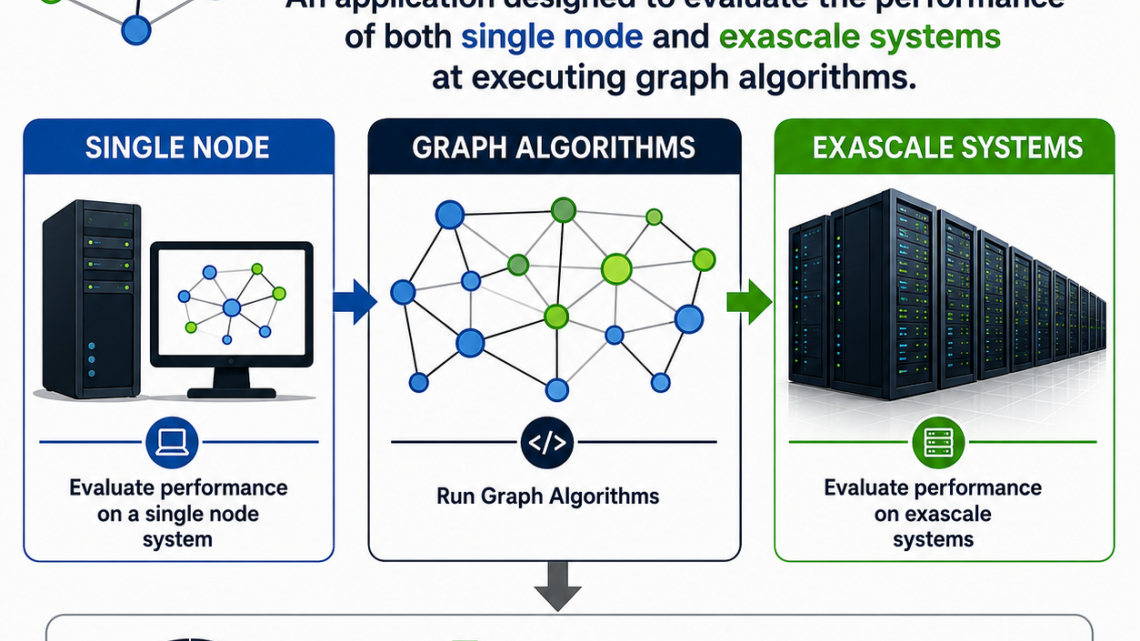
854.graph500, a graph analytics benchmark developed by David Bader, distinguished professor and associate dean for research in the Ying Wu College of Computing and founding director of the Institute for Data Science at NJIT, has been selected for inclusion in SPEC CPU 2026, the newest generation of the computing industry's most widely used and rigorously vetted processor benchmark suite.
Bader's contribution, derived from the Graph500 benchmark, was chosen through the SPEC CPU Search Program, a competitive, multi-stage evaluation in which candidate applications are tested for portability, reproducibility and technical relevance before being accepted into the suite. Bader's submission advanced through every stage of that review to become one of the workloads in the final release. His work marks the first major update in nearly a decade in what is considered the gold standard processor benchmark suite.
Released by the Standard Performance Evaluation Corporation (SPEC), a non-profit consortium founded in 1988, SPEC CPU 2026 grows to 52 benchmarks — up from 43 — with more than double the lines of source code and broadens its coverage into modern domains including artificial intelligence orchestration, electronic design automation, complex databases and deep graph analytics.
Because SPEC CPU is developed collaboratively by competing organizations across the industry, including major processor vendors, its benchmarks are regarded as vendor-neutral and serve as a touchstone by which the next generation of CPUs, memory systems and compilers will be measured.
The inclusion of 854.graph500 reflects the rising importance of graph-structured computation in contemporary workloads, from graph neural networks to the knowledge graphs that increasingly underpin large language models. Graph problems historically pose significant difficulties for processors: they generate irregular memory-access patterns and data-dependent parallelism that differ sharply from the regular, predictable computation of traditional benchmarks, making them a demanding and revealing test of real-world system performance.
"As graph-based workloads become increasingly central to machine learning and AI, from graph neural networks to knowledge graphs powering modern LLMs, the inclusion of 854.graph500 in SPEC CPU 2026 reflects a critical shift in what 'general-purpose' computing must handle," said Bader. "Working with the SPEC committee to adapt Graph500 was a genuinely symbiotic process: their rigorous hardening for portability and determinism produced fixes we up streamed to the community, while SPEC gained a benchmark that captures the irregular memory access patterns and data-dependent parallelism that define this growing class of applications."
Bader, a pioneer in the field of graph analytics and high-performance computing, has spent decades developing algorithms and benchmarks for large-scale graph problems and was among the early architects of the Graph500 supercomputing benchmark that now serves as the parent application for the SPEC workload.
Bader’s recognition of graph computation as a first-class workload for mainstream processors, now formalized in an industry-standard benchmark, underscores NJIT's growing role at the intersection of data science, high-performance computing and artificial intelligence.
