Digital Twin Database Makes a Singular Difference
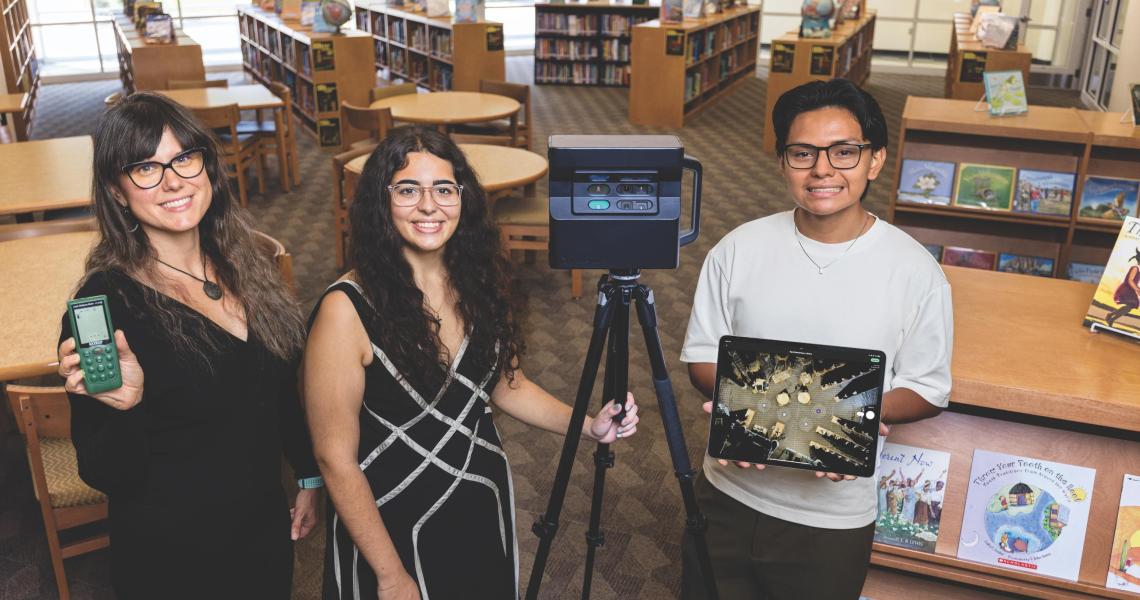
More than 40,000 students attend classes in Newark, some in schools built before 1920. Repairing and maintaining those structures are massive undertakings. A project led by NJIT’s Center for Building Knowledge to create digital twins of every building managed by the Newark Board of Education (BOE) is providing school administrators with the data needed to make more strategic decisions about the highest priority capital renovations.
Using technology employed in real estate, facilities management, and by architects and engineers, a team of 25 NJIT students spent three years creating immersive 3D models of the more than 100 buildings owned by the district. These models are enhanced with the use of Autodesk Revit, a building information modeling software, color-coded floor plans, and a database that is granular in detail; it shows not only what kind of flooring is in a room, for example, but also the condition of the floor.
Led by Terra Meierdierck, energy and education program manager at NJIT’s Center for Building Knowledge, field teams scanned each building, floor by floor and room by room — even boiler rooms, facility infrastructure and storage facilities — with 3D Matterport cameras.
“We are cataloging the condition of all of the schools; that way they have a better understanding of all of the environments that the students are learning in,” Meierdierck says.
It’s the largest such project in the state and David Mizraki, vice president of marketing & operations for Matterport, says it could be the largest in the country.
Facilities managers and architects can now sit at their desks and view an exact 3D model of any building. If, for example, they were looking at a 400,000-square-foot high school, they could see every classroom, gymnasium, cafeteria and even the details of the HVAC equipment. This supports facility managers in making decisions about which repairs to address first.
The district says about 33 schools need to be replaced, at an estimated cost of $2 billion. At the same time, Christopher Caponegro, construction management specialist for the BOE, says there has been a 30% increase in the cost of construction. “The information from this project can help us avoid having to replace some buildings.”
Meierdierck and her students used Matterport cameras to capture images of the buildings while also recording detailed building information with laser measuring tools and visually inspecting the condition of each room, including its finishes and dimensions. That information was then turned into 3D models, or digital twins, allowing users to peer into every room.
“If part of a 120,000-square-foot building needs to be repainted, I can have exact measurements before work begins — and that can translate into cost savings,” Caponegro says.
The new system also allows the school district to look at aggregated data and assess conditions across the district, not just building by building.
The project helps the district with its mandated reporting to the state on their complex needs.
“We definitely have the data set so that we can develop a plan and a strategy to serve the students and the staff of the Newark Board of Education,” Caponegro says.