Cosmetics Industry Brings Hands-On Lab Work to NJIT Students
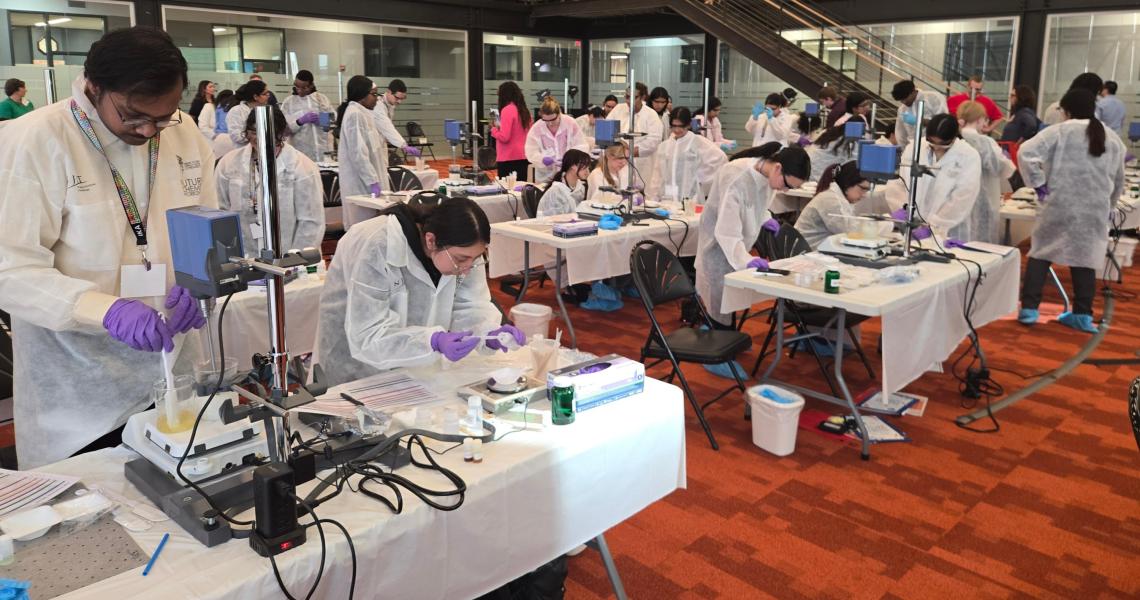
Chemistry and chemical engineering majors learn to make all kinds of compounds and solutions, but an afternoon focusing on the design and packaging of facial serum was probably a first for them.
That’s what happened on March 11 when 50 students gathered in NJIT’s Agile Strategy Lab, with the multipurpose room serving as an actual laboratory, for hands-on training in the science of cosmetics development.
The students learned about the ingredients, proportions, and calculations necessary to make a useful cream. They also learned about the engineering of how to load the product into air-tight tubes for retail sale.
The event came about when NJIT employees Tom Drwiega, associate director of health and safety, and Miosotis Hernandez, assistant director of first-year engineering programs, learned that colleges participate with industry conferences and formulation events hosted by the New York Society of Cosmetic Chemists.
"Students conducted an oil-in-water formulation using real-world cosmetic raw materials. Working in groups of three, they utilized an overhead stirrer & propeller blade provided by IKA Lab Equipment and followed a step-by-step process to prepare both the water phase and oil phase,” Drwiega explained. “Once each phase was properly developed, students incorporated the appropriate emulsifier to combine the two phases into a stable, uniform mixture. After achieving the final formulation, they used plastic syringes to transfer the serum into airless lotion pump bottles."
Each bottle was finished with custom branding that included the serum name and the NJIT logo. NJIT also sent out a digital badge for all of the students to showcase on LinkedIn and their resumes.
“The goal of the workshop was to bridge academic knowledge with real-world applications by enabling students to interact with industry professionals, learn about career pathways in formulation science and gain insight into the interdisciplinary role that engineers played in the development of cosmetic products,” Hernandez added.
Engineers may not think about cosmetics, but it’s serious business, said Moshe Kam, dean of NJIT’s Newark College of Engineering. He spoke of how perfumes began in ancient times, recorded in writing on cuneiform tablets and passed into modern history — “A fascinating topic involving science, engineering, fashion and culture,” along with the environment and healthcare. (A recent alumna, Sriya Chinthalapudi, is working in the high-tech side of the perfume field.)
Panelists and mentors included Christian Merhovsky, an R&D chemist from Studio Green; Laszlo Moharita '01, vice president of global brand package development at Estée Lauder; Gary Morris, senior package development engineer, L’Oréal; Günel Nabiyeva, an NJIT doctoral student in chemical engineering who recently published novel research on sunscreen; and Mara Webb '10, technical sales, DSM-Firmenich.
Barbara Gochis Vera, a sophomore chemical engineering major, said she’s always enjoyed chemistry and understanding how things work. While making what's called CM-25 Radiance Serum, “I learned that there are a lot of components in daily things that you use, and that the tiniest thing can make it change. The tiniest amount of any ingredient that you use can make the slightest difference in the conversation,” she said. “I buy makeup a lot and I’m open to working in the cosmetics field.”
Gochis Vera also observed that even if she interns or works in a different field, including in her passion for baking, the skills that she’s learned in classrooms and from the cosmetics event are transferrable.
Moharita, an NJIT alumnus who received a B.S. in industrial engineering at NJIT, said he interned at a fragrance manufacturing plant. His father worked in packaging, so Moharita was drawn to that side of the process — when other children attended summer camp, he was touring factories.
Now, “I get to get close to how molds that make bottles and packaging get designed and fabricated. So you get to deal with a lot of people that design metal molds and raw metal molds. You get to see it from the very beginning … It involves mechanical engineering, it involves material science, how materials interact with one another, how materials interact with formulas,” Moharita said.
Due to the event’s success, Newark College of Engineering may look to host the workshop annually. They’re also considering ideas for new courses in cosmetic chemistry and industrial packaging.