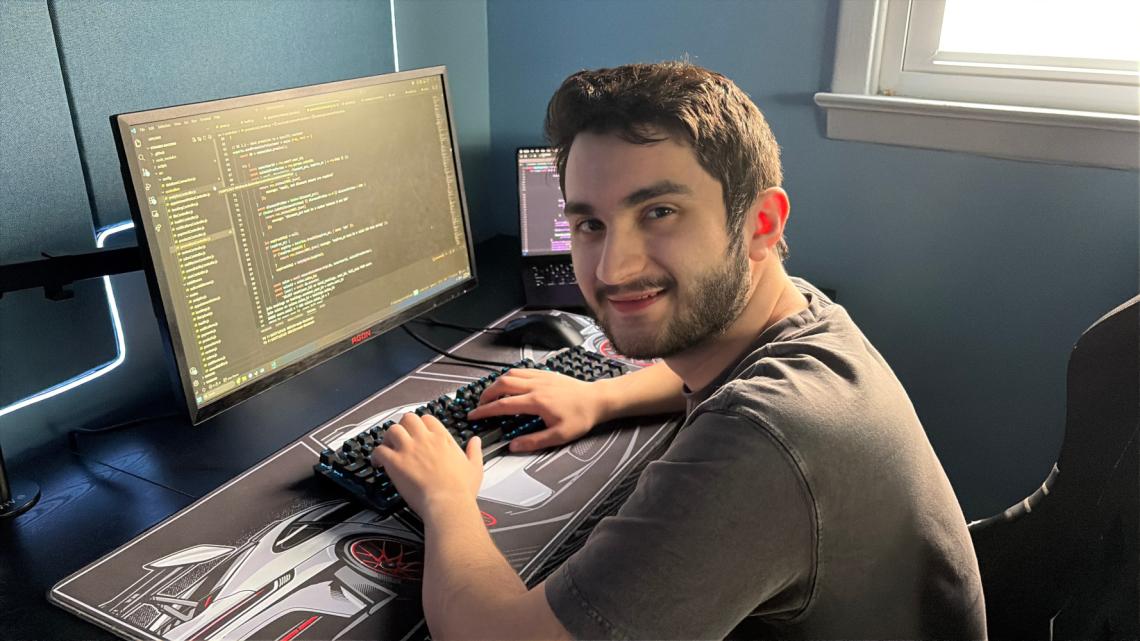
Like many computer science majors in the NJIT class of ‘26, Jonathan Malave hoped he might land a job at a name-brand software company such as Facebook, Amazon, Apple or Google.
But when an opportunity appeared on LinkedIn to work for WMG Inc., which makes software for the nuclear waste industry, Malave decided to apply. “I came across this out of nowhere, just applying for some jobs and trying to make anything stick. And then I saw that it was nuclear waste. That’s really cool! I didn't think anything was going to come of it.”
Malave applied anyway and the results were excellent.
WMG’s main product is called Radman. Organizations that work with radioactivity use the software to help them classify, transport and store dangerous materials in a safe manner, Malave explained. The company, in Peekskill, N.Y., got started in 1979 by handling nuclear material after the infamous Three Mile Island nuclear plant meltdown earlier that year, according to their website.
“It was actually the first technical interview I had. It wasn't just the typical Leet code problem or solving a fictional problem. It was actually questions that my interviewer had to solve while he was on the job,” he noted.
In one question, he was given a number line and had to determine where a particle passing through lead starts and stops. In another, he was asked to plot 3-D space points and convert Curies to volume.
The questions required Malave to quickly think back to his physics courses and look up some formulas. “I wasn't expecting to do all that in an interview, but you know, as we went through it, the questions were really interesting. It wasn’t just fixing this API … it has a real impact and makes you think, instead of just busy work that a new graduate might do.”
He’ll work in an office full of software engineers — it won’t be field work with cooling towers, glowing rods or three-eyed fish nearby. “I’m not going to be exposed … That would be cool, but no. It’s an old bank, which is kind of creepy,” he joked. “My dad was probably more excited than I was.”
“If anything the science kind drew me to it because I knew I'm doing legitimate, good, impactful work. It sounds cool as a non-science person. I'm willing to jump in and learn all these new things just excel at my job here.”
“They said they would get me up to speed on what nuclear regulations I need to know. In the interview, they gave me the actual legal documentation of what classifications nuclear waste has, like Class A, Class B, Class C. They'll get me trained up and they'll give me the knowledge I need to know” to work on their code in Microsoft’s C# and .Net languages, Malave said.
Malave is from Springfield, in Union County, and attended Oratory Prep high school in Summit. He chose NJIT over other local options after visiting the campus and meeting faculty. He cited University Lecturer Dale Mohit’s edition of CS-288, Intensive Programming in Linux, as his most influential course.
Outside of computer science, Malave is interested in video game development. He took a game development minor here at NJIT and participated in several hackathons. He’s also a car enthusiast — right now he has an ordinary Honda, but his dream is a Porsche 911 GT3 RS — yet he’s equally interested in working on autonomous cars someday.
Malave’s parting advice to new students is to apply their knowledge. He said he learned more than expected from an unglamorous internship at a company that makes real estate software.
“I've seen a lot of students just do the courses and then do nothing. But in today's market, and computer science in general, you need to apply it with your projects, internships, and that’s really what’s going to get you that job,” he said. “Having no projects and no internship experience is going to make it ten times harder to find a job.”
